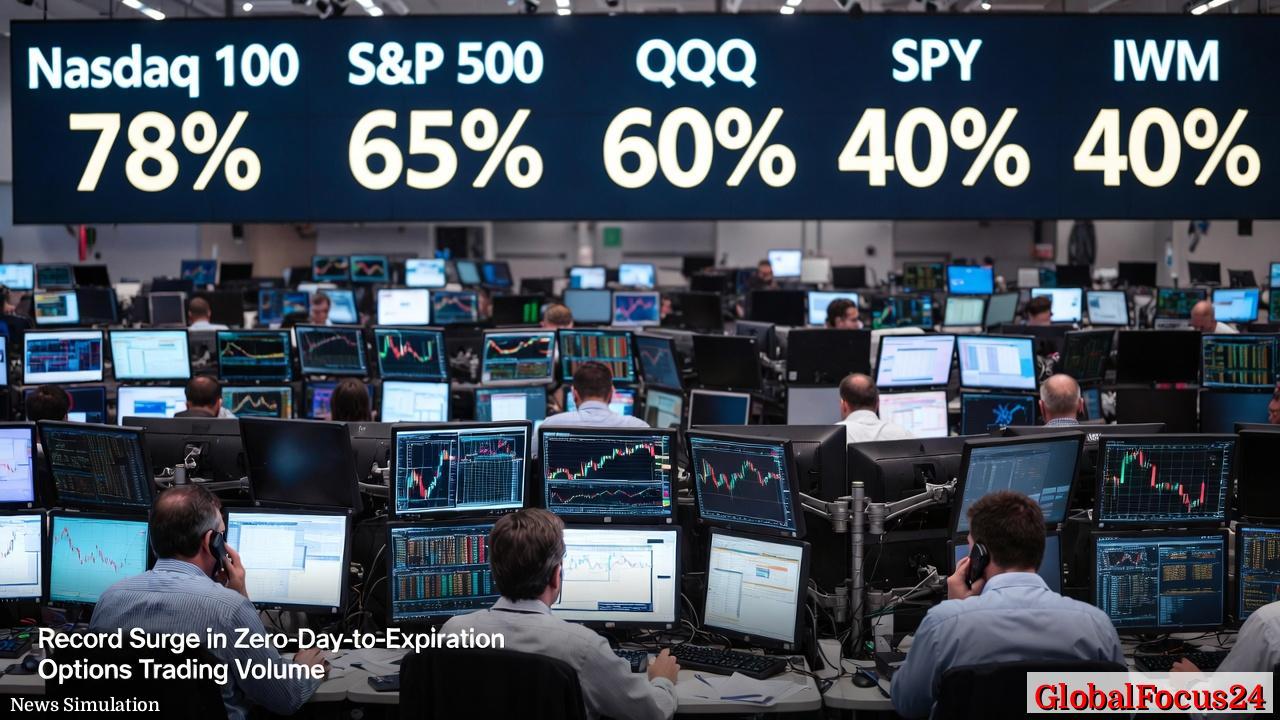
Record Surge in 0DTE Options Trading Across Major Indices and ETFs
A rapid shift in the options market has pushed zero-day-to-expiration (0DTE) trading to new records, reshaping how traders approach risk, liquidity, and hedging. Data indicate that 0DTE options now comprise a dominant share of daily volume across the Nasdaq 100, the S&P 500, and their flagship ETFs, with implications for market dynamics, volatility, and retail participation. The broader picture points to a transformative trend in how investors navigate short-term events, earnings windows, and macros.
Historical context: from novelty to near-ubiquity 0DTE options are contracts that expire on the same trading day they are bought or sold. The concept emerged from traders seeking ultra-short exposure to intraday moves, event-driven speculation, or precise hedging with a rapid feedback loop. In the early 2020s, 0DTE volume existed mainly among a small cadre of high-frequency traders and risk-tolerant retail participants. Over time, platforms expanded access, liquidity deepened, and risk controls evolved, enabling a broader cohort of market participants to engage in 0DTE strategies. The latest data reflect a broad-based adoption that has moved beyond a niche activity to a daily staple in many asset classes.
Key findings across major assets
- Nasdaq 100 options: 0DTE now accounts for roughly 78% of daily volume, up about 23 percentage points since 2024. This concentration indicates a robust appetite for near-term hedging and directional bets tied to the tech-heavy index, where earnings cycles and large-cap stock movements can produce pronounced intraday swings.
- S&P 500 options: 0DTE volume has risen to about 65% of daily options activity, climbing from around 50% in early 2024. The S&P 500’s diverse mix of sectors means that traders often deploy 0DTE strategies to capitalize on macro news or earnings-driven volatility while maintaining tight risk controls.
- Nasdaq 100 ETF (QQQ) and S&P 500 ETF (SPY): Together, 0DTE contracts account for nearly 60% of options trading volume in these two liquid ETFs. This highlights how index proxies breed heightened activity when traders seek quick exposure to broad market moves or hedging opportunities for large stock baskets.
- Russell 2000 ETF (IWM): 0DTE options represent about 40% of options activity, reflecting a different liquidity profile and participant base in the small-cap domain, where volatility can be more pronounced and liquidity more directional.
- Combined footprint: Across these assets, 0DTE options now constitute a record 55% of total options volume, up from 38% in 2024. The shift suggests a systemic change in short-term risk management and speculative behavior across U.S. equity markets.
Drivers of the 0DTE surge
- Accessibility and technology: Advances in trading platforms and execution speed have lowered barriers to entry for 0DTE strategies. Real-time data, rapid order routing, and efficient risk controls empower a wider audience to participate.
- Liquidity and tight spreads: As participation grows, market makers and liquidity providers have expanded their capacity to handle near-term contracts, yielding tighter bid-ask spreads that reduce implicit transaction costs for 0DTE trades.
- Event-driven hedging: Earnings announcements, economic data releases, and geopolitical developments create predictable windows of heightened volatility. Traders increasingly use 0DTE instruments to hedge exposure or to pursue short-lived directional bets aligned with anticipated moves.
- Yield and capital efficiency: Some participants view 0DTE as a way to express views with limited capital at risk relative to longer-dated options, thanks to the rapid decay profile and the ability to scale exposure quickly.
- Retail participation: The rise of commission-free trading and educational resources has democratized access to sophisticated strategies, expanding the pool of retail traders who can execute 0DTE plays.
Economic implications and risk considerations
- Market liquidity and price discovery: A larger share of 0DTE activity can amplify intraday liquidity, particularly around key events. While this can improve price discovery for near-term information, it can also magnify short-term volatility and skew intraday price dynamics.
- Volatility regimes: Concentrated 0DTE trading can contribute to sudden bursts of realized volatility around news releases or policy announcements. Market participants should be mindful of potential feedback loops where hedging activity itself influences price movements.
- Risk management challenges: The ultra-short horizon of 0DTE means that participants must manage time decay, gamma risk, and liquidity constraints in a compressed timeframe. Firms and individual traders alike should ensure robust risk controls, position limits, and stress-testing practices.
- Regulatory and systemic considerations: As 0DTE activity grows, market observers watch for evolving dynamics in liquidity provision, cross-asset correlations, and the potential for rapid liquidity withdrawal during stressed conditions. Clear risk disclosures and prudent capital planning remain important.
Regional comparisons and cross-asset perspectives
- U.S. equities dominate 0DTE activity, reflecting the depth and breadth of liquidity in the Nasdaq 100, S&P 500, and their flagship ETFs. The concentration in these instruments suggests a regional market structure where near-term bets are efficiently priced and readily tradable.
- Comparisons to international markets show emerging trends in 0DTE-like products and daily expiring options, though liquidity and market depth may vary across exchanges and regulatory environments. Investors considering cross-border hedging should assess differences in contract specifications, settlement processes, and risk disclosures.
- Sector-specific considerations: The tech-heavy Nasdaq 100 exhibits particularly high 0DTE activity, aligning with rapid and often news-driven movements in large-cap technology stocks. Broad-market indices like the S&P 500 reflect a mix of sector dynamics but still see strong 0DTE engagement around macro catalysts.
What this means for traders and investors
- Strategic shifts: Market participants increasingly integrate 0DTE into hedging and tactical strategies. Traders may use 0DTE positions to guard against immediate risk from earnings, guidance changes, or macro data surprises, while speculators might chase short-term directional bets with disciplined risk management.
- Portfolio implications: For long-term investors, 0DTE activity can influence implied volatilities and option pricing. Awareness of elevated near-term option demand can inform decisions about hedging costs and risk tolerance, even for patient, longer-horizon strategies.
- Operational readiness: Brokers, custodians, and risk managers should ensure systems are capable of handling peak 0DTE flows. Accurate risk reporting, real-time monitoring, and contingency planning become essential as activity patterns intensify during high-volatility windows.
Public reaction and market sentiment Public dialogue around 0DTE has grown as daily participants observe the rapid turnover in near-term contracts. Some market participants view the trend as a sign of healthy liquidity and democratized access to sophisticated instruments. Others express concern about potential overreliance on ultra-short-term bets and the possibility of abrupt, event-driven losses. Analysts emphasize the importance of education on risk exposure and the need for responsible trading practices, particularly for younger or less experienced market participants.
Future trajectory and considerations for policymakers
- Expected persistence: If current conditions persist, 0DTE activity could remain a defining feature of short-term trading. Traders and institutions may continue refining risk controls and expanding educational resources to address the complexity of these contracts.
- Potential regulation: Regulators may monitor for systemic risk indicators associated with near-term option markets, including liquidity stress tests, disclosure of risk factors, and clarity around best execution during high-velocity trading periods.
- Innovation and market structure: Ongoing product development, such as additional expiration calendars or index-based strategies, could provide new avenues for hedging and speculation while maintaining market integrity.
In conclusion, the record surge in 0DTE options activity across the Nasdaq 100, S&P 500, and their flagship ETFs marks a pivotal moment in how market participants approach short-term risk and opportunity. The convergence of deep liquidity, accessible technology, and a broadening base of participants has produced a landscape where near-term forecasting and rapid hedging are increasingly central to trading behavior. As markets adapt to this pace, investors and institutions alike will need to balance the benefits of immediacy with the discipline required to manage risk in a fast-moving, highly connected financial system.