Peter Magyar Secures Sweeping Victory, Ending Viktor Orban’s 16-Year Rule in Hungary
A Political Earthquake in Budapest
Hungary awoke on April 13 to a stunning political shift. Peter Magyar, leader of the Tisza party, scored a decisive victory in the parliamentary elections held on April 12, capturing 54 percent of the vote and 138 seats in the National Assembly. The result marks the end of Viktor Orban’s sixteen-year tenure as prime minister — one of the longest in European politics — and ushers in a new era for the Central European nation. Orban’s Fidesz party, once the dominant force in Hungarian politics, was reduced to 38 percent of the vote and 55 seats, leaving observers around the world to ponder the scale and implications of the reversal.
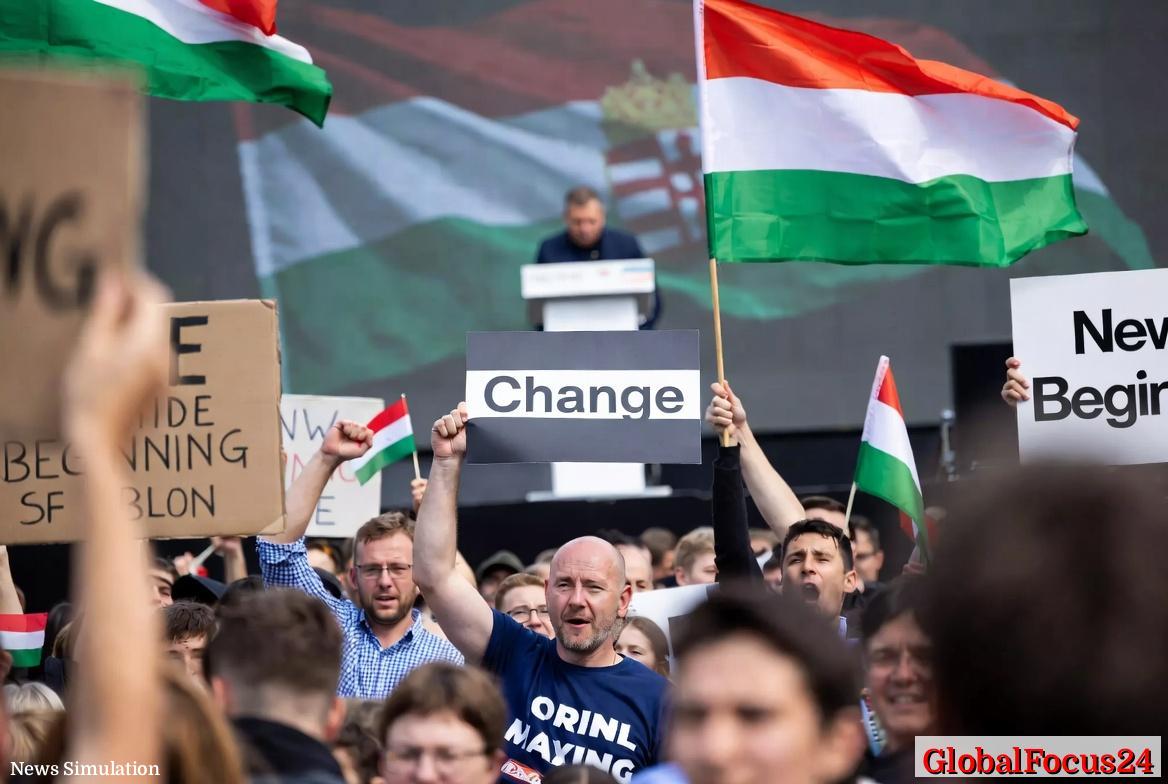
Orban conceded defeat on election night, thanking supporters and promising a smooth transition of power. Magyar, addressing tens of thousands gathered in Budapest’s Kossuth Square, called the win “a mandate for change” and vowed to pursue “a transparent, modern, and fair Hungary.” His remarks struck a note of humility and determination, signaling both the end of an era and the possibility of renewal.
The Rise of Peter Magyar and the Tisza Movement
Peter Magyar’s ascent has been meteoric. A relatively new face in Hungarian politics, he emerged as a reform-minded challenger focused on combating entrenched corruption and revitalizing the economy. His party, Tisza — named for one of Hungary’s great rivers — was founded less than three years ago and rapidly gained momentum by tapping into public frustration with the country’s political stagnation.
Magyar’s campaign gained traction through a strategy of extensive grassroots engagement. Over the past year, he traveled to nearly every major town and county, holding open rallies and town hall meetings. His message resonated especially among younger voters and urban professionals, who complained of rising living costs, limited job opportunities, and declining trust in government institutions. Unlike previous opposition leaders who struggled to unite fragmented factions, Magyar positioned himself outside traditional party structures, portraying Tisza as a “clean slate” alternative with pragmatic goals rather than ideological dogma.
Observers credit his success to a disciplined campaign emphasizing anti-corruption reforms, transparency in public spending, and the modernization of education and healthcare. His use of social media also proved pivotal — broadcasting live discussions and citizen debates that mobilized large segments of previously apathetic voters.
The End of the Orban Era
Viktor Orban’s departure marks a watershed moment not only for Hungary but also for Central Europe. Since returning to power in 2010, Orban oversaw sweeping constitutional changes, centralized authority, and positioned Hungary as a unique model of “illiberal democracy” within the European Union. His government maintained economic stability but was often criticized by Western leaders and NGOs for its handling of media freedoms, judicial independence, and civil rights.
Under Orban, Hungary pursued closer ties with China and Russia while maintaining a cautiously transactional relationship with Brussels. His political machine — built on a vast network of loyal regional officials and government-linked business interests — appeared invincible for over a decade. Yet, rising inflation, slow wage growth, and scandals involving public contracts eroded public confidence. By early 2026, polls suggested a plurality of Hungarians desired “a new direction,” foreshadowing the turbulence that culminated in Magyar’s historic win.
Orban’s departure also represents a generational transition. At 63, he leaves office having shaped nearly every institution in modern Hungary. His party, Fidesz, now faces intense scrutiny as analysts debate whether it can survive in its current form or must reinvent itself in opposition.
Economic Challenges Await the New Government
Key economic indicators reveal the scale of challenges awaiting Magyar’s administration. Hungary’s GDP growth slowed to 2.1 percent in 2025, down from 5 percent in the post-pandemic rebound. Inflation persisted above 8 percent through much of the year, squeezing household budgets and raising questions about fiscal management. Energy costs — compounded by regional instability and supply chain shifts — have disproportionately affected lower-income families, fueling discontent in rural areas.
Magyar’s economic platform centers on restoring investor confidence, tightening anti-corruption measures, and reconnecting Hungary’s industries with European supply chains. His team has pledged to review public contracts signed under previous administrations and restructure funding priorities toward innovation, agriculture, and renewable energy. Economists consider these goals ambitious but achievable if paired with institutional reforms and improved transparency.
A senior analyst at a Budapest-based think tank emphasized that “foreign investors have long viewed Hungary as politically risky despite strong fundamentals.” Magyar’s victory, the analyst noted, “may rekindle interest in Hungarian manufacturing and technology sectors if reforms are carried out credibly.”
Regional Implications and European Perspectives
Hungary’s political transformation resonates across Central and Eastern Europe, where long-serving populist leaders have faced increasing public fatigue. Comparisons are inevitable with shifts in neighboring Slovakia and Poland, both of which underwent leadership changes after years of governance marked by nationalist policies and confrontations with the European Union.
European officials responded cautiously but positively. The European Commission welcomed Magyar’s victory as “a democratic choice expressing the will of the Hungarian people,” and reiterated its intention to collaborate on common priorities such as trade competitiveness, climate policy, and rule-of-law mechanisms. Diplomats see the transition as a potential opening for Hungary to resolve longstanding disputes over suspended EU funding linked to governance concerns.
In regional capitals, reactions were mixed. Prague and Vienna congratulated Magyar and expressed optimism for renewed cooperation within the Visegrád Group. Warsaw, still navigating its own political realignment, urged continued partnership on energy security and border management. Meanwhile, Moscow’s foreign ministry issued a brief statement “noting the election results” and expressing “hope for continuity in bilateral relations.”
Historical Context: Hungary’s Shifting Political Landscape
Hungary’s democratic transition following the end of communist rule in 1989 ushered in decades of political experimentation. The country alternated between liberal, socialist, and conservative governments, each grappling with post-Soviet economic transformation and integration with Western institutions. Hungary joined NATO in 1999 and the European Union in 2004, steps widely seen as benchmarks of stability and progress.
Orban’s long rule, beginning with his return in 2010, was a reversal of earlier liberal trends. His consolidation of power drew comparisons to Hungary’s pre-WWII traditions of central authority, though blended with modern populist rhetoric. Magyar’s victory thus marks the second major political realignment since the early 2000s — a symbolic return to pluralism and a test of whether Hungary’s democracy can regenerate itself organically.
Veterans of Hungary’s 1990s reform movement describe the current moment as “a restoration of voices,” recalling the early optimism that followed the fall of communism. “People are rediscovering what political participation means,” said one former legislator, “and that’s significance beyond one election.”
Public Reaction and National Mood
Across Hungary, the mood is both jubilant and reflective. In Budapest’s city squares, spontaneous celebrations erupted as results were announced, with crowds waving Hungarian flags and chanting the name “Magyar.” Smaller gatherings in towns such as Debrecen, Győr, and Szeged mirrored similar scenes, although many residents expressed cautious optimism rather than exuberance. After years of deep political polarization, the call for unity has become a defining theme of the transition.
Local businesses have already begun speculating about the direction of fiscal policy. Several entrepreneurs interviewed in the days following the election said they hoped for a lighter regulatory touch and faster approval processes for infrastructure projects. Others urged patience, noting that “even with a landslide, rebuilding credibility takes time.” The shared sentiment is a recognition that the country stands at a crossroads, balancing public expectation with administrative reality.
The Road Ahead for Magyar
With a commanding majority in parliament, Magyar faces unique opportunities but also high expectations. Forming his cabinet is expected to be his first major test, as appointments will signal whether he intends to maintain continuity in certain institutions or pursue a complete overhaul. Analysts forecast that his early months in office will focus on anti-corruption legislation, realignment of Hungary’s EU relations, and revisions to education funding.
International observers have already extended invitations for dialogue. The upcoming June European Council summit will serve as Magyar’s debut on the continental stage, where he is anticipated to outline his government’s approach to fiscal discipline and democratic accountability. Domestically, reforms in electoral law, media regulation, and judicial independence are expected to dominate parliamentary debate throughout the year.
Magyar’s leadership style — collaborative, data-driven, and notably less combative — may contrast sharply with Orban’s command-oriented governance. Yet, the durability of his coalition and his ability to maintain unity among reformist factions will determine whether his victory translates into long-term transformation or only temporary upheaval.
A New Chapter for Hungary and Europe
Peter Magyar’s landslide victory signifies more than a change of government: it represents a generational and institutional shift in Hungary’s political landscape. His promise to restore integrity, transparency, and civic trust has struck a powerful chord across the nation and within the broader European community. For a country that has spent much of the past decade navigating tension between sovereignty and integration, the coming years may redefine Hungary’s place both at home and abroad.
As dawn broke over Budapest the morning after the elections, the air carried both excitement and uncertainty. Above the Parliament building by the Danube, the Hungarian tricolor fluttered against clear skies — a symbol of continuity, resilience, and hope for renewal. Peter Magyar’s challenge now is to transform this moment of triumph into sustainable governance, ensuring that the chapter opened in April 2026 leads not just to change, but to enduring progress.