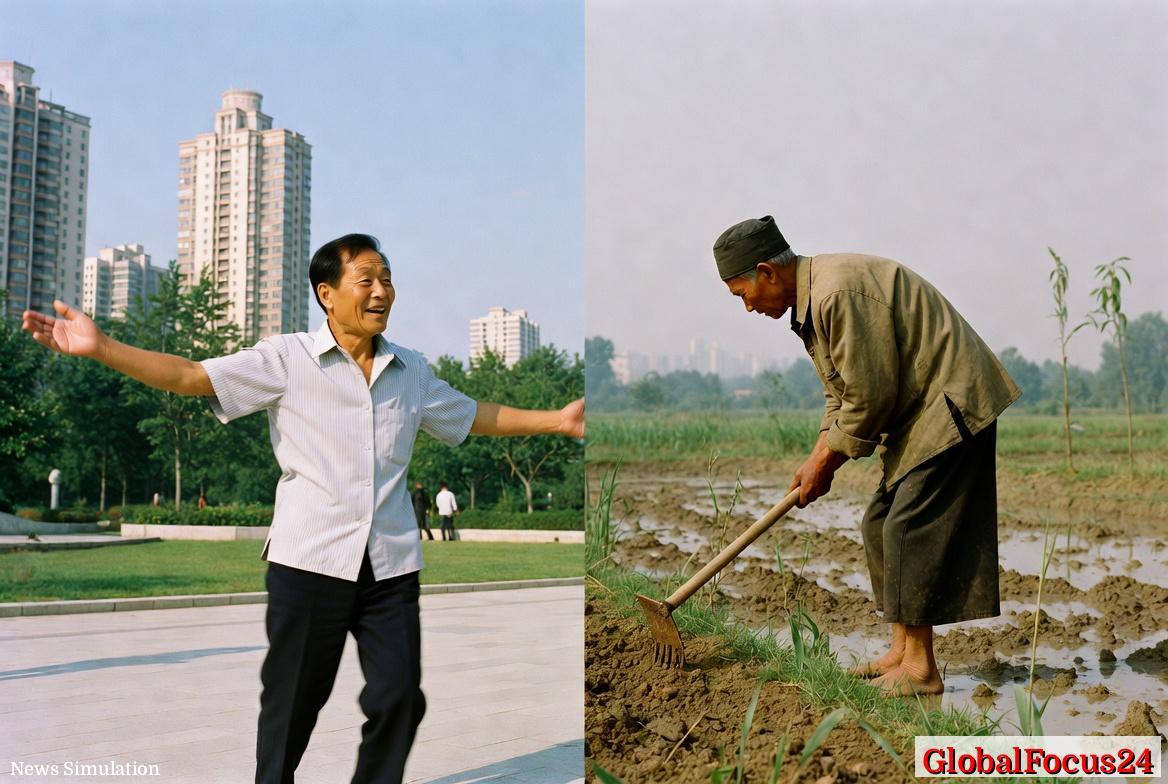
China’s Widening Pension Divide: Aging Farmers Labor While City Retirees Dance
Across China’s vast landscape, a quiet but profound divide defines the twilight years of its elderly citizens. In bustling urban centers, retirees fill parks each morning with music and movement, dancing in synchronized routines that have become as much a symbol of leisure as of national vitality. Yet far from these city rhythms, in the rural heartlands, another generation of seniors rises before dawn — not for recreation, but for labor. They till the soil, mend fences, and tend livestock well into their seventies, driven not by choice but necessity. The root of this divide lies in China’s unequal pension system, a gap that continues to grow even as the nation modernizes.
Historical Roots of the Pension Gap
China’s pension inequality traces back to the country’s economic transformation born from the reforms of the late 1970s and early 1980s. Urban workers employed in state-owned enterprises gained access to structured retirement benefits, social insurance, and state pensions. The system was designed to provide lifelong stability after decades of service. Rural residents, however, were classified differently — considered part of the agricultural workforce rather than formal employees. As a result, for decades they were excluded from the social security schemes available in cities.
In 1999, Beijing introduced the rural pension pilot program in select regions, marking a significant milestone. Yet progress was slow and fragmented. Even after nationwide expansion in 2009, contributions remained minimal, resulting in low disbursements. Many older rural citizens receive monthly payments equivalent to a handful of U.S. dollars, insufficient to cover basic living costs. By comparison, urban retirees often enjoy pensions that can support comfortable lifestyles, including travel, social clubs, and healthcare costs.
This imbalance reflects historical policy decisions that prioritized urban industrial labor over agricultural work. Rural populations were seen as self-sufficient, expected to rely on family structures and land productivity. However, as demographics shifted and younger generations migrated to cities, rural support networks weakened. What was once sustained by tight-knit communities has evolved into a system increasingly defined by economic disparity.
The Economic Reality in Rural China
Today, about eighty percent of able-bodied rural residents between the ages of sixty and eighty remain active in the workforce. The majority work as farmers, subsisting on small plots of land or occasional labor opportunities. With limited pension coverage and rising living costs, continuing to work is not an option — it is a survival strategy.
For many, agricultural work brings diminishing returns. Climate changes, higher fertilizer prices, and shrinking arable land have reduced income reliability. Older farmers face physical exhaustion and health risks, yet lack financial alternatives. Healthcare access in rural regions also remains limited, meaning even small savings are often swallowed by medical bills. This dynamic creates a cyclical burden: elderly residents work longer to pay for healthcare, and poor health forces them to spend more, leaving them trapped in economic insecurity.
Meanwhile, in cities such as Beijing, Shanghai, and Guangzhou, retirement has taken on a very different meaning. Urban pensioners, benefiting from decades of industrial or bureaucratic employment, earn steady monthly stipends. Many use their time to travel domestically, enroll in exercise programs, or join community art groups. The contrast is stark — a reflection not just of wealth disparity but of systemic imbalance in how China defines social security.
Urban Leisure and Rural Labor: Daily Life in Contrast
In urban parks across China, “dama” — groups of elderly women known for their coordinated public dances — have become a cultural phenomenon. Their routines combine exercise, socialization, and celebration of community life. Elderly participants describe these gatherings as sources of joy and identity, allowing them to embrace retirement as an active chapter rather than an end of productivity.
In rural provinces like Henan, Anhui, and Sichuan, mornings unfold differently. Elderly farmers often walk several kilometers to their fields, clutching simple tools passed down for generations. Even in winter months, the sight of silver-haired workers tending crops is common. Many live in multi-generational households, supporting grandchildren whose parents work in cities. Family remittances offer some relief, but with urban living costs rising, younger generations seldom send enough to offset pension shortfalls.
This dichotomy reveals more than income inequality—it underscores social fragmentation shaped by decades of uneven reform. For the rural elderly, retirement is still an unattainable concept. For urban retirees, it is an opportunity for self-fulfillment.
Regional Comparisons and Policy Attempts
The gap between rural and urban pensions varies widely by region. In coastal provinces such as Jiangsu and Zhejiang, accelerated economic development has led local governments to supplement pension funds, narrowing the divide slightly. Rural residents in these areas might earn modest stipends closer to urban levels. Conversely, in inland regions, where economic growth has lagged, rural pensions remain drastically lower.
National policy efforts have sought to improve equity. The 2014 merger of urban and rural pension programs aimed to create a unified system under the umbrella of the basic pension scheme. However, implementation depends heavily on local fiscal capacity. Wealthier municipalities can contribute significantly more per capita, creating regional inconsistencies that mirror broader patterns of uneven development.
China’s Ministry of Human Resources and Social Security continues to announce incremental adjustments, focusing on recalibrating contribution ratios and improving coverage for migrant workers. Yet experts argue that demographic pressures — with the nation’s elderly expected to exceed 400 million by 2035 — could strain resources and make comprehensive balance difficult. Without substantial reform, rural seniors may continue bearing the financial burden of aging in labor rather than leisure.
Economic Impact and National Implications
The pension divide reaches far beyond individual welfare. Economically, it influences rural productivity, consumption patterns, and internal migration. When elderly farmers remain tied to fields, fewer opportunities emerge for agricultural modernization. Younger rural laborers, seeing limited prospects, move to urban centers, deepening the demographic hollowing of villages.
Aging rural communities also dampen local economic circulation. Without disposable income, older residents spend less on commodities, home improvements, or healthcare services, constraining regional growth. In contrast, urban retirees, with stable pensions, contribute actively to service economies — supporting tourism, recreation, and cultural industries. This reliance on pension-enabled consumption has become a quiet but powerful driver of China’s urban economy.
The imbalance also affects national cohesion. Pension inequality reinforces perceptions of a two-tier society, straining the vision of “common prosperity” encouraged by government policy. If not addressed, economists warn, such disparities may deepen rural poverty and inhibit the broader transition to a consumption-driven economy.
Human Stories Behind the Numbers
Behind statistics and reports lie millions of human stories. In the outskirts of Chongqing, 72-year-old Liu Zhimin spends his mornings harvesting leafy greens while his wife sells them at a nearby market. Together they earn about 1,000 yuan a month — insufficient for medical expenses or leisure. Liu’s pension payments total less than 100 yuan per month, barely enough for basic groceries. Yet he smiles describing how work “keeps him alive.” His situation is typical of many in China’s countryside, where self-reliance remains both honor and hardship.
In comparison, 68-year-old Zhang Li, a retired accountant in Shanghai, meets her friends every morning to dance in her neighborhood park. Twice a year, she takes group trips across China — experiences sustained entirely by her state pension. Zhang recognizes her privilege but believes the gap between her life and that of rural elders reflects “different eras colliding.” Her words capture a generational divide shaped by uneven development — a reminder that prosperity in one region may still coexist with endurance in another.
The Road Ahead
China faces a crucial turning point in defining dignity for its aging population. The country’s economic might now enables reforms that were once financially unfeasible. Expanding pension coverage, improving redistribution between urban and rural funds, and incentivizing younger citizens to contribute consistently are among the measures experts propose. Equally important is ensuring that those approaching retirement can rely on stable healthcare systems and affordable living conditions, regardless of residence.
Such transformation requires not only financial commitment but administrative innovation. Integrating digital tracking for contributions, ensuring portability across provinces, and aligning rural payments with cost-of-living indexes could vastly reduce inequality. Ultimately, China’s challenge lies in bridging not just the income gap but the experiential divide — allowing elderly citizens everywhere to age with dignity and comfort.
In the meantime, as music echoes through city parks and the hum of farm tools continues in distant villages, China’s aging population stands at the center of its next social test. The difference between leisure and labor in later life captures more than individual circumstance — it reflects the continuing evolution of a nation determined to balance prosperity with fairness.