Young Biologist Turns Online Backlash Into Global Spotlight on Evolutionary Science
A Celebration That Sparked a Storm
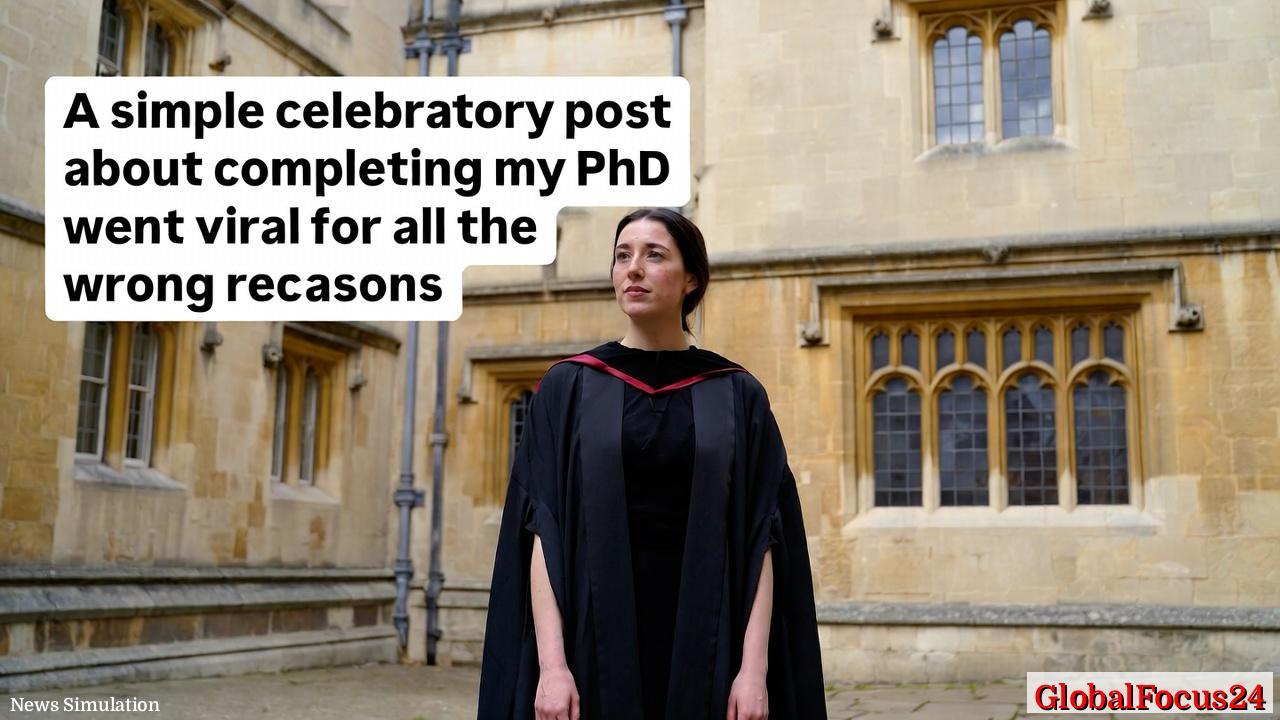
When Juliet Turner, a 27-year-old evolutionary biologist, completed her PhD at the University of Oxford, she decided to share a simple moment of pride. Standing before the honey-gold limestone walls of New College, she posed in her flowing academic gown, captioning the photo, “You can call me Doctor 😎.” The post, shared to celebrate nearly four years of research into insect cooperation and division of labour, was intended to mark the end of a long academic journey.
Within hours, the image went viral. What had been a private gesture of accomplishment turned into a public spectacle that exposed the darker currents of online discourse about women in academia. The post drew millions of views, alongside waves of misogynistic commentary that questioned her intelligence, criticized her appearance, and speculated about her fertility.
Comments ranged from condescending “advice” that she should focus on having children to blatant dismissals of her professional achievement. Some remarks compared her doctoral work to an “evolutionary dead end,” suggesting she was defying nature by pursuing scholarship over family life. Others went further, making cruel jokes about her supposed loneliness — even mocking her decision to include her cat in the acknowledgments section of her thesis.
Yet Turner’s response was not retreat or silence. Instead, she transformed what could have been a demoralizing experience into an opportunity to highlight how women scientists face hostility in public spaces — and to redirect attention toward the very subject of her research: cooperation and evolution.
From Target to Teacher
Rather than delete the post, Turner re-engaged with her audience. She reposted screenshots of the insults alongside her own sharply written commentary, alternating between humor and scientific insight. Her tone remained composed yet cutting, framing the incident not as a personal attack but as a case study in social behavior — exactly the kind she has studied for years.
By treating the comments as examples of maladaptive human cooperation — tribal responses that reject what appears different — Turner turned her critics into a kind of data set. “If ants behaved this way,” she joked in one post, “their colonies would collapse.”
Her measured yet witty counters resonated widely. Supporters praised her for challenging gender stereotypes in academia and using visibility for constructive impact. Within days, Turner’s following ballooned, and so did public interest in her research on insect societies. She began sharing key findings from her thesis, including data showing that larger ant colonies evolve more complex and specialized worker castes. Those caste distinctions, she explained, provide a model for understanding how individual cells in early life forms began specializing — a process that eventually gave rise to multicellular life.
Evolutionary Science Meets Public Discourse
Turner’s research sits within a broader field known as social evolution — the study of how cooperation, altruism, and division of labour arise in nature. Her doctoral work built on decades of research dating back to the 1960s, when scientists like W.D. Hamilton and E.O. Wilson proposed that altruistic behavior could evolve through genetic ties within social groups.
By modeling ant colonies and mapping their evolutionary pathways, Turner helped refine modern understanding of how cooperation scales with population size. Her findings, published in recent peer-reviewed journals in 2024 and 2026, indicate that when colonies surpass a certain size, specialization becomes not only possible but advantageous. Workers differentiate into distinct roles — foraging, caring for larvae, defending the nest — mirroring the way cells in complex organisms evolved unique functions.
That connection between insect behavior and the evolution of multicellularity carries profound implications. It bridges the gap between behavioral ecology and evolutionary developmental biology, offering a view of life’s unfolding not as a random progression but as an emergent property of cooperation itself.
As Turner often explains in interviews, “Division of labour is one of nature’s great success stories. Where cooperation thrives, complexity follows.”
Historical and Social Context
The spectacle surrounding Turner’s viral post sits within a long history of women in science facing skepticism or derision for their visibility. Victorian naturalists like Mary Anning and biologists such as Rosalind Franklin often saw their discoveries dismissed or downplayed. In the 21st century, despite growing awareness of gender bias, women in fields from astrophysics to computer science continue to encounter online harassment that questions their competence on the basis of gender rather than merit.
Turner’s case echoes earlier patterns but unfolds in the age of social media, where amplification happens at lightning speed. A single image shared to celebrate success can ricochet through millions of screens, becoming detached from its original context. What was once the quiet pride of an academic milestone turned into a public referendum on how society perceives ambitious professional women.
For evolutionary biologists, there is an irony in the intensity of the reaction: the same species whose cooperative behavior enabled civilization now weaponizes social networks to punish those who step outside expected roles. Turner’s engagement with her critics lightly underscored that contradiction, using science itself to illuminate it.
The Broader Economic and Institutional Impact
Turner’s sudden fame also drew notice within the academic and nonprofit science community, including the Game & Wildlife Conservation Trust in Fordingbridge, where she now continues her research. The trust, known for combining ecological study with public outreach, quickly recognized how her newfound visibility could invigorate interest in biodiversity and social evolution research.
More broadly, her experience spotlighted how public engagement with science — often an institutional priority but difficult to achieve — can emerge unexpectedly from personal stories. Universities across the UK and Europe have since begun discussing ways to better support early-career researchers, particularly women, in managing online visibility and harassment.
Economically, such viral attention carries tangible effects. Increased public interest can translate into higher readership for scientific publications, greater philanthropic donations, and new collaborations across borders. Researchers in related fields have noted upticks in outreach inquiries following Turner’s media moment, suggesting a positive trickle-down effect that contrasts sharply with the negativity that first triggered it.
At a time when misinformation often dominates social media, Turner’s ability to redirect attention from personal attacks to rigorous scientific content provides a model for digital resilience. She demonstrates that expertise and humor can coexist online — and that hostile attention can, paradoxically, strengthen the public’s curiosity about science.
International and Regional Comparisons
While Turner’s experience unfolded in the UK, similar dynamics have appeared elsewhere. In the United States, female scientists have reported viral scrutiny over their appearance or lifestyle choices, particularly when their research intersects with high-profile topics such as climate change or genetics. In Australia and Canada, professional associations have also documented social-media backlash against outspoken women in science communication.
However, responses vary by region. In Scandinavian countries, comprehensive institutional protections and gender equality policies have reduced the likelihood of such incidents escalating. Universities in Sweden and Norway, for example, maintain rapid-response communication teams to support academics who face harassment online — a structure the UK’s research councils are now studying as a potential model.
Turner’s case has thus inspired discussions not only about sexism but also about how academic institutions handle viral moments in the digital age. Scholars argue that the incident underscores the need for proactive online identity management and improved public relations training for postdoctoral researchers who increasingly serve as science communicators.
Redefining the Narrative
Two months after the viral episode, Turner maintains her lighthearted defiance. Living with her partner and the cat immortalized in her thesis, she continues to publish papers and participate in outreach initiatives encouraging young women to pursue biology. She often speaks at universities and public science events about both her research and the unexpected lessons of going viral.
“The point,” she told one interviewer, “is that cooperation works — in ants, in cells, and in people. Division of labour lets us specialize, but the goal should always be collective progress.”
Her message resonates across demographics. Students see in her a model of determination and intellectual independence. Established scientists recognize her ability to turn public adversity into outreach impact. And the broader public, following her posts and lectures, finds a renewed curiosity about the simple question that drives evolutionary biology: how life, in all its complexity, manages to work together.
A Viral Moment, an Enduring Message
Juliet Turner’s story captures both a personal triumph and a cultural turning point — where digital scrutiny met scientific curiosity, and the latter prevailed. What began as a wave of online hostility evolved into an unlikely lesson in adaptation, resilience, and public engagement.
Her experience reveals that even in the chaotic ecosystem of the internet, positive selection is possible: ideas rooted in evidence and empathy can outcompete noise. In the process, a young scientist not only defended her right to celebrate her success but also brought the ancient story of cooperation — from ant colonies to human society — vividly back into the global conversation.