)
OpenAI Reaches $1 Trillion Valuation Benchmark Through On-Chain Pre-IPO Instruments
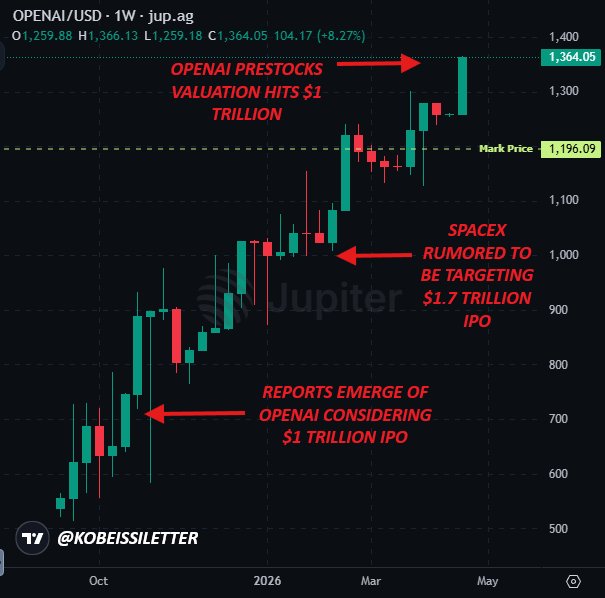
OpenAI has reached a landmark milestone, with its pre-IPO valuation officially surpassing the $1 trillion threshold. The figure, driven by on-chain trading of pre-IPO instruments secured 1:1 by SPV exposure on the Jupiter platform, offers a real-time proxy for the company’s implied IPO valuation. As markets digest this development, analysts and regional observers are weighing the implications for the tech sector, investment structures, and broader economic dynamics.
Historical Context: From Startup to Unicorn to Market Benchmark OpenAI’s trajectory has been marked by rapid progression from a research-driven nonprofit to a leading technol ogy company at the intersection of artificial intelligence, platform economics, and industrial applications. Since its inception, the organization has attracted attention for its ambitious research agenda, strategic partnerships, and increasingly commercialized offerings. The milestone of a trillion-dollar implied valuation, even before a traditional public listing, underscores a broader trend: major AI leaders are shaping market expectations and financing mechanisms in real time, outside of conventional IPO cycles.
The valuation moment also echoes the broader history of technology platform companies that achieved outsized market perception ahead of or alongside traditional funding rounds. In recent years, investors have shown a growing willingness to attribute substantial value to AI frontiers and associated ecosystems, sometimes independent of immediate profitability metrics. This dynamic—where the perceived future potential informs present-day pricing—has become a defining feature of the software and AI landscape.
Economic Impact: Implications for Talent, Capital Flows, and Innovation A trillion-dollar implied valuation for OpenAI carries multiple near-term and longer-term economic effects. First, it signals a sustained demand for top AI talent, from machine learning researchers to product leaders and infrastructure engineers. Higher valuation expectations tend to attract skilled professionals seeking opportunities at the frontier of AI development, spurring wage growth and competition for scarce talent across regions.
Second, the instruments underpinning the on-chain valuation framework illustrate a broader shift in how investors allocate risk and liquidity around high-growth tech firms. Real-time pricing signals from SPV-backed exposures create a more dynamic market environment, potentially increasing capital liquidity for early-stage AI ventures and related infrastructure providers. Such liquidity can accelerate experimentation, prototype development, and the deployment of AI solutions in sectors like healthcare, finance, manufacturing, and logistics.
Third, the real-time proxy for implied IPO valuation may influence corporate strategy within the AI ecosystem. Founders and leadership teams could weigh strategic decisions—such as partnerships, platform expansions, or selective capital raises—against observed market sentiment. This environment can foster more disciplined capital allocation, as management weighs milestones, product cadence, regulatory considerations, and competitive dynamics.
Regional Comparisons: Global AI Hubs and Local Ecosystems Different AI hubs may experience varied impacts from a trillion-dollar implied valuation. In the United States, where AI research and commercialization have deep roots in both academia and enterprise, the valuation milestone could reinforce ongoing investments in data infrastructure, cloud computing capacity, and secure AI governance frameworks. Regions with robust talent pipelines and supportive regulatory environments may see amplified venture activity, while those with constrained access to capital might seek similar on-chain or tokenized structures to diversify funding channels.
In Europe, AI ecosystems emphasize data privacy, interoperability, and ethical governance. A high implied valuation for a major AI player could prompt policy discussions around responsible AI deployment, risk management, and cross-border data flows. The event may also influence private equity and venture capital allocation, encouraging more European funds to explore frontier AI platforms through non-traditional financing mechanisms.
Asia presents a diverse landscape, with strong cloud and semiconductor ecosystems, rapid digital adoption, and expanding AI applications across manufacturing, healthcare, and smart cities. A trillion-dollar signal could intensify competition among regional tech giants and emerging startups to attract talent and strategic partnerships, while policymakers balance rapid innovation with cybersecurity and national strategic considerations.
On-chain Pre-IPO Instruments: Mechanics, Risk, and Market Structure The on-chain approach to pricing pre-IPO exposure relies on instruments backed 1:1 by special purpose vehicle (SPV) exposures, ensuring a direct linkage to OpenAI’s implied valuation. Traders access these instruments on decentralized or semi-decentralized marketplaces, enabling real-time pricing and liquidity for a pre-IPO asset class. The Jupiter platform, as referenced in market activity, provides a venue for such tokenized exposure with collateralization and risk controls designed to align with on-chain trading norms.
Key mechanisms to understand:
- 1:1 backing: Each instrument is designed to mirror a proportional exposure to OpenAI’s eventual IPO value, creating a clear and transparent risk-reward profile.
- SPV exposure: Special purpose vehicles hold the underlying assets or monetary claims that support the instrument’s value, providing a controlled structure for investors seeking near-IPO returns.
- Real-time pricing: Continuous trading activity yields an up-to-date proxy for implied IPO valuation, enabling rapid interpretation of market sentiment and potential arbitrage opportunities.
- Liquidity considerations: On-chain markets can offer high-frequency trading, but liquidity depth may depend on participant interest, regulatory clarity, and the broader macro environment.
Industry observers highlight several risk considerations for this structure. First, pre-IPO tokens and SPV-backed exposures inherently reflect market perceptions of future performance, which can be highly volatile and sensitive tos, regulatory developments, or shifts in AI policy and safety discourse. Second, valuation accuracy hinges on the soundness of the underlying SPV arrangements and the enforceability of on-chain claims in various jurisdictions. Third, as investors transition from private equity norms to tokenized instruments, they must assess custody, legal rights, tax treatment, and the potential for mispricing in fast-moving markets.
Historical precedents and future prospects Historically, the tech sector has seen market valuations detach from current profitability during periods of rapid innovation. The emergence of tokenized pre-IPO instruments is part of a broader evolution in financing mechanisms, leveraging blockchain-enabled liquidity and transparent pricing to bridge the gap between private development and public market access. If successful, these instruments could become a standard pre-IPO liquidity channel for other AI platforms, cloud-native tools, and enterprise software companies poised for rapid expansion.
The long-term outlook for OpenAI, framed by this valuation milestone, will hinge on several factors. Product-market fit across diverse industries, the ability to scale compute infrastructure responsibly, and robust governance that aligns with safety and ethical considerations will all influence how the company translates implied valuation into realized performance. Market participants will be watching for milestones such as product launches, enterprise adoption rates, strategic partnerships, and the evolution of competitive dynamics in AI ecosystems.
Public Reaction and Market Sentiment Public and investor sentiment around OpenAI’s trillion-dollar implied valuation is mixed, with a sense of urgency and curiosity driving commentary across financial and technology circles. Enthusiasts point to the speed at which OpenAI has translated research into deployable platforms, noting that continued momentum could redefine how organizations approach automation, data analysis, and decision support. Skeptics urge caution, emphasizing the speculative nature of pre-IPO pricing and the need for transparency around underlying assets, risk disclosures, and potential regulatory implications in the tokenized market.
Nonetheless, the valuation milestone has catalyzed broader discussions about AI's role in the economy. Businesses across sectors are evaluating how AI capabilities—from natural language processing to computer vision—can optimize operations, unlock productivity gains, and create new revenue streams. Policymakers and industry groups alike are considering governance standards, interoperability, and ethical frameworks to ensure safe and beneficial AI deployment as demand for AI-enabled solutions continues to grow.
Operational and supply chain considerations Beyond market dynamics, the OpenAI milestone reverberates through operational planning for AI providers and their customers. Enterprises experimenting with AI solutions must consider data governance, model management, and cost-containment strategies amid fluctuating demand for compute resources. The implied valuation signal may influence budgeting and procurement decisions, encouraging organizations to front-load investment in scalable AI infrastructure, developer ecosystems, and security capabilities to maximize return on AI investments.
In regions with advanced cloud ecosystems, service providers may respond with new tiers of AI-ready infrastructure and purpose-built solutions for businesses seeking to integrate AI into core workflows. This alignment between demand dynamics and supply capabilities underscores the importance of resilient, scalable, and secure AI platforms that can accommodate rapid growth in adoption while maintaining robust governance.
Conclusion: A Milestone That Reshapes Perception, Not Just Price OpenAI’s $1 trillion implied valuation marks a turning point in how the market perceives the potential of advanced AI platforms. While this figure reflects investor sentiment and market liquidity in on-chain pre-IPO instruments, it also signals a broader shift toward dynamic, tech-forward capital markets that can respond quickly to breakthroughs in AI research and deployment. The milestone is likely to influence strategic decision-making across the AI ecosystem, from early-stage startups seeking to emulate a fraction of this trajectory to established technology firms evaluating partnerships, investments, and governance models that align with rapid innovation.
As regional markets digest the implications, stakeholders will be attentive to how this development affects talent flows, investment strategy, and regulatory discourse. The interplay between speculative pricing and tangible progress in AI deployment will continue to shape expectations for the next wave of AI-enabled transformation across industries.
For readers seeking further context, the OpenAI value milestone serves as a reference point for understanding how market mechanisms are adapting to new technology paradigms. It highlights the growing importance of flexible financing structures, real-time valuation signals, and the ongoing evolution of the AI economy.
Follow-up note: If you’d like, I can tailor this piece to a specific region or industry sector, or adjust the depth of technical detail to match a particular audience, such as finance professionals, policymakers, or general readers.