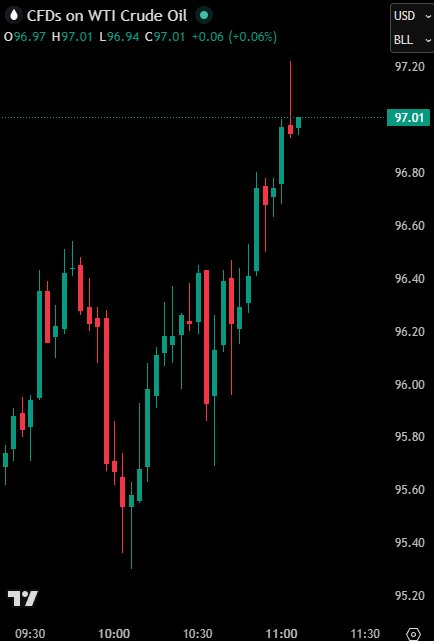
US Oil Prices Rally as Peace Talks Stall Heightens Market Uncertainty
In a developing market snapshot, U.S. crude oil prices extended their gains, topping $97 per barrel as investors reacted to renewed signs that progress in peace talks between the United States and Iran may be stalling. The latest move builds on a multi-week run of price increases driven by supply considerations, geopolitical risk assessments, and shifting expectations about global demand. The complex interplay of these factors underscores how energy markets remain highly sensitive to diplomacy, production dynamics, and macroeconomic trends.
Historical Context: Oil Prices Through the Years and the Iran Factor To understand the current price trajectory, it’s helpful to recall the broader history of oil markets in the modern era. Crude prices have long reflected a balance of supply cuts, production quotas, and geopolitical tension. In the 2010s, for instance, global oil prices were often swayed by decisions from major producers and regional flashpoints in the Middle East. The 2020s brought an emphasis on energy security, decarbonization pressures, and the persistent influence of geopolitics on trading desks and hedging strategies. The potential for renewed friction or rapprochement between the United States and Iran has repeatedly acted as a catalyst for risk premia in crude markets, with traders calibrating scenarios around supply disruption, sanctions, and potential reconciliation.
Current Market Dynamics: What Driving Prices Above $97
- Geopolitical risk premium: The prospect of stalled negotiations between the U.S. and Iran introduces a risk premium. Market participants price in the possibility of sanctions or supply restrictions affecting Iranian crude and related flows in global markets.
- Supply-demand balance: While production remains resilient in several regions, ongoing global demand recovery—driven by recovering travel, manufacturing activity, and energy-intensive industries—supports pricing momentum. Any signs of tighter supply or uneven compliance with output agreements can amplify price moves.
- Inventory and refinery considerations: U.S. and global inventories, as well as refinery utilization rates, influence short-term price volatility. Market watchers monitor builds or draws in strategic stocks and seasonal maintenance schedules that can tighten or loosen near-term supply reliability.
- Dollar and macro factors: Fluctuations in the U.S. dollar’s value and broader macroeconomic indicators—such as inflation data, consumer demand trends, and central bank policy expectations—shape oil price levels by affecting purchasing power and global demand projections.
Regional Comparisons: How the U.S. Market Fits Into a Global Mosaic
- North America: In the United States, equities and energy sectors often move in step with crude prices, given the sector’s exposure to exploration, production, and refining margins. Local consumption patterns, seasonal demand, and infrastructure constraints can also modulate price transmission to households and businesses.
- Europe: European markets typically respond to Brent-linked pricing and pipeline dynamics that connect to Middle Eastern and North African supply routes. Economic growth, energy security concerns, and European Union policies on energy transition influence how price changes are absorbed by industry and consumers.
- Asia-Pacific: The Asia-Pacific region remains a major driver of global oil demand, with large economies like China and India shaping the demand outlook. In this region, price sensitivity can be heightened by refining capacity, import diversification, and regional refiners’ ability to adapt to price swings.
Economic Impact: Implications Across Sectors and Households
- Energy-intensive industries: Sectors such as manufacturing, chemicals, and transportation can experience elevated input costs when crude prices rise. Companies often respond with hedging strategies, efficiency improvements, or price adjustments for end products.
- Inflation and consumer spending: Higher energy costs can ripple through consumer prices, influencing inflation perceptions, disposable income, and spending patterns. Central banks monitor energy price trajectories as part of broader inflation guidance.
- Public and private investment: Sustained price support for crude can influence capital allocation in the energy sector, including upstream exploration, midstream infrastructure, and downstream refining capacity. Conversely, higher prices may temper investment if demand signals weaken.
- Labor markets and regional economies: Regions with strong energy sectors may see supportive employment effects in drilling, services, and logistics, while regions dependent on energy-intensive energy importation could experience more pronounced economic adjustments.
Market Reactions and Public Sentiment
- Investor positioning: Traders often adjust portfolios to balance risk and return in response to evolving diplomacy news, supply expectations, and economic data. Volatility can intensify arounddevelopments related to negotiations, sanctions, or unexpected supply disruptions.
- Consumer outlook: Public reaction to higher gasoline prices can influence sentiment and conversations around energy independence, small business costs, and household budgeting. While the price pass-through to fuel costs varies by region and policy environment, households frequently feel thenumbers in daily routines.
- Corporate communications: Energy companies and industrial users may issue guidance or commentary about price sensitivity, hedging programs, and strategic planning to reassure stakeholders about resilience in a changing energy landscape.
Sustainability and Policy Context: A Long-Term Lens While short-term price movements often dominates, the energy market is increasingly guided by longer-term policy signals. Global decarbonization efforts, energy security considerations, and investment in new technologies all interact with traditional supply-demand dynamics. Governments and industry players are continually balancing near-term volatility with strategic aims of reliability, affordability, and environmental stewardship. In this environment, volatility can persist as markets test reactions to policy shifts, technological breakthroughs, and geopolitical developments.
Technical and Market Considerations: Reading the Chart of Momentum
- Price levels and momentum: A move above a symbolic threshold such as $97 can attract momentum trading as traders test the durability of the breakout. Support and resistance levels, implied volatility, and open interest in futures and options markets contribute to the texture of price action.
- Contango and backwardation: The shape of the futures curve influences storage economics and hedging decisions. In times of supply concerns, backwardation can emerge, signaling tight near-term supply relative to longer-dated contracts.
- Inventory signaling: Weekly inventory data and refinery utilization rates provide a steady stream of signals about near-term tightness or relief. Market participants weigh these indicators against geopoliticals to construct scenarios for the coming weeks.
Regional Infrastructure and Energy Security Implications
- Pipeline and maritime routes: Any disruption or bottleneck in critical pipelines or shipping lanes can have outsized effects on regional and global pricing. Safeguarding energy corridors becomes a policy priority for producer and consumer nations alike.
- Strategic reserves: The role of national oil reserves as a buffer against short-term shocks remains a strategic tool for energy security. The timing and scale of releases – if any – are closely watched for their potential to dampen price spikes or support strategic planning.
- Refining capacity: The utilization rates of refineries influence the balance between crude pricing and refined product costs. Maintenance cycles, outages, or shifts in product mix can alter the effective cost of gasoline and diesel for end users.
Outlook: What Traders, Analysts, and Policymakers Are Watching
- Diplomatic signals: The trajectory of U.S.–Iran talks will continue to be a focal point for risk pricing in crude markets. Clarity on deadlines, concessions, and potential timelines could reduce uncertainty or intensify it, depending on developments.
- Demand forecasts: Global economic indicators, particularly in major consuming regions, will shape the demand side of the equation. Upbeat growth can support higher prices by tightening the balance of supply and demand.
- Supply responses: Producers’ adherence to output agreements, as well as alternative supply sources, will influence how long elevated price levels persist. Any unexpected changes in production could quickly reframe market expectations.
Conclusion: A Market in Flux, Yet Steady in Its Core Dynamics As prices push above the $97-per-barrel mark amid concerns about stalled peace talks, the oil market demonstrates its enduring sensitivity to geopolitical, economic, and policy signals. While volatility is a persistent feature of energy markets, the underlying forces of supply discipline, global demand, and strategic reserves provide a framework for understanding price movements. For businesses, investors, and households alike, the current moment underscores the importance of diversified risk management, prudent budgeting, and attentive monitoring of the evolving diplomacy and policy landscape that shapes energy pricing for months to come.