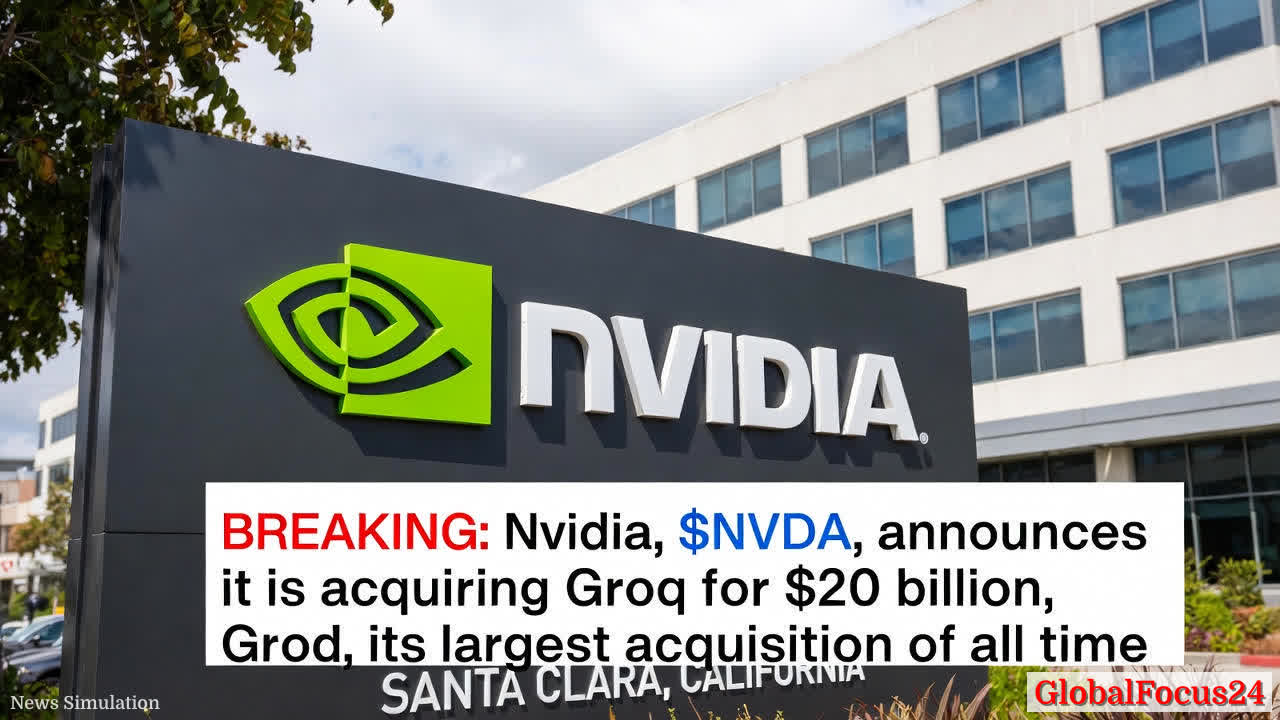
Nvidia to Acquire Groq in $20 Billion Landmark Deal Targeting AI Inference Chips
A transformative agreement between Nvidia and Groq, a specialized AI accelerator startup, unfolds as Nvidia announces a $20 billion deal aimed at expanding its leadership in AI inference hardware. The transaction, described by officials as the largest in Nvidia’s history, signals a bold bet on Groq’s proprietary technologies and talent, while preserving Groq’s early-stage cloud division as a separate, ongoing operation. The arrangement combines licensing, asset acquisition, and executive hiring, underscoring an aggressive push to accelerate AI workloads from research to real-world deployment.
Historical context and market positioning
Nvidia’s ascent in AI hardware has been closely tied to the evolution of the GPU as a general-purpose computing engine, enabling breakthroughs in machine learning, natural language processing, and computer vision. In recent years, the industry has increasingly distinguished between two core classes of AI accelerators: training accelerators, optimized for building models, and inference accelerators, designed for running those models efficiently in production. Inference chips must deliver low latency, high throughput, and energy efficiency at scale, a combination that is central to real-time AI services, cloud platforms, and edge deployments.
Groq’s technology, rooted in years of research into high-speed inference, positions the startup as a notable challenger in the inference-chip segment. Its Language Processing Units (LPUs) are engineered to accelerate natural language understanding, multi-modal workloads, and other AI tasks with a focus on low latency and deterministic performance. The acquisition—through licensing, selective asset transfer, and leadership integration—suggests Nvidia’s intent to weave Groq’s architecture and talent into its broader AI infrastructure portfolio. The broader market has watched closely as leading AI firms strategically consolidate capabilities that bridge research innovations with scalable production hardware.
Economic impact and strategic implications
The $20 billion transaction is unprecedented in Nvidia’s dealmaking history and sends a clear signal about the market’s expectations for AI hardware ecosystems. By absorbing Groq’s LPUs and related intellectual property, Nvidia seeks to:
- Expand inference throughput for cloud-based AI services, enabling more concurrent users and complex prompts without compromising latency.
- Strengthen position in edge AI scenarios where power efficiency and compact form factors matter, broadening Nvidia’s footprint across data centers, telecommunications, and industrial applications.
- Accelerate time-to-market for integrated AI stacks by leveraging Groq’s architectural innovations within Nvidia’s existing CUDA ecosystem, software libraries, and developer tools.
- Attract and retain top engineering talent, including Groq’s leadership and essential engineering teams, whose expertise in inference-optimized design complements Nvidia’s marquee GPU offerings.
Analysts note that the deal aligns with a larger industry trajectory: hardware providers increasingly pursue end-to-end AI pipelines, from model training to real-time inference, to monetize AI capabilities at scale. The Groq collaboration can also influence pricing dynamics, supply chain resilience, and customer differentiation as enterprises evaluate cost per inference, performance per watt, and total cost of ownership for AI deployments.
Regional perspectives and comparative benchmarks
Regionally, the deal resonates across major AI ecosystems in North America, Europe, and Asia-Pacific, where hyperscalers, enterprise users, and national initiatives drive demand for high-performance AI hardware. By integrating Groq’s LPUs, Nvidia could reinforce its competitive edge relative to other major accelerator developers, including firms focused on domain-specific accelerators and custom silicon. Notably, the integration is expected to influence:
- North American data-center strategies: Large cloud providers and research institutions seek scalable inference solutions to support real-time analytics, streaming AI services, and on-demand language models. Nvidia’s expanded portfolio could translate into expanded procurement avenues and deeper collaboration with enterprise customers.
- European and Asian campuses: As nations advance digital infrastructure and AI governance, the availability of efficient inference hardware becomes a critical enabler for innovation, manufacturing optimization, and intelligent automation across sectors such as manufacturing, logistics, and healthcare.
- Global supply chains: A larger, more integrated AI hardware stack may affect supplier relationships, silicon manufacturing timelines, and the geographic distribution of engineering centers as companies strategize around risk diversification and critical bottlenecks.
Technical and architectural considerations
Groq’s LPUs are designed to optimize the execution of transformer-based and other contemporary AI models, emphasizing predictable latency and throughput. In a broader Nvidia context, the Groq IP and talent could inform several technical developments, including:
- Inference acceleration paradigms: Merging Groq’s architectural ideas with Nvidia’s existing tensor cores and software optimization toolchains could yield hybrid acceleration pathways that tailor compute to model type and workload profile.
- Software ecosystem synergies: Developers could benefit from extended libraries, compilers, and runtime environments that harmonize Groq-inspired hardware with Nvidia’s CUDA, cuDNN, and other AI software infrastructure.
- Power efficiency and performance scaling: Efficient inference is crucial for large-scale deployments and edge devices alike. Groq’s approach may contribute to improvements in energy-per-ference metrics and thermal design, enhancing total cost of ownership for data centers and edge platforms.
Public reactions and market sentiment
Investors and industry watchers have generally welcomed the strategic emphasis on end-to-end AI infrastructure. The deal’s scale demonstrates confidence in the sustained demand for high-performance inference capabilities as AI models grow more capable and resource-intensive. Public sentiment among customers and partners appears optimistic about the potential for rapid deployment, improved service responsiveness, and expanded access to AI-powered applications across sectors. While integrating two large organizations always carries execution risk, stakeholders anticipate that the combined entity will deliver stronger stewardship of silicon development, software ecosystems, and customer support.
Operational and regulatory considerations
The transaction involves licensing Groq’s technology, asset acquisition, and leadership appointments, while Groq’s cloud business continues to operate independently. This arrangement may help maintain ongoing collaboration with customers who rely on Groq’s cloud services, reducing disruption during the transition. From a regulatory standpoint, the deal will undergo standard antitrust review processes in relevant jurisdictions to ensure fair competition and to address any potential concerns about market concentration in AI hardware. Historically, Nvidia has navigated similar integrations by preserving key customer relationships and maintaining transparent communication with stakeholders.
Historical context: industry cycles and technology maturation
The hardware AI industry has witnessed repeated cycles of consolidation as firms race to translate breakthroughs into scalable, economically viable products. In earlier eras, the emphasis was on raw compute power, with GPUs pioneering consumer and enterprise AI acceleration. As models evolved toward larger parameter counts and more complex inference pipelines, the importance of specialized hardware, memory bandwidth, and software optimization grew steeper. Nvidia’s pursuit of Groq reflects a maturation phase in which end-to-end capability—spanning silicon design, firmware, drivers, and developer tools—becomes a differentiator in a crowded market. By combining Groq’s LPUs with Nvidia’s broad platform, the industry could see a acceleration in the adoption of more capable AI services across industries.
Regional comparisons: similar deals and benchmarks
While the Nvidia-Groq agreement stands out for its scale, regional analogs highlight a consistent pattern: strategic acquisitions aimed at strengthening AI inference capabilities. In other markets, tech conglomerates have pursued:
- Large-scale integrations to secure computational throughput for cloud AI services, with emphasis on low latency and reliability.
- Talent acquisitions to supplement engineering expertise in neural processing, compiler design, and hardware-software co-design.
- Preservation of existing cloud or service offerings to minimize disruption for customers and partners during the transition.
Prospects for customers and developers
For enterprises deploying AI at scale, the deal promises a more tightly integrated hardware-software stack, potentially enabling faster model deployment, lower latency, and improved efficiency. Developers could benefit from enhanced tooling and more predictable performance characteristics, particularly for latency-sensitive applications such as real-time language translation, AI-assisted decision-making, and interactive digital assistants. The expanded ecosystem may also foster collaboration across industries, including healthcare, finance, manufacturing, and transportation, with broader access to advanced AI capabilities.
Bottom line
The Nvidia-Groq agreement marks a watershed moment in the hardware AI landscape, signaling a commitment to advancing inference technology as a core driver of AI-enabled productivity and innovation. By licensing Groq’s LPUs, acquiring select technology and assets, and integrating top talent, Nvidia aims to accelerate the pace at which enterprises can deploy high-performance AI across cloud and edge environments. As the deal proceeds through regulatory reviews and operational integration, stakeholders will watch closely for real-world performance gains, customer adoption, and the extent to which the combined platform reshapes the competitive dynamics of AI hardware.
Public-facing updates and anticipated milestones
Industry observers expect a phased integration plan that preserves core Groq customers while gradually migrating capabilities into Nvidia’s strategic roadmap. Milestones likely to be highlighted include interoperability demonstrations, software toolchain enhancements, and joint go-to-market initiatives that showcase the scalability and reliability of the merged platform. As deployment timelines unfold, users will be looking for evidence of tangible improvements in inference speed, energy efficiency, and total cost of ownership, particularly for large-scale language models and enterprise-grade AI workloads.
Relevant regional comparisons and future outlook
Looking ahead, the convergence of Groq’s LPU-focused approach with Nvidia’s established GPU and software ecosystem could set a new standard for how AI inference is delivered at scale. Regions with robust data-center infrastructure and favorable policy environments are expected to benefit most from accelerated AI services, including clinical decision support, real-time analytics, and customer-facing AI experiences. While competition remains intense, a more integrated hardware-software paradigm may reshape vendor selection criteria for enterprises seeking durable performance, reliability, and long-term support in mission-critical AI deployments.
Further context for professionals and researchers
For researchers, the deal may open opportunities to collaborate on next-generation inference architectures, compiler optimizations, and standardized benchmarks that better reflect real-world workloads. For practitioners, it emphasizes the importance of evaluating hardware choices not only by raw speed but also by ecosystem maturity, software compatibility, and the breadth of developer tools available to optimize and deploy complex AI applications.
Notes on sustainability and responsible AI considerations
As AI deployments scale, energy efficiency and responsible AI practices gain prominence. Inference hardware design, along with software optimization, can help reduce energy consumption per inference and support greener data-center operations. Stakeholders involved in the Nvidia-Groq collaboration are likely to emphasize commitments to responsible AI deployment, safety considerations, and transparent governance of AI systems as they scale the combined platform.
Final reflections for the industry
The move signals a clear industry focus on end-to-end AI readiness—where the line between silicon, firmware, software, and services grows ever more blurred. If the integration achieves its ambitious objectives, the resulting platform could redefine performance standards for AI inference, influence model deployment strategies across sectors, and broaden the accessibility of advanced AI capabilities to organizations of varying sizes. As the market absorbs the implications of this landmark agreement, developers, customers, and competitors alike will adjust their expectations for what a scalable, efficient, and reliable AI infrastructure can deliver in the coming years.