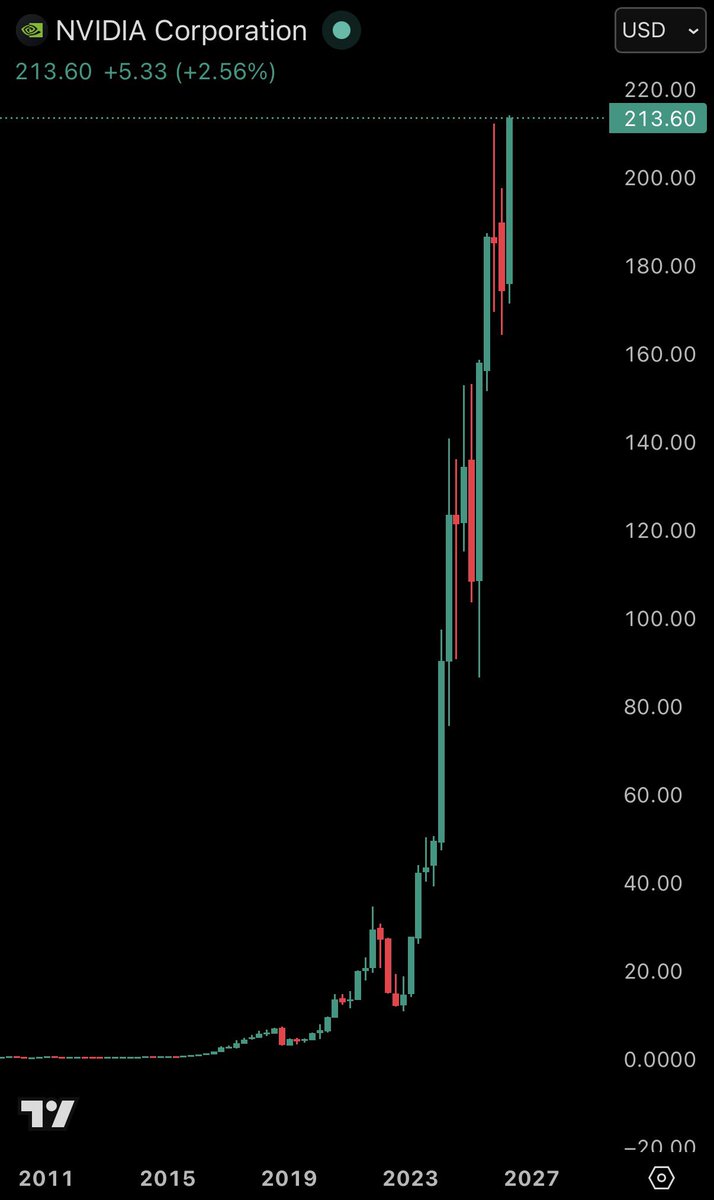
NVIDIA Passes Record: A $5.2 Trillion Benchmark in an AI-Driven Era
NVIDIA has reached a milestone that underscores the rapid transformation of the global technology economy: a market capitalization of $5.2 trillion, accompanied by a sustained surge in stock value driven by demand for artificial intelligence, accelerated computing, and data-center innovation. The milestone reflects more than a single quarter’s performance; it signals a fundamental shift in how investors view semiconductor leadership, the AI software stack, and the broader ecosystem that powers modern digital infrastructure. As the company rides a wave of AI adoption across industries, analysts and policymakers alike are watching closely to understand the implications for growth, competition, and regional technology ecosystems.
A historic ascent in market value
Since 2022, NVIDIA has added roughly $4.9 trillion in market value, a trajectory that has surprised many observers and reshaped expectations for semiconductor firms. The stock’s climb has been propelled by multiple factors: the rapid expansion of data-center capacity to support large language models and generative AI workloads, breakthroughs in GPU architectures optimized for parallel computing, and a broader realization that AI acceleration is a foundational technology across sectors from healthcare to manufacturing. The valuation also reflects investor confidence in NVIDIA’s ability to monetize software platforms, such as AI development kits, enterprise tooling, and cloud-native AI services that sit atop its hardware foundation.
Looking beyond the stock ticker, the market capitalization milestone embodies a broader confidence in a new generation of compute infrastructure. Modern AI systems require specialized accelerators, high-bandwidth memory, and tight software-hardware integration. NVIDIA’s strategic investments in software ecosystems—ranging from developer tools to optimized frameworks—have helped create an end-to-end stack that reduces time-to-value for enterprise customers. This alignment between hardware performance and software capability has catalyzed enterprise procurement, shaping a wave of capital expenditure in data centers, edge deployments, and hybrid cloud architectures.
Historical context: from graphics to general-purpose acceleration
NVIDIA’s origins as a graphics processor company provide an instructive backdrop to its current market position. In the 1990s and early 2000s, the demand for immersive gaming and high-fidelity graphics established GPU technology as a critical computing acceleration paradigm. The company then pivoted toward general-purpose computing on GPUs (GPGPU), unlocking vast potential for scientific computing, simulation, and, eventually, AI training and inference. This evolution illustrates a broader pattern in technology: specialized hardware increasingly becomes the backbone of enterprise-scale AI workloads, while software ecosystems evolve to exploit that hardware efficiently.
The AI era accelerated NVIDIA’s ascent. As developers, data scientists, and enterprises sought faster, more energy-efficient ways to train large models, NVIDIA’s GPUs—paired with software frameworks and developer tools—became the de facto standard in many AI workloads. The result has been a virtuous circle: strong demand for GPUs drives higher volumes and pricing power, which in turn funds further R&D into more capable accelerators and optimized software. The company’s market leadership during this transition has reshaped competitive dynamics in semiconductors, with other chipmakers intensifying investments in AI-specific accelerators and related technologies.
Economic impact: ripple effects across regions and industries
The implications of NVIDIA’s market performance extend beyond the company’s quarterly earnings. For technology ecosystems, the rise in market value has multiple cascading effects:
- Data-center investment: Enterprises increasingly allocate capital to AI-ready infrastructure. This includes servers with multiple GPUs, high-speed interconnects, and scalable storage solutions. Data-center projects drive demand for power, cooling, and maintenance services, influencing regional electricity grids and procurement strategies for major metropolitan areas and tech hubs.
- Supply chain realignment: The AI hardware supply chain emphasizes advanced manufacturing, wafer production, and packaging capabilities. Regions with established semiconductor ecosystems—such as parts of North America, Europe, and Asia—stand to benefit from investment flows, job creation, and knowledge transfer tied to AI hardware development. Supplier diversification and resilience become strategic priorities as demand for specialized components grows.
- Talent and education: A new wave of tech talent—engineers, data scientists, and software developers—flows toward AI-centric computing. Universities and training programs align curricula with the needs of high-performance computing, while public and private organizations pursue upskilling initiatives to meet the demand for AI-savvy professionals.
- Corporate strategy and competition: NVIDIA’s leadership in AI acceleration shapes procurement decisions across industries, including finance, healthcare, manufacturing, and logistics. Competitors respond by enhancing performance per watt, expanding software ecosystems, and seeking differentiated capabilities such as edge AI, real-time inference, or cost-effective training solutions. The resulting competition accelerates innovation across the semiconductor value chain.
Regional comparisons: where the AI hardware market is growing most
Different regions highlight distinct strengths in the AI hardware ecosystem:
- North America: The United States and Canada are centers for AI research, cloud providers, and enterprise software. The concentration of hyperscale data centers, venture capital, and talent pipelines supports ongoing investment in AI infrastructure.
- Europe: EU initiatives emphasize advanced manufacturing, regulatory clarity, and AI ethics frameworks that influence deployment. Regional incentives and trade policies can shape the pace at which AI hardware and software ecosystems mature.
- Asia-Pacific: Countries with established semiconductor manufacturing capabilities and massive production ecosystems—such as Taiwan, South Korea, and parts of Southeast Asia—play a critical role in the supply chain. The region’s scale and manufacturing sophistication contribute to global capacity for AI accelerators, memory, and related components.
- Emerging markets: As AI adoption expands globally, larger-scale data processing and AI-enabled services drive demand in regions with growing digital infrastructure. Local data centers, telecommunications upgrades, and cloud-service expansion contribute to regional development and job creation.
Industry dynamics: end-to-end AI adoption and the hardware-software loop
A robust AI strategy requires more than top-tier hardware. Enterprises increasingly pursue end-to-end solutions:
- Hardware foundation: High-performance GPUs, tensor cores, and related accelerators deliver the computational backbone for training and inferencing at scale. Power efficiency and cooling solutions are essential considerations for data-center operators.
- Software ecosystems: Frameworks, libraries, and developer tools streamline model development, tuning, and deployment. A healthy software environment lowers the cost and time to bring AI capabilities into production.
- Ecosystem partners: System integrators, cloud providers, and software vendors collaborate to deliver turnkey AI solutions. This collaboration accelerates adoption across industries that might lack in-house expertise for large-scale AI initiatives.
- Security and governance: AI deployments raise concerns about data privacy, model reliability, and risk management. Enterprises increasingly invest in governance frameworks and security measures to mitigate operational risk.
Public reaction and market psychology
Markets react not only to quarterly results but to broader narratives about the future of technology. The ascent to a $5.2 trillion benchmark has sparked conversation about AI’s transformative potential, the sustainability of demand, and the resilience of supply chains. Public sentiment often fluctuates with news about regulatory developments, hardware pricing dynamics, and shifts in enterprise spending. Yet the prevailing tone among industry observers is one of cautious optimism: AI acceleration is redefining productivity, enabling new capabilities across sectors, and creating macroeconomic momentum in areas like cloud services, data-center construction, and chip manufacturing.
Supply chain resilience and policy considerations
As AI hardware demand grows, policymakers and industry leaders emphasize resilience. Key considerations include:
- Diversification of suppliers: To reduce risk from single points of failure, stakeholders explore diversified supply chains for silicon materials, packaging, and testing services.
- Domestic manufacturing incentives: Some regions pursue incentives for semiconductor fabs and R&D ecosystems to maintain strategic capabilities within their borders.
- Trade and export controls: International policy frameworks can influence the flow of AI-ready components, affecting pricing, lead times, and global collaboration.
- Energy efficiency and sustainability: Data centers consume substantial power, making efficiency improvements and sustainable practices a priority for operators aiming to balance performance with environmental considerations.
A look ahead: pacing, risk, and opportunity
The path forward for NVIDIA and the broader AI hardware landscape involves balancing rapid innovation with prudent risk management. Anticipated developments include:
- Next-generation accelerators: Continued improvements in computational density, memory bandwidth, and energy efficiency will push AI workloads toward faster training cycles and lower operational costs.
- Expanded cloud partnerships: Cloud providers will likely deepen collaborations with hardware vendors to offer optimized AI platforms, enabling businesses to scale AI initiatives more quickly.
- Edge AI expansion: A growing segment of AI workloads will move closer to the edge, unlocking applications in robotics, autonomous systems, and real-time decision-making in industrial settings.
- Regulatory environment: Evolving regulatory landscapes related to AI governance, data privacy, and export controls will shape how AI technologies are developed and deployed globally.
Conclusion: a milestone that signals broader technological momentum
NVIDIA’s record-setting market capitalization underscores a moment of acceleration in the global technology economy. The company’s remarkable rise since 2022 reflects a combination of technical leadership, a thriving software ecosystem, and a broad shift toward AI-enabled productivity across industries. The historical trajectory—from graphics processing to AI acceleration—illustrates how specialized hardware can catalyze systemic change in enterprise computing. As regional ecosystems adapt to growing demand for AI hardware and services, the economic impact will ripple through data centers, manufacturing, and job markets, shaping investment decisions for years to come. In this context, the $5.2 trillion milestone is not merely a financial figure; it is a marker of a transformative era in which AI-enabled computation is becoming a foundational driver of global growth.