Nvidia Shares Tumble Despite Record Quarterly Revenue as Investors Question AI Rally’s Next Leg
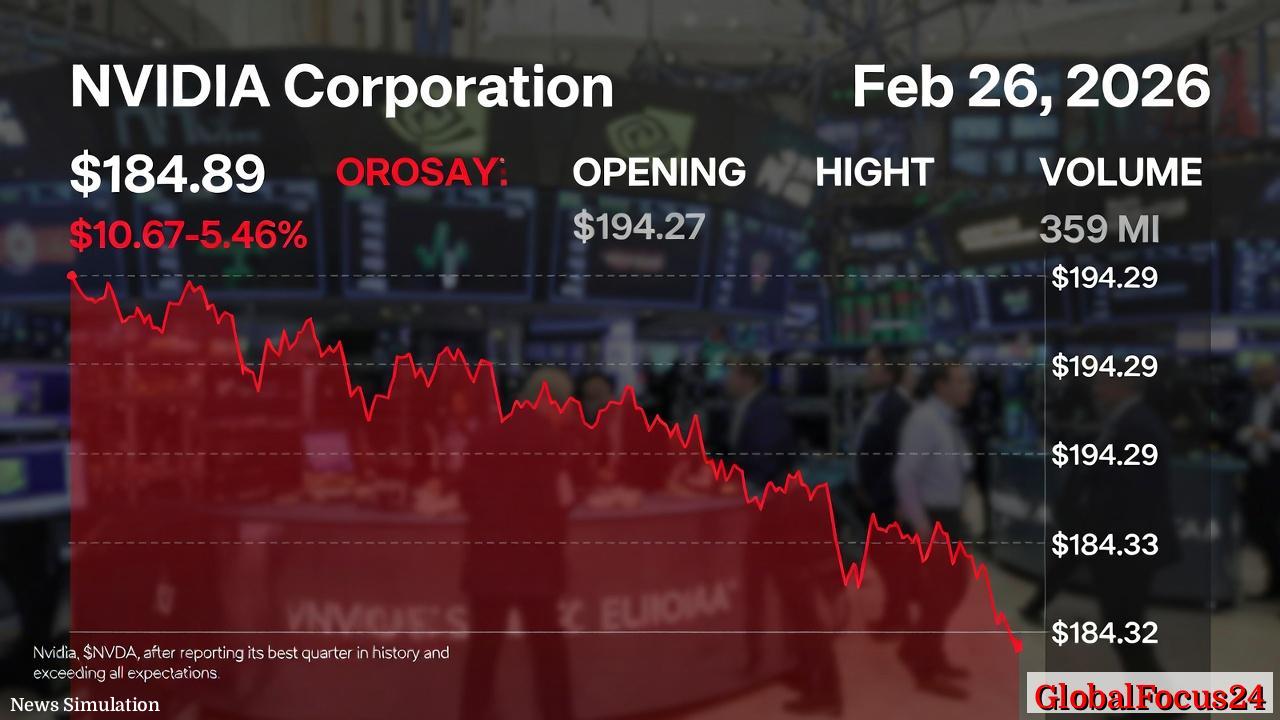
Nvidia Corporation shares fell sharply on February 26, 2026, even as the chipmaker reported another quarter of record revenue and profits powered by surging demand for artificial intelligence hardware. The stock closed at 184.89 dollars, down 10.67 dollars or 5.46% from the prior session, marking its steepest one-day percentage loss since April of last year and erasing tens of billions of dollars in market value in a single session.
The selloff underscored growing investor unease about how long Nvidia’s historic growth in AI-related spending can continue at its current pace, and whether the market had already priced in years of blockbuster results.
A Steep One-Day Drop After an Initial Pop
Nvidia shares opened Thursday’s session at 194.27 dollars, just above the prior close, and briefly touched an intraday high of 194.29 dollars before selling pressure built through the trading day. The stock slid to a low of 184.32 dollars before the closing bell, sealing a 5.46% decline that stood out even in a volatile technology sector.
Trading volume surged above 359 million shares, far exceeding typical daily turnover and signaling that large institutional investors as well as short-term traders were repositioning following the earnings release. Market data providers noted that at its intraday lows the stock was flirting with its worst single-day percentage drop since April 16, 2025, when Nvidia also suffered a sharp reversal after an extended rally.
The intraday pattern contrasted sharply with the initial reaction in after-hours trading the previous evening, when Nvidia’s shares rose onnumbers that beat Wall Street expectations for revenue, earnings and guidance. The swift reversal from enthusiasm to broad-based selling underscored how sensitive the stock has become to any perceived gap between sky-high expectations and management’s messaging.
Record Revenue and Profits from AI Demand
For its fiscal fourth quarter ended January 25, 2026, Nvidia reported record revenue of 68.1 billion dollars, up 20% from the prior quarter and 73% from the same period a year earlier. Earnings per share rose roughly 82% year-over-year to 1.62 dollars, also ahead of consensus forecasts.
The company’s data center segment, which supplies graphics processors and systems used to train and run large artificial intelligence models, remained the dominant growth engine, accounting for more than 90% of total revenue and rising roughly 75% from a year earlier. Nvidia highlighted major platform shifts toward accelerated computing and AI workloads in cloud data centers, telecommunications networks and enterprise infrastructure as key drivers of demand.
For the full fiscal year 2026, Nvidia generated 215.9 billion dollars in revenue, up 65% year-over-year, and net income jumped to 43 billion dollars from 22.1 billion dollars a year earlier, underscoring the scale and profitability of the AI boom. Analysts noted that the company continued to exceed consensus estimates on all major financial metrics, reflecting its commanding position in high-end AI chips and systems.
Guidance Tops Expectations but Fails to Impress
Looking ahead, Nvidia guided for first-quarter fiscal 2027 revenue of about 78 billion dollars, plus or minus 2%, which implies year-over-year growth of nearly 77% and represents another step up from the just-reported quarter. That forecast topped average analyst expectations of roughly 72.8 billion dollars and even surpassed some of the most optimistic buy-side projections in the 74 to 75 billion dollar range.
Despite this, some investors appeared disappointed that management did not provide even more aggressive targets or new details on long-term AI revenue opportunities beyond previously cited figures of more than 500 billion dollars for its next-generation Blackwell and Rubin data center platforms. Market strategists suggested that after months of extraordinary share price gains, investors were looking for incremental catalysts—such as larger capital return plans, additional disclosure on order backlogs, or more granular regional and customer breakdowns—to justify further upside.
This dynamic—where “beats and raises” on earnings and guidance are no longer sufficient to propel the stock higher—has become a familiar pattern in the latest phase of the AI-driven market rally, particularly for large-cap technology leaders whose growth has already reset investor expectations.
Historical Context: Volatility After Blockbuster Quarters
Nvidia’s latest pullback fits into a history of pronounced volatility around its earnings releases, especially during the past two years as the company emerged as the primary beneficiary of a surge in AI infrastructure investment. In April 2025, the stock experienced one of its sharpest single-day slides in years following a strong run-up, as traders reassessed valuations and hedged exposures despite continued fundamental strength.
Over the longer term, however, previous drawdowns have often been followed by renewed gains as earnings growth and cash generation caught up with market expectations. Since 2023, Nvidia has repeatedly reset the ceiling for data center revenue, gross margins and profitability, gradually convincing skeptics that AI hardware demand is not a short-lived phenomenon but a multi-year investment cycle.
Analysts cautioned that historical patterns are not guarantees, but they noted that corrections such as Thursday’s move can help relieve valuation pressure and shake out momentum-driven positions, potentially restoring a more stable base of long-term shareholders.
Economic Impact and Market Ripple Effects
Nvidia’s downturn had immediate spillover effects across equity markets, given its status as one of the world’s largest publicly traded companies by market capitalization and a key component of major stock indices. The company’s roughly 5% decline dragged on benchmark U.S. equity gauges, with technology and semiconductor peers also trading lower as investors reassessed the near-term trajectory of AI spending and capital expenditure plans at cloud providers.
The move also highlighted how concentrated market performance has become in recent years, with a handful of mega-cap technology firms accounting for a significant share of index-level gains and losses. When a company of Nvidia’s size discounts future growth, it can translate into hundreds of billions of dollars in aggregate market capitalization evaporating in a single session, with potential effects on household wealth, pension fund valuations and risk appetite across asset classes.
Economists have pointed out that Nvidia’s earnings and investment plans are closely tied to broader capital spending in cloud computing, telecommunications and enterprise IT, sectors that themselves shape productivity trends and digital infrastructure across advanced economies. A sustained deceleration in AI-related orders could therefore have knock-on effects on suppliers, equipment manufacturers and specialized software firms, while continued strength would support further job creation and R&D spending in high-value technology hubs.
Regional and Sector Comparisons
Compared with other global chipmakers, Nvidia remains an outlier both in growth and in market sensitivity. Many Asian and European semiconductor firms have reported improving conditions in areas such as automotive electronics and industrial applications, but their revenue growth and margins still trail the levels Nvidia is generating from AI accelerators and data center solutions.
In the United States, the company’s performance continues to outpace several large peers in the semiconductor and broader technology space, yet the valuation premium it commands also magnifies the impact of any shift in sentiment. By contrast, diversified hardware and consumer technology companies often see more muted stock reactions to earnings beats or misses, reflecting slower growth trajectories and more established business cycles.
Regionally, demand for Nvidia’s products spans North America, Europe and Asia, where hyperscale cloud providers, internet platforms and AI start-ups are racing to secure computing capacity. The stock’s latest decline occurred against a backdrop of increasing competition from chipmakers in the United States and abroad that are accelerating their own AI product roadmaps, as well as initiatives by governments in Asia and Europe to bolster domestic semiconductor capabilities.
Investor Concerns Behind the Selloff
Market observers pointed to several factors that may have contributed to Thursday’s selloff despite Nvidia’s strongnumbers. One recurring theme is concern about the sustainability of AI capital expenditures by key customers such as major cloud providers and large technology platforms. Some investors worry that if end-user demand for AI services or applications moderates, cloud operators could slow the pace of new hardware deployments, affecting Nvidia’s order growth.
Regulatory filings have also drawn attention to the company’s large and growing purchase obligations—non-cancellable orders placed with suppliers to secure manufacturing capacity and critical components. Prominent investors have flagged these commitments, which have reportedly surged to around 95 billion dollars, as a potential risk if downstream demand fails to materialize in line with expectations, though Nvidia has emphasized that its obligations reflect long-term visibility into customer pipelines.
Additionally, the company’s 10-K indicated ongoing uncertainty around a high-profile, multibillion-dollar partnership under discussion with OpenAI, noting that there is no guarantee a definitive agreement will be reached. While such disclosures are standard, they have fed into a narrative that some of the most aggressive AI build-out scenarios may not materialize as quickly as hoped, prompting a recalibration of forward-looking assumptions among investors.
Public Reaction and Market Sentiment
The abrupt decline in Nvidia’s share price sparked intense debate among traders, analysts and retail investors, many of whom have treated the stock as a bellwether for the broader AI boom. On trading desks and online forums, reactions ranged from concern that Thursday’s move could mark the start of a deeper correction in AI-related equities to views that the pullback offered a long-awaited entry point after an extended rally.
Portfolio managers noted that flows into semiconductor and AI-themed funds had been strong in recent months, raising the risk that any disappointment could trigger forced de-risking as investors rebalance portfolios or meet margin calls. At the same time, long-term investors focused on fundamentals pointed to Nvidia’s still-accelerating revenue growth, strong free cash flow generation and robust balance sheet as reasons to see the drop as driven more by sentiment than by a deterioration in the underlying business.
Outlook: Strong Fundamentals, Higher Scrutiny
Looking ahead, Nvidia faces a dual reality: its financial performance continues to surpass almost every major peer, yet each successive quarter raises the bar it must clear to satisfy increasingly demanding markets. The company’s leadership in high-performance AI chips, software ecosystems and system-level solutions gives it a powerful competitive position, but it also exposes the stock to sharper swings whenever investors reassess how much future growth is already reflected in the share price.
For now, the latest results indicate that demand for AI infrastructure remains exceptionally strong and that Nvidia’s guidance still points to rapid expansion in the coming quarters. The 5.46% decline on February 26, however, serves as a reminder that even record-breaking earnings are no guarantee of market approval when expectations, valuations and uncertainty about the next phase of the AI cycle converge.