)
Meta-AMD Deal Signals a New Era in AI Compute Power
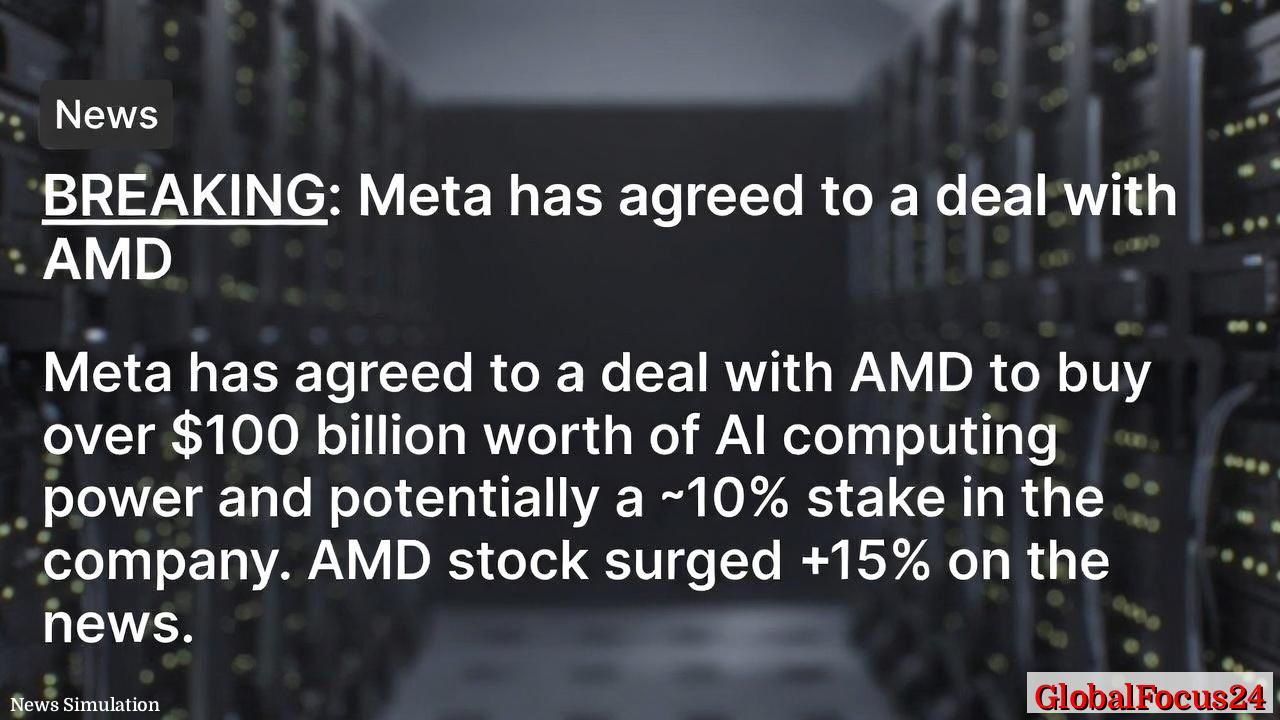
In a landmark move that could reshape the technology landscape for years to come, Meta Platforms has agreed to a strategic deal with Advanced Micro Devices (AMD) to purchase more than $100 billion worth of AI computing capacity. The arrangement, described by insiders as a multi-year collaboration, envisions AMD delivering a vast and scalable fleet of high-performance accelerators, servers, and related infrastructure to support Meta’s expanding artificial intelligence initiatives. The prospective advance in compute capacity is expected to accelerate Meta’s AI research, product development, and user-facing experiences across its social networks, virtual reality platforms, and enterprise offerings.
A Historic Context for AI Compute Scaling
The push to secure massive volumes of AI compute power is not new, but the scale of this potential agreement marks a notable inflection point. Over the past decade, the trajectory of AI breakthroughs has been tightly coupled with the availability of specialized hardware—graphics processing units (GPUs) and, more recently, AI accelerators designed to handle the enormous matrix operations at the heart of modern machine learning. Early adopters of cloud-based AI workstreams leveraged sizzling hardware to train foundational models, often requiring tens of thousands of GPUs running in parallel for weeks or months. The industry gradually moved toward more energy-efficient architectures, custom silicon, and optimized software stacks to reduce costs and improve throughput.
In this context, the Meta-AMD agreement reflects a broader trend: major technology companies are seeking not only to access leading-edge compute power but also to secure reliable, long-term supply chains that can scale with ambitious AI roadmaps. For Meta, a company with a diversified portfolio spanning social media, digital advertising, augmented reality, and the burgeoning metaverse ecosystem, the demand for robust, private infrastructure is intertwined with strategic goals around safety, personalization, and real-time content understanding. The deal signals a shifting equilibrium in which AI compute becomes a central, strategic asset—not merely a commodity—driving product differentiation and competitive advantage.
Economic Impact Across the AI Ecosystem
The potential implications of a multi-year, multi-hundred-billion-dollar compute commitment extend well beyond the balance sheets of Meta and AMD. The immediate effect on AMD’s business model could be transformative: a long-duration, technology-agnostic provision of AI acceleration gear creates a predictable revenue stream and accelerates the company’s research and development cadence. It could also catalyze further investments in chip design, manufacturing capacity, and software ecosystems needed to optimize performance for Meta’s workloads. The ripple effects may include:
- Capital intensity and supply chain recalibration: A sustained demand wave of this magnitude can influence supplier networks, wafer fabrication capacity, memory modules, and cooling solutions. Suppliers may accelerate capital expenditures to meet throughput expectations, potentially reordering capital allocation across the semiconductor industry.
- Innovation acceleration: The collaboration could spur new generations of AI accelerators tailored to large-scale, consumer-focused AI tasks. Expect joint optimization efforts in compiler toolchains, runtime environments, and energy-efficient architectures designed for inference at scale and training as needed.
- Job creation and regional development: The deployment of expansive compute clusters often necessitates specialized operational expertise, data-center construction, and regional resilience planning. This can stimulate employment, workforce training programs, and technology clustering in regions with favorable energy, tax, and regulatory conditions.
- Competitive dynamics: The arrangement could intensify competition among leading hardware providers, including other semiconductor firms and hyperscalers, prompting investments in hybrid compute strategies that blend on-premises deployments with cloud-based resources.
Regional Comparisons: Global Patterns in AI Compute Adoption
The proposed agreement sits within a global pattern of AI compute investments that vary by region according to technology ecosystems, regulatory climates, and energy costs. In North America, the capital markets and large-scale data-center ecosystems have supported rapid expansion of AI workloads, with major cloud providers competing to deliver low-latency services across the United States and Canada. In Europe, data sovereignty, privacy frameworks, and energy diversification are shaping how AI compute resources are deployed, while governments have introduced incentives to accelerate domestic semiconductor development and digital infrastructure. In Asia, high-capacity manufacturing, robust supplier ecosystems, and strong demand from mobile and enterprise AI segments are driving accelerated hardware innovation and deployment.
Against this backdrop, Meta’s potential commitment to an AMD-powered compute backbone could position the company to leverage regional advantages—balancing performance, energy efficiency, and cost—while diversifying away from earlier single-supplier dependencies. This approach aligns with broader industry moves toward multi-vendor flexibility and strategic reserves to withstand supply-chain shocks, a topic that has gained heightened prominence in the wake of global semiconductor shortages and geopolitical tensions.
Technological and Operational Implications
The integration of AMD-driven AI infrastructure into Meta’s operations will entail substantial technical orchestration. The following aspects are central to achieving the promised outcomes:
- Scaling inference and training workloads: AI models used by social platforms—ranging from recommendation systems to content moderation and language understanding—demand both high-throughput inference and periodic large-scale training. Advanced accelerators, specialized interconnects, and software optimizations will be essential to maintain responsiveness while controlling power draw.
- Energy efficiency and thermal management: Modern data centers pursue aggressive power-per-operations metrics. The AMD-based stack will require sophisticated cooling, power management, and workload scheduling to minimize heat output and maximize uptime, particularly in regions with extreme climates or variable energy prices.
- Software ecosystems: The efficacy of any hardware investment hinges on a strong software stack. This includes optimized drivers, compiler toolchains, AI frameworks, and model deployment pipelines. Close collaboration between Meta engineers and AMD software groups will likely yield tailored enhancements that extract maximum performance for Meta’s workloads.
- Security and privacy foundations: As AI features permeate social platforms, security-by-design principles remain paramount. Hardware-assisted security features, trusted execution environments, and robust firmware update mechanisms will play a critical role in safeguarding user data and platform integrity.
Public Reaction and Market Dynamics
The market’s immediate reaction to the news has been pronounced, with investor interest intensifying around the potential for sustained AI-driven growth. The stock market’s sensitivity to major compute-related announcements is well-established, as equity investors weigh the long-term value of such strategic commitments against near-term capital expenditure and amortization schedules. While stock movements are inherently volatile and influenced by a range of factors, a positive reception to a large-scale compute deal often reflects expectations of enhanced product capabilities, improved competitive positioning, and the potential for revenue expansion through AI-enabled services.
Public sentiment around AI generally expresses a mix of optimism about innovation and concern about disruption. For Meta, the prospect of deeper AI integration could heighten expectations for more personalized experiences, faster content understanding, and safer, more efficient moderation. At the same time, stakeholders may seek clarity on governance, privacy protections, and the distribution of value generated by AI-enabled services. Transparent communication around performance milestones, uptime guarantees, and energy usage will likely shape public perception in the months ahead.
Historical Lens: AI Hardware Investments Compared
Looking back, several pivotal moments illustrate how hardware investments have historically influenced AI progress. The early adoption of GPU clusters by tech firms catalyzed rapid experimentation with deep learning models, enabling breakthroughs in image recognition and natural language processing. The subsequent shift toward domain-specific accelerators and tensor processing units (TPUs) highlighted the value of purpose-built silicon for AI workloads. Each step in this hardware evolution tended to coincide with leaps in model scale, training efficiency, and deployment practicality.
Meta’s potential collaboration with AMD can be viewed as an extension of this lineage—an emphasis on scalable, industry-grade compute power tailored to the demands of real-world AI applications within a social and digital ecosystem. By securing a reliable, large-scale compute foundation, Meta could reduce the time-to-insight for experiments, accelerate iteration cycles, and unlock more ambitious experimentation with multimodal AI, real-time language translation, and complex content understanding.
Potential Risks and Considerations
No large strategic deal comes without risks. Several factors could influence the ultimate realization and impact of Meta’s AMD-powered compute strategy:
- Price and contractual complexity: A multi-year, multi-hundred-billion-dollar arrangement can involve intricate pricing structures, performance-based milestones, and evolving technology roadmaps. Effective governance and change-management practices will be essential to keep the collaboration aligned with business goals and budget constraints.
- Technology risk: While AMD’s hardware stack has demonstrated robust performance, AI workloads can evolve rapidly. Meta will need to maintain flexibility to adapt to future architectural shifts, software innovations, and potential disruption from alternative accelerators or quantum computing breakthroughs.
- Regulatory and ethical considerations: As AI capabilities expand, regulatory scrutiny around data usage, privacy, and transparency could intensify. Meta will need to balance AI-powered features with user protections and compliance requirements across diverse jurisdictions.
- Competitive dynamics: The scale and visibility of such a deal could spur reactions from competitors, potentially triggering downstream investments in competing architectures, partnerships, or internal AI accelerators. The competitive landscape for AI hardware is dynamic and can shift quickly based on breakthroughs and strategic alignments.
- Operational complexity: Deploying and managing a vast compute fabric requires rigorous site selection, power procurement, and resilience planning. Any missteps in capacity planning or maintenance could affect performance and uptime, undermining the expected benefits.
Implications for Innovation Pipelines
For researchers and product teams, access to substantial, stable compute resources can be a gamechanger. It enables more aggressive experimentation with larger models, more complex multimodal systems, and longer training cycles that were previously impractical due to cost or latency concerns. The potential for near-real-time model updates and more personalized user experiences could reshape how Meta designs its products and moderates content, ensuring that algorithmic decisions are informed by richer data signals while maintaining critical safeguards.
Moreover, the collaboration may foster cross-pollination between Meta’s research initiatives and AMD’s engineering priorities. Joint ventures often yield optimized hardware-software stacks, benchmarking suites, and development frameworks that accelerate progress across both organizations and their ecosystems. This type of mutual reinforcement can create a virtuous circle: improved performance spurs more experimentation, which in turn drives further hardware refinements.
Regional Economic Outlook
From a regional perspective, such a deal could contribute to broader economic activity across key tech hubs. In areas hosting large data centers and semiconductor manufacturing, new investments enter circulation through construction, equipment procurement, and ongoing operations. Local governments may observe employment gains in specialized roles such as systems integration, facilities management, and cybersecurity. At the same time, communities connected to energy networks or manufacturing corridors could experience indirect benefits through improved infrastructure and related services.
Energy considerations are particularly salient. Large data centers consume significant electrical power, and the environmental footprint of AI workloads has drawn increasing attention. Companies pursuing scalable AI initiatives are placing greater emphasis on energy efficiency, renewable energy procurement, and advances in cooling technologies. A responsible approach to energy strategy can help balance performance ambitions with sustainability commitments, a dynamic that resonates with stakeholders and broader societal priorities.
Regional Comparisons: Adoption in the United States, Europe, and Asia
- United States: The U.S. continues to lead in cloud infrastructure deployment and AI research funding. A deal of this magnitude aligns with a broader national emphasis on advanced manufacturing, semiconductor competitiveness, and digital innovation as levers for economic growth and national security.
- Europe: European markets often prioritize data governance, privacy, and energy policy alignment. A large-scale compute initiative would need to navigate regulatory frameworks and energy pricing structures while aligning with regional sustainability goals and industrial strategies.
- Asia-Pacific: The APAC region is prominent for its manufacturing capacity and consumer technology adoption. Strategic partnerships and supply-chain resilience in this region are critical for maintaining the velocity of AI deployments across diverse industries, from consumer electronics to enterprise AI solutions.
What This Means for Consumers and Businesses
For everyday users, the ripple effects of enhanced AI compute power can manifest in more capable features across platforms, including smarter content recommendations, more accurate language translation, and more responsive virtual assistant capabilities. For advertisers and creators, more efficient model training and deployment can translate into faster experimentation cycles, better targeting insights, and potentially new monetization opportunities facilitated by AI-enabled tools.
Businesses outside Meta could also benefit indirectly through broader industry improvements in AI tooling, efficiency, and standardization. As compute becomes more accessible and consistently available, startups and established firms alike may accelerate product development, reduce time-to-market risk, and explore new business models centered around AI-enabled services.
Conclusion: A Turning Point for AI Compute Strategy
The proposed agreement between Meta and AMD marks a moment of considerable significance in the ongoing evolution of AI infrastructure. By committing to an unprecedented scale of AI compute power, Meta signals its intention to push the boundaries of what is technically possible in social platforms, digital experiences, and AI-driven product design. For AMD, the deal could catalyze a multi-year growth trajectory, expand market share in high-performance accelerators, and solidify its role as a cornerstone supplier for some of the industry’s most ambitious AI initiatives.
As the ecosystem absorbs this development, observers will watch closely how the collaboration translates into real-world performance, energy efficiency, and user-impactful outcomes. The story unfolding here is not just about hardware and revenue figures; it is about the broader narrative of AI’s integration into everyday digital life, the engineering discipline required to scale intelligent systems responsibly, and the regional economic currents that accompany such transformative technology investments.
Public interest will continue to rise as more details emerge about deployment timelines, governance frameworks, and the ultimate balance of on-premises versus cloud hosting. The path ahead will require careful navigation of technical challenges, regulatory considerations, and ethical commitments, all while maintaining a steady cadence of innovation that serves users, fosters trust, and advances the frontier of artificial intelligence.