Massive S&P 500 Futures Trade Precedes Trump Iran Announcement, Adding $2 Trillion in Market Value
A Sudden Surge in Futures Before Breaking News
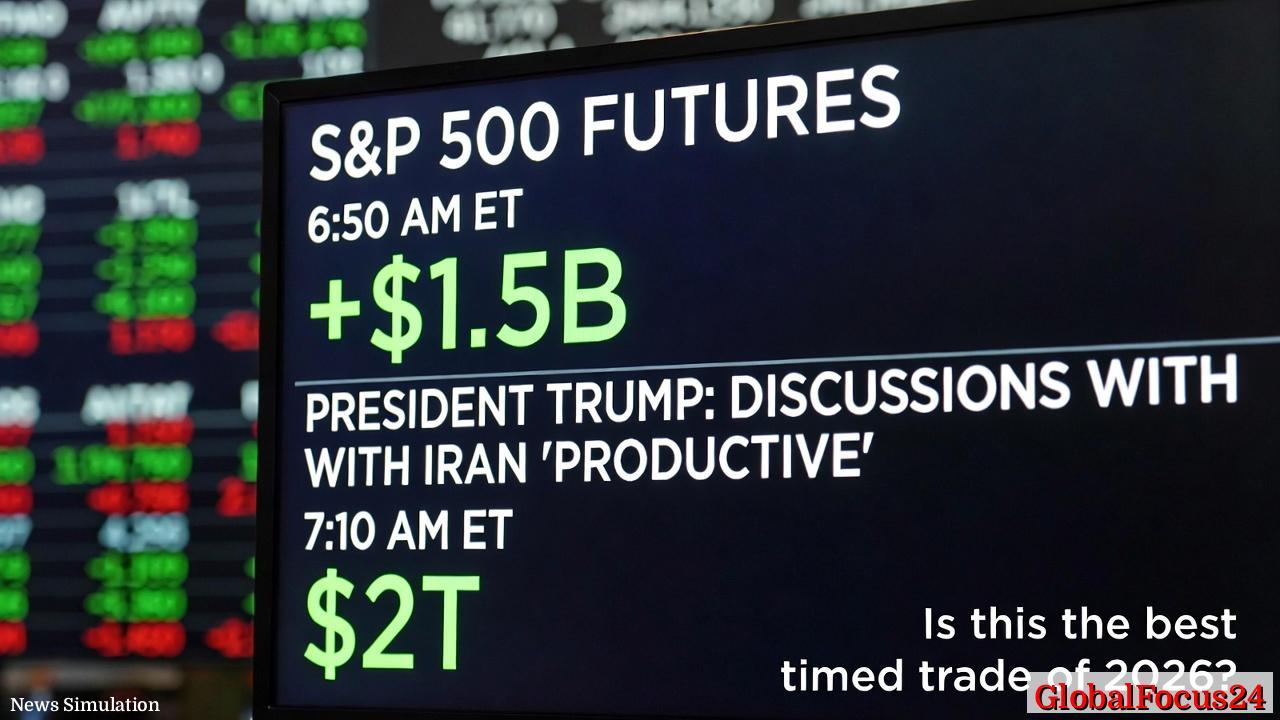
Global financial markets jolted to attention Monday morning after an unusually large trade in S&P 500 futures coincided with a sudden burst of optimism following a U.S. announcement regarding Iran. At approximately 6:50 a.m. Eastern Time, roughly $1.5 billion in notional value of S&P 500 futures contracts changed hands — a move significant enough to lift the index by 0.3 percent within a single minute, an exceptionally rare occurrence in pre-market trading hours.
Just fourteen minutes later, at 7:04 a.m. ET, former President Donald Trump issued a statement that productive discussions with Iran were underway, hinting at potential diplomatic progress after years of heightened tension. The announcement rippled instantly through global markets. By 7:10 a.m. ET, the S&P 500 had surged, adding nearly $2 trillion in aggregate market capitalization across major constituents — one of the fastest intraday paper gains on record.
While high-frequency trading and speculative flows frequently precede major policy developments, the precise timing and scale of Monday’s futures activity have drawn attention from market analysts, regulators, and institutional investors alike.
Breaking Down the Market Reaction
The futures market, a bellwether of investor sentiment ahead of regular trading sessions, saw a marked shift in liquidity. Traders reported that bid volumes surged beyond typical pre-market ranges, suggesting an institutional order rather than algorithmic drift. The S&P 500 E-mini contracts, which track the benchmark index, rallied sharply, prompting comparable moves across equity-linked instruments globally.
Wall Street participants immediately noted correlations between the timing of the futures purchase and the policy announcement. While coincidence cannot be ruled out, the speed of the resulting market capitalization gain underscored how geopolitical developments can amplify risk and reward dynamics in an era of automated execution and instantaneous news dissemination.
By the time U.S. markets officially opened, trading desks from New York to London were recalibrating positions, reversing hedges, and reassessing exposure to oil prices, energy equities, and dollar-sensitive assets. Brent crude futures, a proxy for global oil sentiment, dipped slightly as traders priced in the possibility of de-escalation in Middle Eastern tensions.
Historical Context: Markets and Geopolitical Surprises
Financial history offers several examples of market volatility immediately preceding or following high-impact policy events. During the Gulf War in 1991, energy markets spiked within minutes of ceasefire news. In 2018, the S&P 500 also swung sharply when U.S. trade delegations announced temporary truces with China amid broader tariff disputes.
The difference today lies in the velocity and data transparency of market movements. Automated trading algorithms can interpret microsecond-level signals, amplifying small shifts in sentiment. In Monday’s case, a mere 0.3 percent pre-market rise cascaded into a multitrillion-dollar equity surge once news wires confirmed diplomatic developments.
Regulators and exchanges have long monitored for such correlations, particularly after instances where insider knowledge or advanced access to information led to abnormal trading patterns. The U.S. Securities and Exchange Commission (SEC) and Commodity Futures Trading Commission (CFTC) both maintain surveillance algorithms designed to detect anomalous trades that correspond closely with undisclosed policy or corporate announcements.
Economic and Strategic Implications
The broader economic impact of Monday’s event extends beyond immediate paper gains. Investor optimism about improved relations with Iran carries potential implications for global energy supply stability, the U.S. inflation outlook, and Federal Reserve policy trajectories.
Lower geopolitical risk in the Middle East tends to lead to a decline in oil prices, easing cost pressures for consumers and corporations alike. Should diplomatic momentum continue, analysts suggest downstream effects such as cheaper transportation costs, improved corporate margins, and increased disposable incomes could bolster overall U.S. GDP growth over the next quarter.
At the same time, the Federal Reserve’s balancing act may grow more complex. A surge in equity values — particularly one driven by geopolitical optimism — can feed into wealth effects that stimulate consumer spending, effectively loosening financial conditions. If inflation indicators remain sticky, stronger equity markets may complicate efforts to maintain tight monetary policy.
Comparing Global Market Reactions
Across international exchanges, reactions mirrored U.S. momentum, though on a smaller scale. The Stoxx Europe 600 climbed 0.8 percent by midday trading in London, led by gains in energy, industrials, and aerospace sectors. Asian markets, still absorbing overnight developments, closed mixed: the Nikkei 225 rose modestly while China’s Shanghai Composite remained flat as investors weighed potential shifts in global demand patterns.
Emerging markets, particularly in oil-exporting regions, saw currency fluctuations reflecting revised expectations for energy revenues. The Saudi Tadawul index dipped 1.2 percent in early trading, while the Iranian rial appreciated marginally on unofficial currency exchanges, signaling cautious optimism for improved trade access if talks progress further.
These cross-regional movements highlight how tightly interconnected modern capital flows have become. A single high-impact policy comment from Washington can reverberate across sovereign debt yields, commodity prices, and interbank funding rates within minutes.
Could the Timing Be Coincidental?
While the sequence of events appears unusually synchronized, financial experts caution that simultaneous developments are not necessarily evidence of coordinated activity. Pre-market futures buying can stem from portfolio rebalancing, derivatives hedging, or macro-trend positioning. Hedge funds and asset managers often execute large trades before anticipated policy news, particularly when risk models signal heightened volatility potential.
Still, the trade’s scale — roughly equivalent to 15,000 standard futures contracts — stands out. Analysts point to comparable episodes in past years, including the sharp pre-election trading volatility in 2020 and large futures bets placed ahead of Federal Reserve rate decisions. In each instance, the intersection of policy timing and market moves prompted scrutiny but rarely culminated in enforcement action unless linked to direct leaks or data breaches.
Market integrity remains a central concern for regulators, who have sought to restore confidence following prior episodes of unusual trading activity, such as the 2010 “Flash Crash” and more recent meme-stock driven surges. If investigations were to find that Monday’s futures buyer acted on non-public information, penalties could be severe given the immediate profit estimate — nearly $60 million in minutes on paper valuation.
Investor Sentiment and Public Response
The optics of such rapid financial gains amid geopolitical uncertainty have stirred debate among analysts and investors. Social media chatter intensified within hours of the event, with traders sharing screenshots of the pre-market surge and calling for transparency around the trade’s origin.
Retail investors, now a larger share of market volume than in previous decades, expressed frustration at what they perceive as “two-tiered information access.” Meanwhile, institutional strategists emphasized that liquidity events of this magnitude are integral to maintaining price discovery in large-cap markets.
Several fund managers noted that high-frequency systems and institutional order flow often respond to subtle cues — such as shifts in U.S. Treasury futures or implied volatility indices — that precede public announcements without directly violating disclosure rules. This gray area has shaped much of the post-2020 regulatory debate on fairness in modern markets.
Broader Policy and Market Outlook
If diplomatic dialogues between the U.S. and Iran continue positively, markets could see further relief in energy and defense sectors. A possible easing of sanctions might return Iranian oil exports to global supply chains, reinforcing downward pressure on crude benchmarks that have remained elevated since late 2024. Lower energy costs, in turn, could moderate inflation, potentially allowing central banks more flexibility in upcoming rate decisions.
However, analysts also warn that early rallies driven by geopolitics can fade quickly if negotiations stall or optimism wanes. The S&P 500’s 2020s-era bull markets have repeatedly been punctuated by similar bursts of euphoria followed by rapid corrections when policy expectations failed to materialize.
For now, Monday’s event serves as a stark reminder of how swiftly global capital can respond to geopolitical signals — and how closely human and machine decision-making now intertwine in the pursuit of opportunity.
Looking Ahead
As New York’s trading week unfolds, investors will be watching for official confirmation of progress in U.S.–Iran discussions and any regulatory follow-up concerning Monday’s record-setting futures activity. The correlation between the pre-announcement futures spike and subsequent market rally may remain a subject of scrutiny for weeks.
Whether coincidence, intuition, or algorithmic foresight, the episode underscores the extraordinary sensitivity of modern markets to policy hints and diplomatic shifts. In a world where milliseconds separate information and execution, the line between informed trading and lucky timing grows ever finer — and the financial consequences, as this event demonstrates, can be counted in the trillions.