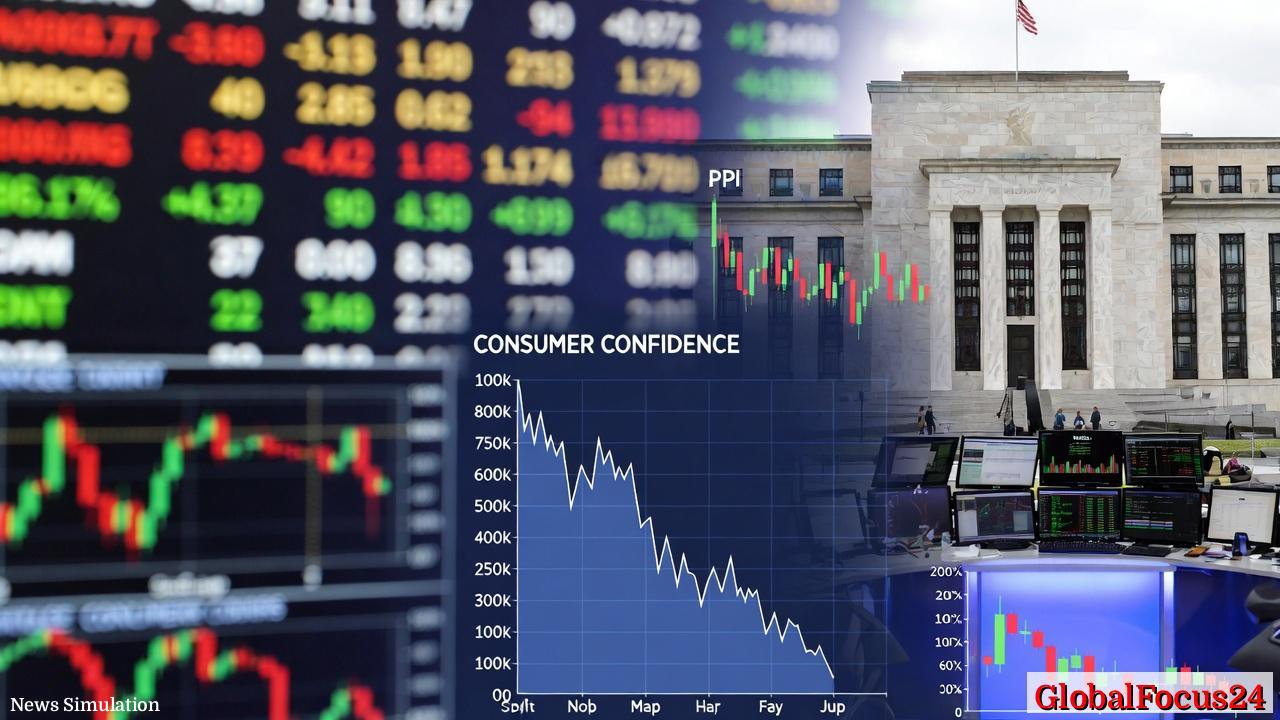
Global Markets Brace for Turbulent Week as Trade Policy, Earnings, and Data Drive Volatility
Investors face a packed economic calendar this week as the markets navigate a landscape of heightened uncertainty. A confluence of trade policy developments, earnings reports, and key macroeconomic indicators promises to keep volatility elevated for several days. Traders and analysts are watching a range of catalysts—from a newly announced global tariff to fresh readings on consumer sentiment and inflation—as they recalibrate risk positions and sector exposures.
Global tariff shock reshapes trade and prices On Monday, the global trade policy arena shifts with the implementation of a 15% tariff across a broad set of goods. The move arrives at a moment when supply chains remain sensitive to policy changes, and it creates ripple effects across manufacturing, logistics, and consumer prices. In the near term, import costs are expected to rise for affected items, potentially pressuring margins for importers and downstream retailers. Economists underscore that the tariff may also accelerate shifts in production geography as firms explore alternatives to mitigate cost increases, possibly boosting investment in regions with competitive labor and robust supply networks.
Historical context anchors the moment. Tariff policy has long served as a blunt instrument to influence trade flows, but it often carries lags and unintended consequences. Previous episodes have shown that after an initial adjustment period, markets tend to price in the policy while macroeconomics—growth, inflation, and employment—respond over quarters rather than days. The current move, combined with ongoing geopolitical considerations and domestic policy debates, heightens the risk of short-term volatility as participants reassess supply chains, currency values, and industry-specific exposure.
Economic impact set against regional breadth The tariff schedule is not uniform across all regions, but the global scope means many economies will feel the effects indirectly through price signals, input costs, and demand shifts. In consumer markets, higher import costs may feed into retail prices, potentially altering consumer purchasing power and confidence. For businesses, the policy can alter hedging strategies, inventory decisions, and capitalization plans, particularly in sectors with high import content or exposed international supply lines.
Regionally, the impact will be uneven. Countries with large manufacturing bases and integrated export-oriented sectors may experience more pronounced adjustments in trade balances and industrial activity. Conversely, economies with diversified production and strong domestic markets may demonstrate more resilience, though they still face the challenge of import price pressures. Analysts suggest that currencies in trade-sensitive regions could exhibit increased volatility as traders reassess relative competitiveness and risk premia.
Tuesday’s consumer confidence snapshot in focus February consumer confidence figures due Tuesday will provide a gauge of household sentiment amid policy shifts and inflation dynamics. Confidence data matter not only for consumer spending now but also for the trajectory of personal consumption expenditures, which constitute a substantial share of economic activity. Historically, confidence measures have shown intermittent correlation with near-term consumption, but they can also signal turning points when households adjust expectations about future income, employment prospects, and interest rates.
The interplay between confidence and policy is nuanced. If sentiment remains buoyant despite tariff developments, consumer spending could prove more resilient, helping cushion some of the fiscal and monetary transmission channels. If confidence wavers, discretionary spending could soften, amplifying concerns about growth momentum. Retailers, manufacturers, and service providers will monitor the release closely as they calibrate inventory levels and promotional strategies.
Nvidia earnings: a tech sector benchmark On Wednesday, Nvidia reports quarterly results that are closely watched by market participants for insights into demand dynamics in semiconductors, artificial intelligence, and data center spending. The company’s performance is often interpreted as a proxy for the health of a high-growth technology ecosystem, given its role in AI workloads, hyperscale cloud deployments, and enterprise software innovations. Traders will scrutinize not onlyearnings and revenue but also guidance on market demand, supply chain constraints, and pricing trends for advanced chips.
Beyond company-specific factors, Nvidia’s results can inform broader sector sentiment. A robust quarter could reinforce optimism about technology capex cycles and the AI revolution, potentially supporting equities across the sector. Conversely, signs of demand softening or margin pressure could temper enthusiasm and influence risk sentiment in related industries such as software services, hardware manufacturers, and data infrastructure providers.
Jobs and inflation data on the horizon Initial jobless claims come Thursday, offering another window into the labor market’s health. The pace of new claims and the overall trend in unemployment help shape expectations for wage growth, consumer spending, and Federal Reserve policy. In a framework where central banks closely monitor labor market tightness as a barometer of inflation risks, the claims data can tilt short-term rate expectations and market positioning.
Friday brings January producer price index inflation numbers, a crucial indicator of wholesale inflation pressures. The PPI, together with other inflation measures, feeds into the assessment of price dynamics at the production level and helps analysts gauge the persistence of inflationary pressures across industries. A softer-than-expected PPI could bolster hopes for a cooling inflation trajectory, while a stronger print might reinforce concern about sustained price gains and the need for policy restraint or adjustment.
A calendar of central bank voices adds to the narrative Adding to the complexity, eleven Federal Reserve speakers are slated to address audiences across the week. The cumulative tone and content of these speeches can influence market expectations about the trajectory of interest rates, the balance of risks to the economic outlook, and the Fed’s willingness to adjust policy in response to incoming data. Market participants will be listening for nuanced signals on inflation expectations, labor market conditions, and the pace at which the central bank sees room to maneuver in policy settings.
Historical patterns and forward-looking implications The week’s confluence of tariff implementation, consumer sentiment data, corporate earnings, labor metrics, inflation indicators, and central bank commentary recalls historical episodes where policy shocks and data surprises triggered meaningful shifts in risk appetite. Investors often recalibrate portfolios by reassessing exposure across cyclicals, defensives, growth, and value plays in light of evolving macro signals. The balance between a supportive macro backdrop—characterized by steady domestic demand and controlled inflation—and external policy shocks will be critical to the direction of equity and bond markets.
Regional comparisons illuminate diverging paths In major markets around the world, responses to the tariff environment and domestic data releases are likely to diverge. Economies with robust export orientations and diversified manufacturing bases may experience pronounced adjustments in trade flows, while consumer-centric economies could see sentiment and retail activity driving short-term fluctuations. Currency movements will also reflect relative policy expectations and trade dynamics, with investors scanning for safe-haven assets in times of heightened uncertainty and rotation into areas with resilient growth prospects.
Sector-by-sector implications
- Industrials and manufacturing: Tariff-driven input cost pressures and potential supply chain realignments could affect capital expenditure, project timelines, and inventory management.
- Technology and AI: Nvidia’s earnings provide a lens into demand for advanced chips and AI infrastructure, with broader implications for software, cloud services, and data center ecosystems.
- Retail and consumer goods: Retail price transmission from import costs may influence consumer purchasing behavior and margins, particularly in discretionary categories.
- Energy and materials: Global policy shifts can impact commodity demand dynamics, with potential knock-on effects for energy markets and raw materials pricing.
- Financials: Market volatility surrounding policy announcements and data surprises can broaden spreads, influence liquidity conditions, and shape investment strategies.
Public reaction and the behavioral backdrop Public reaction to tariff implementations and the week’s data releases tends to reflect a mix of concern about price changes and optimism about long-term economic resilience. Industry groups may voice apprehension about supply chain disruption and competitiveness, while investors weigh the potential for policy clarity and monetary accommodation. The tone of press coverage and market commentary often oscillates between caution driven by uncertainty and confidence grounded in underlying economic fundamentals, creating a dynamic backdrop for decision-making across households, businesses, and institutions.
Looking ahead: what to watch next
- Policy clarity: Any updates or clarifications on tariff exemptions, timing, and scope could stabilize or further disrupt markets depending on the direction.
- Data surprises: A deviation from consensus in consumer confidence, jobless claims, or producer prices could tilt near-term market expectations for growth and inflation.
- Earnings trajectory: Nvidia’s results and other earnings reports in the coming weeks will shape perceptions of technology demand, corporate health, and capital spending cycles.
- Monetary policy signals: Central bank commentary and upcoming macro data will influence interest rate expectations and financial conditions, affecting equity valuations and fixed income portfolios.
Conclusion As investors navigate a week packed with critical data points and policy developments, the overarching themes are adaptability and vigilance. The 15% global tariff introduces a policy shock with wide-reaching implications for prices, supply chains, and investment decisions. Concurrently, fresh readings on consumer confidence and inflation, coupled with Nvidia’s earnings and an array of Federal Reserve voices, set the stage for a highly volatile environment. In this landscape, informed risk management, diversified exposures, and a clear view of relative sector dynamics become essential tools for participants—whether steering portfolios, managing corporate strategies, or assessing broader economic resilience.