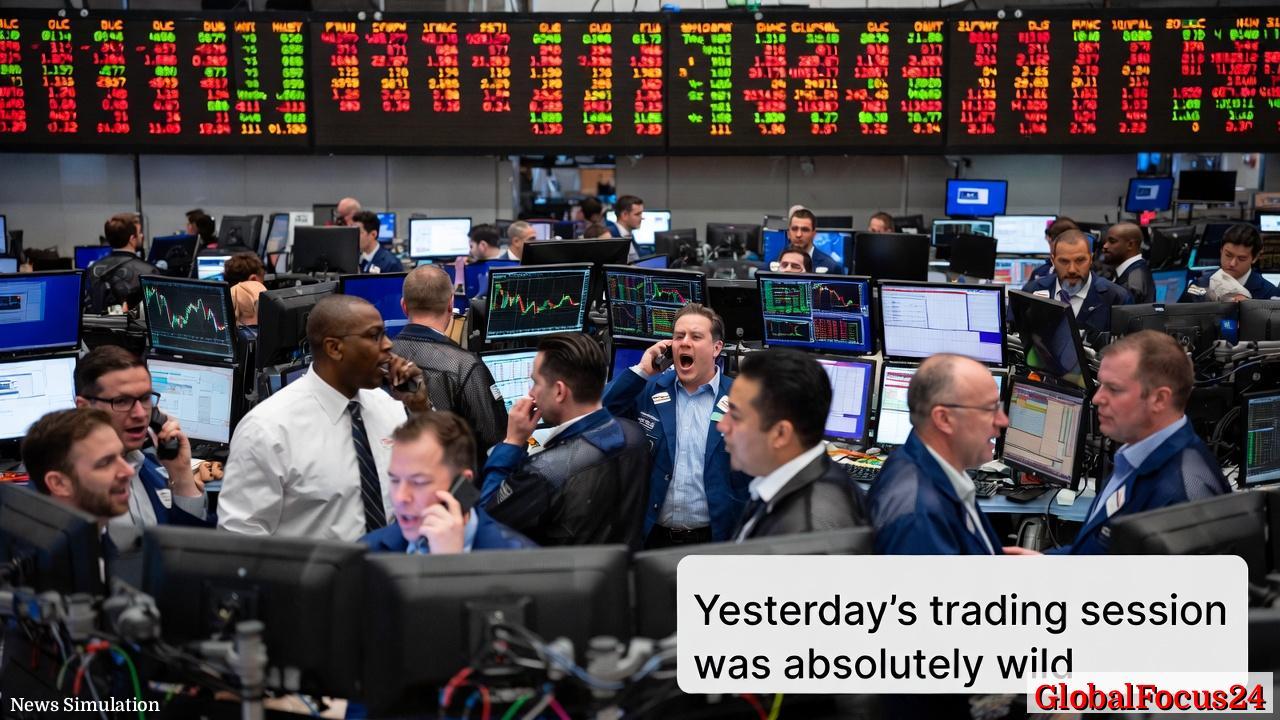
Long-Only Funds Dump $9.6 Billion in U.S. Stocks Amid Historic Market Rout
Investors Trigger Record Sell-Off as Market Turbulence Spreads
In one of the most dramatic market sessions in recent memory, long-only funds offloaded a record-shattering $9.6 billion in U.S. equities during Thursday morning’s sell-off — the largest single-day liquidation ever recorded. The move, described by market analysts as a 5-sigma event — a statistical rarity that almost never occurs under normal conditions — underscores a surge in investor panic not seen since mid-2025.
The previous record of $8.7 billion was set on July 31, 2025, amid fears of an economic slowdown and shifting Federal Reserve policy. Thursday’s decline exceeded that by nearly $1 billion, signaling the extent to which institutional investors are retreating from risk amid deteriorating sentiment across global markets.
Unprecedented Scale and Speed of Selling
According to preliminary flow data from investment tracking firms, every major sector came under pressure, with Technology, Consumer Discretionary, and Industrials leading the exodus. These sectors, traditionally sensitive to interest rate expectations and economic momentum, saw widespread redemptions as funds reassessed their growth assumptions for the remainder of 2026.
Portfolio managers described the selling as “indiscriminate,” with automated systems amplifying downward momentum as stop-loss levels were triggered across major indices. The S&P 500 fell sharply in the morning session before paring some losses later in the day, while the Nasdaq Composite and Dow Jones Industrial Average both recorded their steepest intraday drops since last autumn.
Historical Context: Echoes of Past Market Shocks
The magnitude of Thursday’s fund outflows draws comparisons to previous market dislocations. The COVID-19 crash in March 2020, the inflation-driven rout of 2022, and the liquidity squeeze of mid-2025 each tested investor confidence — but few episodes have matched this week’s combination of scale, speed, and cross-sector breadth.
Analysts note that while $9.6 billion may appear small in relative terms against trillions in overall U.S. market capitalization, the rate at which that capital exited underscores a liquidity crunch. In earlier decades, even half such an outflow might have triggered circuit breakers or emergency interventions. Today’s market structure, dominated by algorithmic and passive trading strategies, can magnify the impact when traditional investors suddenly move to cash.
“The density of selling points to deep stress in institutional positioning,” said one New York-based strategist. “What’s remarkable is how synchronized the move was — there was nowhere to hide.”
Sector Breakdown: Tech Leads the Retreat
Technology stocks bore the brunt of the sell-off, reflecting broad investor unease about high valuations and slowing corporate earnings growth. Several megacap firms that drove the 2025 rebound saw accelerated selling as hedge funds and mutual funds liquidated large positions.
The Consumer Discretionary sector followed closely, with investors rotating away from cyclical names exposed to weakening household spending. Retailers, travel platforms, and automotive manufacturers suffered sharp declines. Meanwhile, Industrial stocks fell on concerns that global manufacturing demand is softening amid sluggish overseas growth.
Energy stocks, by contrast, experienced only moderate outflows, buoyed by stable crude oil prices and a flight to real asset-linked investments. Defensive sectors like Utilities and Health Care recorded smaller declines, as fund managers sought partial shelter from volatility.
Global Context: Regional Divergences Emerge
Markets in Europe and Asia mirrored U.S. declines but not with the same intensity. The Stoxx 600 in Europe closed down modestly as investors awaited further signals on the European Central Bank’s rate path, while Asian indices such as Japan’s Nikkei 225 and Hong Kong’s Hang Seng saw limited spillover earlier in the global trading day.
This divergence reflects differing regional fundamentals. The U.S., where corporate earnings have recently slowed after several quarters of expansion, may be entering a more volatile phase as investors recalibrate expectations for Federal Reserve policy. European and Asian markets, having already priced in slower growth, appear less susceptible to abrupt portfolio shifts for now.
Still, international fund managers cautioned that sustained U.S. weakness could eventually ripple outward, tightening global liquidity and pressuring risk assets worldwide.
Investor Sentiment Turns Deeply Bearish
By late Thursday, market sentiment gauges showed a dramatic swing toward bearish territory. Surveys tracking investor mood pointed to the lowest optimism levels since early 2023, when inflation fears last dominateds. Volatility indices spiked, and put-to-call ratios reached multi-month highs — signals consistent with investors bracing for continued turbulence.
“This isn’t just a technical shakeout; it’s a psychological one,” said a senior risk officer at a leading asset management firm. “The appetite for risk is collapsing faster than the market itself.”
Economic Implications and Policy Watch
The economic reverberations of such a large-scale sell-off extend beyond the markets. Consumer confidence, already fragile due to fluctuating interest rates and uneven job growth, could face renewed pressure if equity losses persist. Lower portfolio values often translate into reduced household spending, which accounts for nearly 70% of U.S. GDP.
Economists warn that if this pattern endures, the recent signs of a soft-landing scenario could waver. Corporate executives, fearing slower demand, might cut back on hiring or capital expenditures, creating a feedback loop that further dampens growth prospects.
Policymakers are monitoring developments closely. While the Federal Reserve has maintained its measured approach in recent months, futures markets now price higher odds of a rate cut later this year, assuming inflation continues to ease. However, officials are likely to weigh the risks of re-stimulating asset bubbles against the need to stabilize confidence.
Long-Only Funds Under Pressure
For long-only funds — which typically hold stocks for extended periods and avoid short positions — Thursday’s exodus reflects both strategic rebalancing and forced repositioning. Facing redemptions and internal risk limits, many managers opted to trim exposure across the board rather than selectively.
Such funds, often representing pension plans and retirement accounts, have historically provided a steadier hand during volatility. Their participation in this sell-off, however, highlights the unusual depth of market anxiety. “When long-only money becomes the marginal seller, it’s a sign nerves have truly frayed,” said a veteran portfolio consultant in Boston.
A Statistical Outlier: Understanding a 5-Sigma Event
The characterization of the sell-off as a 5-sigma event underscores its mathematical improbability. In financial terms, a movement of this magnitude should statistically occur less than once in several million trading days — effectively, a “black swan” moment in the normal distribution of market returns.
While not all investors interpret sigma levels literally, the label captures the sheer extremity of the move. It suggests a market environment where traditional models of risk and correlation may fail to predict outcomes, heightening the need for caution and adaptive risk management.
Lessons from Previous Market Shocks
Looking back, similar moments of capitulation have sometimes marked turning points rather than long-term collapses. During the dot-com crash of 2000, panic selling created entry opportunities for patient investors. Likewise, the 2020 pandemic plunge was followed by one of the fastest recoveries in stock market history, fueled by aggressive stimulus measures.
Whether this week’s record liquidation signals a comparable inflection point remains unclear. Analysts are divided: some see capitulation as a potential precursor to stabilization, while others warn that technical damage and persistent macro uncertainty argue against a quick rebound.
Outlook: Can Stability Return?
Market historians note that extreme outflows often precede rebounds once forced selling subsides. However, the path to recovery depends on broader economic conditions. If inflation remains contained and earnings stabilize, investors could regain confidence in the second half of 2026. Conversely, any hint of renewed inflation or weaker corporate guidance could keep volatility elevated through year-end.
For now, the lesson of Thursday’s record-breaking sell-off is clear: risk appetite can evaporate rapidly even in the world’s most liquid markets. Despite years of resilience, the fundamental psychology of investing — oscillating between fear and greed — continues to drive cycles that challenge both models and nerves.
As one fund manager observed amid the chaos: “The market always finds new ways to remind us that certainty is an illusion.”