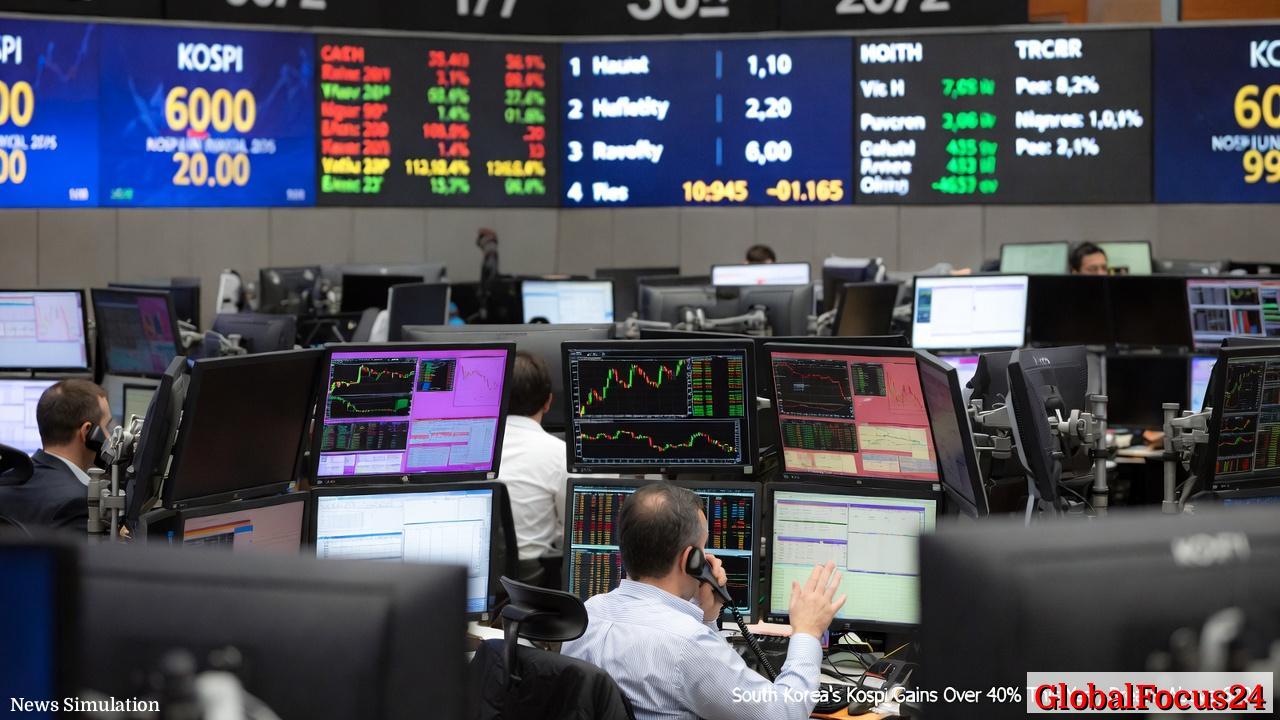
South Korea’s Kospi Surges Over 40% to Clear 6,000 as Tech Revival Drives Market Rally
In a striking testament to resilience and renewed investor confidence, South Korea’s Kospi index closed above the 6,000 mark for the first time this year, posting a gain of more than 40% since the start of the calendar year. The milestone underscores a broad-based rally centered on technology and export-oriented sectors, with semiconductors leading the pack and weighing on regional rivals in Asia-Pacific markets. As traders recalibrate expectations around global demand, the Kospi’s ascent reflects a mix of favorable macro cues, corporate earnings strength, and renewed appetite for high-tech equities that have benefited from a more accommodative global financial backdrop.
A notable acceleration in the market’s ascent stems from the semiconductor sector, long a bellwether for the Korean equity landscape. Companies that design, manufacture, and supply key chips have benefited from a combination of robust data-center spending, revival in consumer electronics demand, and ongoing investments in advanced manufacturing processes. The sector’s performance has a cascading effect on the broader market, given the sector’s heavy weighting in the Kospi and the broader perception of Korea as a technology powerhouse with deep supply-chain capabilities. In parallel, manufacturing, automotive components, and renewable energy equipment have shown improved operating momentum, contributing to the index’s resilience amid global macro volatility.
Historical context helps illuminate why the Kospi’s current trajectory matters. From its mid-2010s highs and subsequent volatility, the market has consistently reflected Korea’s economic pivot toward knowledge-intensive industries and export competitiveness. The Kospi’s sensitivity to global trade dynamics is well-documented; however, periods of sustained gains often coincide with breakthroughs in semiconductor end markets, memory pricing stabilization, and the health of global consumer electronics cycles. The 2024-2025 period featured a complex mix of supply-chain normalization, currency movements, and interest-rate expectations that tested investor patience. The current surge suggests a renewed alignment between corporate earnings expansion and investor appetite for risk within a favorable external environment.
Economically, the implications of a 40% year-to-date leap in the Kospi extend beyond daily price movements. A rising equity market can bolster consumer and business confidence, potentially spurring higher equity-based compensation take-ups, improved pension fund allocations, and greater access to capital for expansion plans. For conglomerates and mid-sized exporters alike, a higher index level can smooth the path to financing for research and development, capacity upgrades, and strategic acquisitions that strengthen competitive positioning. Yet the market’s upside is tempered by the need to monitor valuation levels, the persistence of supply-chain constraints, and external shocks that could recalibrate risk premiums.
Regional comparisons offer a useful lens for assessing the Kospi’s performance in a broader context. Across Asia, several major benchmarks have shown varying degrees of resilience amid regional fiscal and monetary support. In some markets, tech-heavy indices have tracked closely with the Korean experience, benefiting from synchronized cycles in semiconductors and consumer electronics demand. In others, concerns about regulatory shifts, inflationary pressure, or political uncertainty have created more tentative price action. For investors, comparing Koreas’s market behavior to its neighbors helps gauge the relative strength of export-led growth versus domestic consumption dynamics, and highlights the role of global supply chains in shaping market sentiment.
From a sectoral perspective, the strength of semiconductors remains the defining feature of the Kospi’s current rally. Chipmakers, equipment suppliers, and foundries have rallied on expectations of sustained long-term demand, particularly in high-performance computing, data centers, and 5G-enabled infrastructure. The spillover effect benefits ancillary industries such as display technology, electronic components, and software ecosystems that enable chip-enabled solutions. Investors also watch for signs of cyclical recovery in traditional manufacturing, autos, and energy sectors, where improved profitability can contribute to broader index strength. The evolving mix of gains and leadership within the Kospi will be watched closely by market participants seeking to understand the sustainability of the rally.
GDP growth prospects and external demand indicators remain important for validating the market’s optimism. South Korea’s economy has benefited from a normalization of global trade flows, improving export orders, and a comparatively resilient manufacturing base. With consumer sentiment improving and employment trends favorable, domestic demand supports the broader growth narrative, even as the external environment continues to pose uncertainty. Analysts note that the health of supply chains, exchange rate stability, and inflation dynamics will influence future capital allocation decisions, including whether investors view the current price levels as the beginning of a longer horizon of expansion or a temporary surge.
Corporate earnings trajectories play a pivotal role in sustaining momentum. Companies reporting profits that exceed expectations—especially in sectors tied to technology, electronics, and automotive components—can reinforce investor confidence and attract new capital. Conversely, if earnings deliveries disappoint or guidance weakens, market volatility can resurface. In the current climate, investors are placing increased emphasis on gross margins, capital expenditure efficiency, and product diversification strategies that reduce exposure to any single market cycle. The ability of firms to translate research and development investments into marketable products will shape the next phase of the Kospi’s performance.
Public reaction to the rally has been nuanced. Some investors celebrate the milestone as a sign of structural strength in Korea’s high-tech economy and a favorable inflection point for savings and investment. Others warn that rapid gains can lead to overhang risks, particularly if global liquidity conditions tighten or if geopolitical tensions affect supply chains. Financial commentators have urged a balanced approach to risk, recommending diversified exposure across sectors and regions while keeping an eye on macro indicators such as inflation, interest rates, and currency movements. The consensus underscores a cautious optimism: a rising market can stimulate more robust capital formation, but it should be accompanied by prudent risk management and long-term strategic planning.
Market mechanisms and policy signals also shape the trajectory of the Kospi. Local financial authorities monitor liquidity conditions, corporate governance standards, and market integrity as critical elements that support broader participation from domestic and international investors. While monetary policy in the region has influenced risk appetite, the broader narrative emphasizes structural advantages—South Korea’s advanced manufacturing base, skilled labor force, and robust R&D ecosystem—that can sustain a competitive edge in global markets. The interplay between policy normalization, fiscal incentives for technology-intensive industries, and private investment will be watched closely as the market seeks to extend gains into the second half of the year.
Looking ahead, analysts offer a range of scenarios for the Kospi’s path. A continued tech-driven rally would likely hinge on sustained demand for semiconductors, favorable global capex cycles, and continued innovation in related sectors such as artificial intelligence, cloud computing, and green technologies. On the other hand, a moderation in growth, tighter financial conditions, or a shift in global risk sentiment could reorient investors toward defensives or value-oriented segments. In either case, the market’s resilience will depend on corporate earnings quality, effective execution of growth strategies, and the ability of Korea’s exporters to adapt to evolving global trade patterns.
Regional investment patterns are shifting in tandem with the Kospi’s ascent. Domestic investors, including life insurers and institutional funds, have shown a preference for high-growth names with scalable business models. International funds, attracted by Korea’s technology leadership, have added exposure to names tied to memory, logic devices, and components that power a broad spectrum of digital applications. For traders, this broader participation supports liquidity and can help stabilize prices during periods of volatility, though it also means that global sentiment can translate quickly into price movements across the index.
As the market closes above the coveted threshold, the broader implications for South Korea’s financial markets are worth noting. A sustained move beyond 6,000 could attract attention from forward-looking investors, who may anticipate a longer-term upward trend contingent on earnings visibility and macro stability. The milestone also highlights the importance of ongoing innovation ecosystems, including government-backed research initiatives, private-sector collaboration, and international partnerships that help keep Korea at the forefront of semiconductor development and high-tech manufacturing.
In sum, the Kospi’s sharp ascent past the 6,000 level signals more than a numerical achievement. It reflects a confluence of factors—technological leadership, improving global demand for electronics and related services, and a domestic market that prizes innovation and efficiency. While risks remain—from global macro shifts to geopolitical uncertainties—the current momentum suggests a market environment where growth-oriented equities, particularly those tied to the technology supply chain, can continue to drive upside. For observers, the question is how long this rally can endure and what new catalysts will emerge to sustain investor enthusiasm in the months ahead.