South Korea’s Exports Jump in Early February, Driven by Semiconductors and Global AI Demand
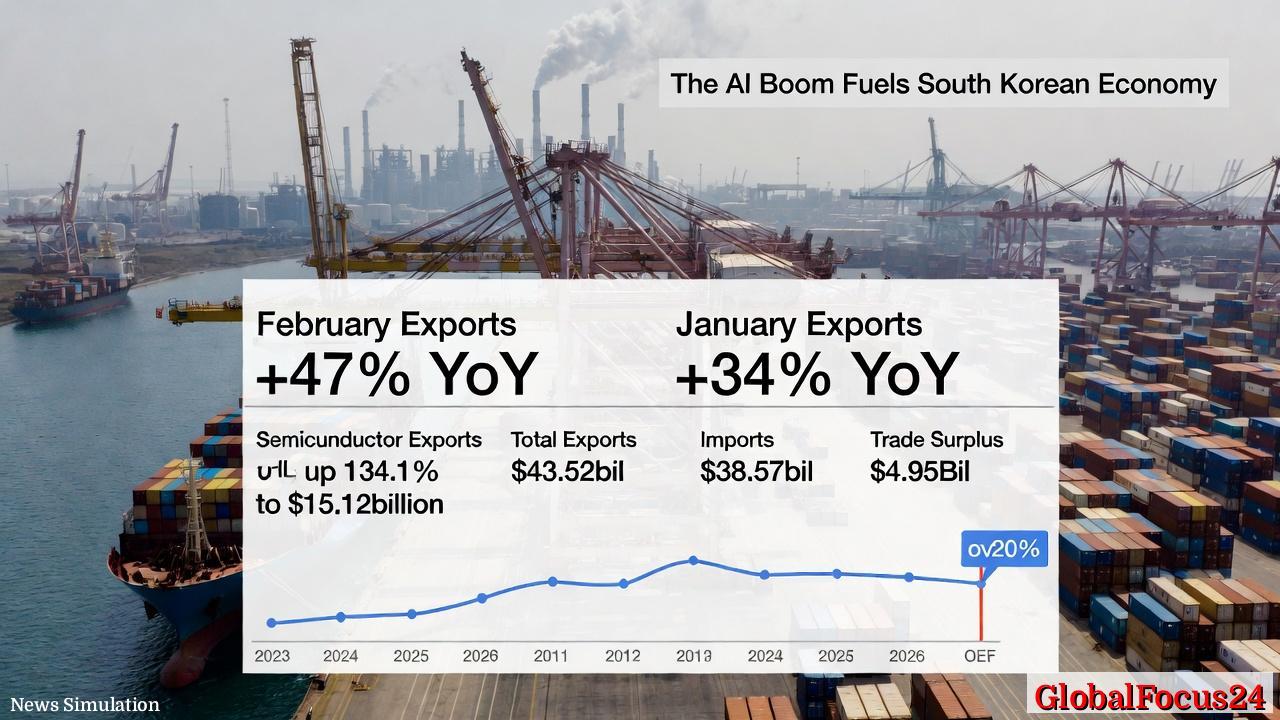
South Korea’s export engine roared back to strength in the first half of February, with customs data showing a sharp year-on-year pickup and a continued reliance on semiconductors as a key growth pillar. In the first 20 days of February, shipments rose 23.5% year-on-year to $43.52 billion, while working-day adjusted figures indicated an even more robust gain of 47.3% in average daily exports, reaching $3.35 billion. This pace places early February among the strongest readings in several years, underscoring both resilience and renewed momentum in Korea’s outward-facing economy.
Historical context: a history of export resilience South Korea’s export performance has long been tied to global demand cycles, industrial composition, and exchange-rate dynamics. The country’s export model, built on high-value manufacturing and integrated global supply chains, has historically counted semiconductors, automotive parts, and consumer electronics among its most important export categories. The February data continue a notable sequence: January exports posted a record $65.85 billion, up 33.9% year-on-year, with semiconductors more than doubling from a year earlier. Taken together, the January-February trajectory points to a persistent, albeit volatile, trend of export strength that outpaces broader regional trade activity.
The semiconductor story: AI demand as a decisive driver Semiconductors dominated Korea’s early-February shipments, surging 134.1% year-on-year to $15.12 billion and accounting for 34.7% of total exports. This sector’s strength reflects a global wave of AI-related computing demand, data center expansions, and new generation chip deployments across cloud services, enterprise IT, and consumer devices. The year-over-year acceleration in semiconductor exports widened the share of total exports allocated to chips by roughly 16 percentage points from the previous year, illustrating how pivotal AI-driven demand has become for Korea’s external sector.
Beyond semiconductors: a broader export mix and regional performance While the semiconductor cycle is thedriver, other Korean export categories contributed to the overall gain. Components, electronics, and precision machinery have also benefited from global supply-chain normalization and ongoing capital expenditure by multinational manufacturers. The February figures suggest that Korea’s export recovery is not solely a one-off semiconductor spike but part of a broader revival in technology-intensive industries.
In terms of regional performance, Korea’s export landscape continues to reflect diversified demand across major markets. The United States remains a steady consumer of Korean technology and components, while Europe’s industrial sectors show resilience in energy-intensive machinery and automotive-related shipments. Asian markets, including China and Southeast Asia, have provided both challenges and opportunities as regional supply chains recalibrate amid ongoing normalization efforts. The February data indicate that even amid scattered global trade tensions, Korea’s export engine remains capable of delivering solid gains when global demand for high-tech goods is robust.
Import dynamics and the trade balance Imports rose 11.7% year-on-year to $38.57 billion in the same period, narrowing but not erasing trade challenges faced by downstream industries reliant on global supply chains. The upturn in imports, coupled with stronger export performance, generated a trade surplus of $4.95 billion for the 20-day period. This surplus underscores Korea’s continued ability to finance imports of essential capital goods and intermediate materials while maintaining a favorable external balance, a feature that supports macroeconomic stability and investment sentiment.
Economic implications: growth signals and policy considerations The early-February export surge sends a positive signal about Korea’s external demand environment and the endurance of its manufacturing base. A sustained runway of growth in high-value exports, especially semiconductors, could bolster GDP growth prospects for the first half of the year and contribute to confidence among exporters and investors. However, policymakers will likely remain vigilant about external risks, including potential shifts in global AI investment cycles, semiconductor supply dynamics, and currency fluctuations that could influence competitiveness and earnings.
From a policy perspective, the data reinforce the importance of maintaining a supportive environment for advanced manufacturing and R&D investment. Measures that bolster semiconductor supply chains, protect intellectual property, and facilitate export finance can help sustain the momentum. Additionally, ongoing diversification of export markets and product lines remains a prudent strategy to mitigate risk if demand in any single sector or region falters.
Regional comparisons: how Korea stacks up against peers Against regional peers in East Asia, Korea’s export strength in February demonstrates a resilient performance amid a landscape of uneven growth. While some economies rely more heavily on raw materials or lower-value-added goods, Korea’s emphasis on high-tech components and precision machinery positions it to capitalize on global digitalization trends. In contrast to commodity-exporting neighbors, Korea’s sensitivity to global demand for semiconductors and data-center equipment underscores its exposure to technology cycles but also its potential for outsized gains when AI and cloud infrastructure investments accelerate.
Supply chain context and global demand dynamics The February data come at a moment when global supply chains are adjusting to post-pandemic normalization and the rapid expansion of AI infrastructure. Semiconductor manufacturers have benefited from expanding data-center capacity, with cloud service providers and enterprise IT departments accelerating capex. This environment supports elevated chip prices and volume, particularly for memory and AI-accelerator segments. For Korea, a nation with deep ties to semiconductor fabrication and design, the takeaway is clear: global AI-led demand translates into tangible export growth and improved current account dynamics.
Market implications and investor sentiment For investors and markets, the early-February surge in exports could translate into more stable macroeconomic expectations and improved confidence in export-oriented sectors. If the momentum continues, it may influence exports forecasts, import needs, and currency stability. However, the global economy remains susceptible to shifts in technology cycles, geopolitical developments, and trade policy changes that could reintroduce volatility to export earnings.
Public reaction and the broader narrative Public sentiment around Korea’s export performance typically hinges on job creation, wage growth, and the ripple effects of demand for high-tech goods across industries. A strong export cycle often feeds into manufacturing payrolls, supplier networks, and regional economic activity, supporting consumer confidence and local investment. As February data underscore, the health of the export machine is not just a statistic—it’s a signal of how global technology trends can shape everyday livelihoods in cities and towns across the peninsula.
Conclusion: a snapshot of resilience and opportunity The early February export data illuminate a story of resilience in South Korea’s external sector, anchored by a robust semiconductor cycle and a broader rebound in technology-intensive exports. With shipments up sharply on both annual and daily bases, Korea demonstrates its capacity to navigate global demand surges while managing import needs and preserving a healthy trade surplus. As global demand for AI, data processing, and digital infrastructure continues to grow, Korea’s export profile positions the economy to capture a meaningful share of this expansion, even as it remains exposed to the cyclical nature of tech demand and the uncertainties of international trade.
Key figures for reference
- Exports (first 20 days of February): up 23.5% year-on-year to $43.52 billion
- Working-day adjusted exports: up 47.3% to $3.35 billion per day
- Semiconductors exports: up 134.1% to $15.12 billion, 34.7% of total exports
- Imports: up 11.7% to $38.57 billion
- Trade balance: surplus of $4.95 billion
- Comparisons to January: January exports at a record $65.85 billion, up 33.9% year-on-year, with semiconductors more than doubling
Notes on context and trajectory
- The February performance follows a strong January, reinforcing a narrative of renewed momentum in Korea’s external sector.
- The semiconductor segment remains a central driver, reflecting global AI investment cycles and data-center expansion.
- Continued diversification of export destinations and products will be important to sustain growth and mitigate sector-specific risks.