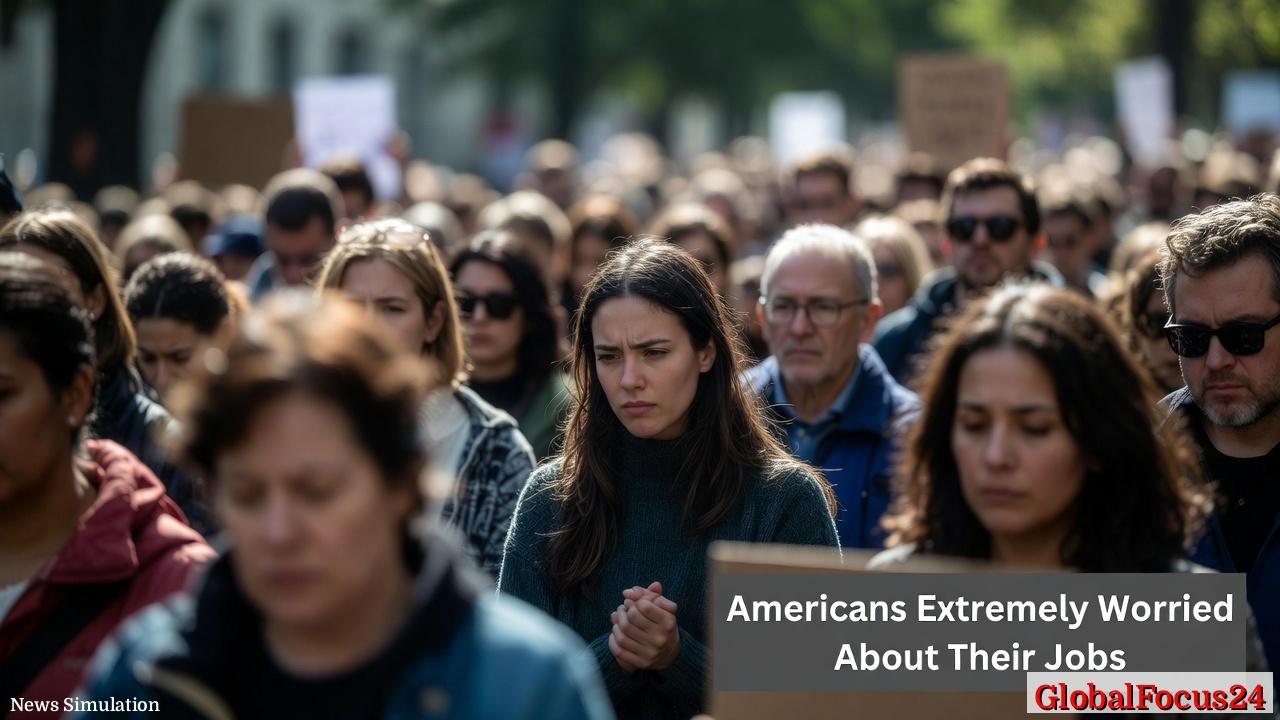
Americans Face Sharp Labor-Market Strains as Hiring Slows and Job-Finder Confidence Drops
Amid growing concerns over job security, the U.S. labor market is showing notable fragility. New indicators tracking hiring activity and job-transition confidence point to a cooling economy and heightened anxiety among workers about future employment prospects. Taken together, these signals sketch a clearer picture of a labor market that remains technically tight in some areas while exhibiting pronounced weakness in others, a combination that raises questions for policymakers, employers, and job seekers alike.
Historical context: a long arc of labor-market resilience tempered by episodic strain
The American labor market has long been characterized by cycles of expansion and contraction, yet the past decade has offered a unique blend of resilience and volatility. After the Great Recession, hiring rebounded into a period of relatively steady job growth, fueled by a mix of secular demand for advanced skills and a broadening of opportunities in consumer, technology, and service sectors. The COVID-19 shock upended that trajectory in 2020, but the labor market quickly recovered as vaccination campaigns progressed and fiscal measures supported demand. Since then, the pace of hiring has ebbed and flowed with the inflation trajectory, monetary policy normalization, and shifting global supply chains. The latest data, however, signals a shift toward slower job creation and increased difficulty for workers trying to move between roles.
Current indicators and what they imply
- Job-finder probability: The perceived likelihood that a worker who loses a job can find another within three months slipped to 44.0%, the second-lowest reading on record. This gauge, which captures public sentiment about re-employment prospects, reflects not only available vacancies but also perceived barriers to mobility, such as skill mismatches, geographic constraints, and concerns about income stability during job transitions. A decline of 12 percentage points since late 2024 points to mounting unease among households about the immediacy of securing new employment.
- Hiring activity: The hiring rate sits at 3.3%, a level not seen since the early phases of the 2008 financial crisis. This metric, which tracks the share of employers actively seeking new workers, underscores a slower pace of recruitment across industries. When hiring activity slows to these depths, the pool of open roles tends to shrink, and competition for available positions intensifies, particularly for midcareer workers and those in industries facing structural headwinds.
- Employer hiring plans: In the first two months of the year, employers announced plans to hire 18,061 people, a 56% drop from the same period a year earlier. This sharp decline signals caution among businesses about near-term demand, profitability, and the need to manage labor costs in a climate of mixed macro signals. Thefigure masks sector-specific dynamics, with some industries retrenching more aggressively while others maintain modest hiring momentum.
Regional and sectoral nuances
- Regional contrasts: Regions with concentrated exposure to cyclical industries—manufacturing, energy, and hospitality—may experience more pronounced hiring slowdowns during downturns. Conversely, areas with a growing tech-enabled services footprint or healthcare demand could see relative steadiness, albeit tempered by broader national trends. Urban centers historically anchor job creation with diversified economies, yet they also face elevated living costs that influence both employer hiring decisions and worker mobility.
- Sectoral dynamics: Traditional heavyweights in the job market—education, healthcare, and public administration—often exhibit steadier demand but can be constrained by budget cycles and policy changes. Cyclical sectors such as manufacturing and construction are more sensitive to interest-rate shifts and consumer demand, while technology-adjacent roles may face hiring pauses during periods of uncertainty or recalibration of project scopes.
Implications for households and policymakers
- Worker outlook and earnings potential: A softer job-finder probability, combined with slower hiring rates, tends to compress mobility-based wage gains. For workers, this can translate into longer job searches, wage stagnation in the near term, or a pivot toward industries with greater resilience or required skill development. For policymakers, the signal emphasizes the need for training and re-skilling programs, targeted wage subsidies, and support for geographic mobility to align labor supply with demand.
- Confidence versus reality: Public sentiment about re-employment prospects often lags or leads actual hiring trends. The current dip in job-finder confidence could become self-reinforcing if it dampens job applications, reduces labor force participation, or slows entrepreneurship, creating a feedback loop that exacerbates hiring freezes.
- Inflation and monetary policy context: Labor-market strength has historically influenced inflation dynamics and central-bank decisions. A deteriorating hiring environment complicates the inflation narrative: it could ease wage pressures in the short term but raise concerns about weaker demand and slower growth. Policymakers must balance price stability with the goal of maintaining broad-based employment opportunities.
Regional comparisons: how today’s trends stack up against peers and predecessors
- Domestic contrasts: Within the United States, metropolitan areas with robust higher-education ecosystems and diversified tech and healthcare sectors have tended to weather downturns better than regions heavily reliant on single industries. In this cycle, those diversified economies may still bear the burden of slower national demand, while more concentrated regions could experience sharper employment declines.
- International context: While this analysis centers on the United States, global labor-market patterns during economic slowdowns show similar tensions—weakening hiring activity, cautious employer outlooks, and rising concerns about retraining and job-switching. Comparisons across advanced economies highlight that labor-market adaptability, rather than sheer hiring momentum, is often the differentiator in sustaining growth during episodes of macro uncertainty.
Economic impact: what the numbers mean for growth, productivity, and living standards
- Growth trajectory: Persistent hiring softness and lower job-transition confidence can dampen household spending and investment, creating a drag on near-term GDP growth. Slower payroll gains, if sustained, may prompt revisions to growth projections and influence business planning across small and midsize enterprises, which historically drive a large share of employment gains.
- Productivity considerations: A weaker labor market can catalyze a focus on productivity-enhancing investments, automation, and reskilling. Firms may accelerate adoption of efficiency-enhancing technologies and training programs to compensate for slower headcount growth, potentially shaping the longer-run path of productivity and competitiveness.
- Living standards: For workers, slower job mobility and reduced hiring activity can affect wage dynamics and income growth. Regions with stronger social safety nets and access to retraining resources may cushion households from the worst effects, but nationwide, the trend underscores the importance of policies that support labor-market transitions without dampening incentives to work.
What to watch next: signals that could alter the outlook
- Vacancy and wage data: Continuous monitoring of vacancies and wage growth will help determine whether the slowdown is primarily a demand-side phenomenon or if supply-side frictions are intensifying. A gradual easing in wage growth could accompany a stabilizing or modestly improving job-finder outlook.
- Labor-force participation: Shifts in participation rates can either amplify or mitigate the effects of a cooling job market. An uptick in participation—through re-entry of workers who paused careers or through new entrants—could offset some of the negative impact on hiring.
- Policy actions: The trajectory of fiscal and monetary policy, targeted training programs, and regional employment initiatives will influence the degree to which the labor market can adjust to slower hiring and persistently tight labor costs.
Historical parallels: lessons from past downturns
- 2008 financial crisis: The early years of the financial crisis featured deep hiring freezes and prolonged recovery periods, with the labor market experiencing dramatic restructuring. While the current environment is not identical, the comparable depth of hiring slowdowns and cautious employer sentiment invites a cautious, data-driven approach to forecasting and policy design.
- Pandemic-era adjustments: The COVID-19 era introduced rapid shifts in demand and labor supply, accelerating the adoption of remote work, digitization, and new workforce arrangements. The present dynamics echo a return toward more traditional cycles, yet the lessons about retraining, mobility, and sectoral transitions remain highly relevant.
Public reaction and societal context: a shared moment of unease and resilience
Public sentiment reflects both concern for immediate job security and resilience in seeking opportunities through skill development and flexible career paths. Communities that have fostered robust retraining ecosystems—community colleges, workforce boards, and industry partnerships—are better positioned to absorb shocks, matching workers with in-demand roles as markets recalibrate. At the same time, households facing uncertainty may prioritize cost-of-living management, delayed purchases, and cautious financial planning, influencing consumer behavior and local economic conditions.
Conclusion: navigating a cautious horizon with informed policy and adaptive strategy
The latest labor-market indicators reveal a shift toward a more tempered employment landscape in the United States. Hiring activity has cooled, and the odds of finding a new job after a layoff have declined to near-historic lows, underscoring a climate of heightened caution for workers and businesses alike. Yet within this environment lies a path for adaptation: targeted retraining, geographic mobility support, and policy measures that align skill development with evolving demand can help sustain momentum in the long run. As the economy absorbs these shifts, the focus for policymakers, employers, and workers should be on practical steps that enhance resilience, support productive transitions, and maintain confidence in the broader labor-market trajectory.