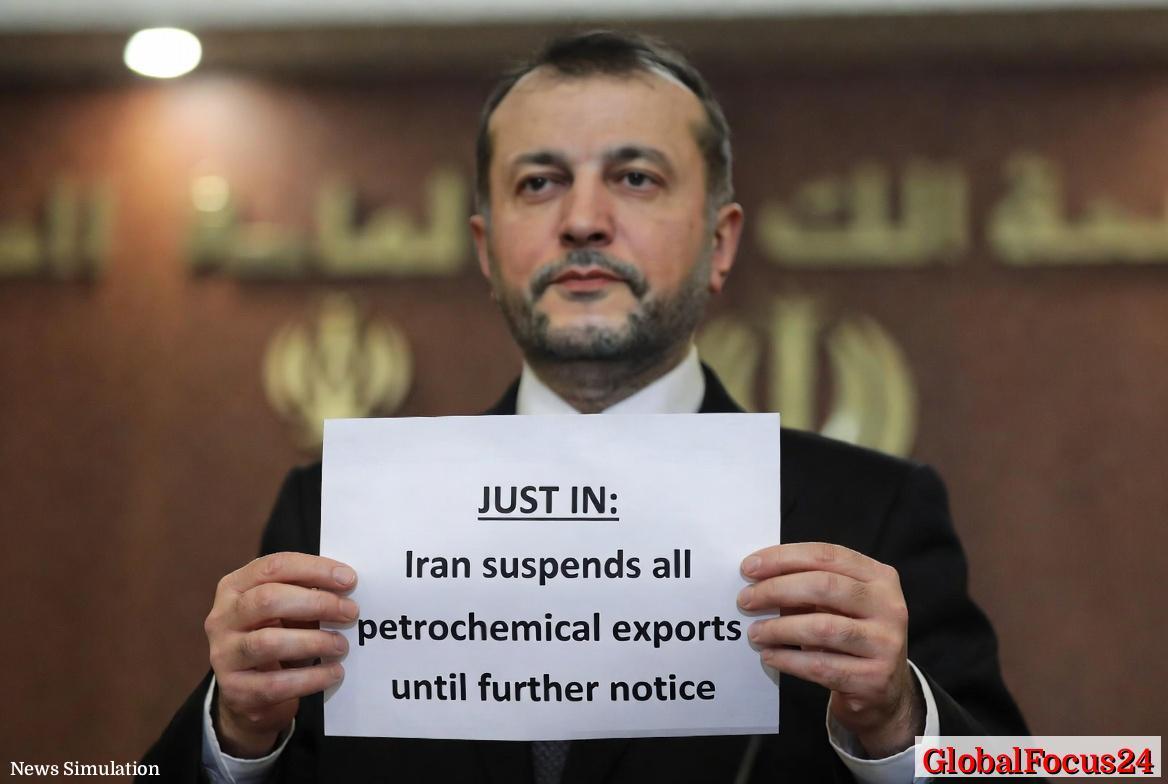
Iran Halts Petrochemical Exports Amid Escalating Regional Pressures
Tehran’s Sudden Suspension Sends Shockwaves Through Global Markets
Iran has abruptly suspended all petrochemical exports until further notice, a move that is sending ripples through global commodity markets and prompting concerns across Asia and Europe—two regions heavily reliant on Iran’s chemical and energy supplies. The announcement, issued late Tuesday by the Ministry of Industry, Mine, and Trade, cited “strategic national interests” and “temporary reorganization of supply chains” as the official reasons behind the halt, though analysts suggest that deeper geopolitical and economic pressures may be at play.
The suspension marks one of the most significant interruptions in Iran’s petrochemical trade in the past decade and raises questions about the availability and price stability of essential raw materials used across manufacturing, agriculture, and consumer goods industries.
The Petrochemical Industry’s Central Role in Iran’s Economy
Petrochemicals are a cornerstone of Iran’s non-oil economy. The country ranks among the top global producers, exporting billions of dollars’ worth of urea, methanol, polyethylene, and other downstream products annually. These exports have become a crucial source of foreign currency, especially as sanctions have constrained crude oil sales. In recent years, the petrochemical sector has served as a financial lifeline for Tehran, bolstering domestic revenue and sustaining industrial activity amid volatile global energy markets.
According to figures from the National Petrochemical Company, Iran produced more than 67 million tons of petrochemical products last year, with nearly half designated for export. The major buyers include China, India, Turkey, and several Southeast Asian countries. Interruptions of this scale are expected to significantly affect those supply relationships, particularly in a market already grappling with logistic bottlenecks and price inflation.
Regional Reactions and Market Response
Traders in Dubai and Singapore reported immediate volatility following Tehran’s announcement. Prices for methanol and other key derivatives saw rapid surges on spot markets, with some contracts spiking by more than 12 percent within hours. Shipping companies operating out of Iran's Bandar Imam Khomeini port stated that vessels scheduled for April loading had been instructed to halt operations pending new government directives.
China’s manufacturers, who rely on Iranian petrochemicals for plastics and textile materials, have expressed frustration over potential delivery delays. Indian fertilizer producers, who source large quantities of Iranian urea, face uncertainty about supplies ahead of the spring planting season—a critical period for the agricultural sector. European refiners, although less dependent than their Asian counterparts, are also on alert, particularly as they seek alternatives amid broader Middle Eastern shipping constraints.
Historical Context: A Pattern of Strategic Leverage
This is not the first time Iran has used its petrochemical exports as a strategic tool. In the early 2010s, amid tightening Western sanctions, Tehran adjusted exports to maintain leverage in international negotiations. Similarly, during previous regional tensions, temporary export restrictions have served as both economic recalibration measures and signals of strategic intent to external powers.
However, industry insiders emphasize that the current suspension appears broader and more sudden than previous measures, suggesting internal logistical or financial triggers alongside geopolitical ones. Iran has been undertaking a major overhaul of its domestic refining and processing infrastructure to add value to its hydrocarbon exports. The halt could be intended to redirect supplies to local industries or to ensure the completion of ongoing modernization efforts without draining inventory.
Economic Impact Within Iran
The immediate domestic effects may be mixed. On one hand, the suspension could limit foreign revenue inflows, potentially straining Iran’s already tight foreign exchange reserves. On the other, redirecting output for domestic use could benefit the country’s manufacturing and construction sectors, which have been hampered by material shortages and currency fluctuations.
Iran’s government recently announced plans to expand downstream chemical production by 2027, aiming to shift from raw material exports to higher-value industrial goods. A suspension of exports may fit into that broader industrial strategy, aligning short-term disruptions with long-term transformation goals. Yet, economic analysts caution that the policy could backfire if foreign buyers turn permanently toward competing producers in the Gulf, Russia, or Southeast Asia.
Global Supply Chain Consequences
The international implications of Iran’s decision are far-reaching. The petrochemical supply chain is a complex web where feedstock disruptions can trigger cascading effects. Products like polyethylene and methanol are essential for packaging, automotive parts, pharmaceuticals, and a host of other industries. Even short-term uncertainty can lead to inventory hoarding and contract renegotiations, intensifying pressure on prices.
Producers in Saudi Arabia and Qatar may benefit in the short term as buyers seek alternative sources in the Gulf. However, their output capacities are already near full, and any significant redirection of trade flows could take months. In East Asia, South Korea and Japan, though less reliant on Iranian supplies, may still face indirect effects through price linkages across regional markets.
Comparisons with Previous Disruptions
Historically, petrochemical supply interruptions—such as during the Gulf War in the early 1990s or the U.S. sanctions escalation of 2018–2019—have triggered sharp price increases and trade route reshuffling. Yet, those disruptions often led to new patterns of resilience. The 2019 restrictions, for instance, spurred major Asian buyers to diversify import sources, investing in domestic capacity and forging new partnerships in Central Asia and Africa.
This current halt could accelerate similar trends. India, for instance, has already initiated discussions with Saudi Arabia and Kuwait to secure additional volumes of urea and methanol. China, meanwhile, could ramp up domestic production, tapping into its growing coal-to-chemicals industry to replace Iranian imports. Such adjustments, while costly in the short term, may reduce long-term dependence on politically sensitive supply channels.
The Geopolitical Undercurrents
Although officials have avoided linking the export suspension to any specific external event, regional analysts note a convergence of pressures. The Persian Gulf has seen renewed tensions affecting maritime logistics, while global energy routes remain under strain due to security incidents in the Red Sea. In addition, ongoing disputes over payment mechanisms and sanctions compliance have complicated financial transactions for Iranian exporters.
Iran’s decision may therefore serve multiple objectives: recalibrating export strategies, asserting economic sovereignty, and signaling its ability to influence global markets despite ongoing restrictions. The timing—coming amid rising crude prices and widespread shipping uncertainty—suggests careful calculation by Tehran to maximize strategic impact.
Industry Perspectives and Forecasts
Industry experts anticipate that if the suspension lasts more than a few weeks, global markets could experience sustained price increases across several downstream sectors. Consultancy firms project that methanol and polyethylene prices could rise by up to 15 percent within a month if replacement supplies are not secured. Logistics disruptions may also intensify as importers reposition chartered vessels and reevaluate long-term contracts.
Within Iran, producers operating under the state-owned National Petrochemical Company have reportedly been instructed to prioritize domestic buyers during the suspension period. Industrial associations in Tehran have welcomed the move, arguing that local manufacturers have struggled for years to obtain these materials at stable prices due to export-driven shortages.
Broader Implications for Regional Economies
Iran’s decision comes at a time when Middle Eastern economies are seeking stronger industrial diversification. For neighboring exporters such as Saudi Arabia and the United Arab Emirates, the suspension could open short-term opportunities but also underscores regional exposure to political and logistical volatility. Meanwhile, Turkey—an important consumer of Iranian petrochemicals—faces potential challenges in maintaining its industrial output, particularly in plastics and synthetic fibers.
Beyond the Middle East, European markets are monitoring potential spillovers. As the continent navigates its own energy transition and dependence on imported petrochemical feedstocks, shifts in Gulf trade flows could influence longer-term investment decisions. The current uncertainty reinforces the need for diversified sourcing and strategic reserves, particularly for high-demand sectors like automotive manufacturing and construction materials.
Looking Ahead: A Tense Balance Between Strategy and Stability
The duration of Iran’s export suspension remains unclear. Officials in Tehran have provided no timeline for resumption, and traders anticipate a period of negotiation and recalibration before normal operations resume. Analysts suggest that any reinstatement of exports could be tied to benchmarks in domestic production targets or progress in regional diplomacy.
For now, the global chemical sector faces a renewed test of resilience. The situation underscores how deeply intertwined modern supply chains have become—and how swiftly a single national policy shift can affect prices, contracts, and strategic planning across continents. Whether the halt is a short-term maneuver or a prelude to a larger restructuring, its repercussions are already reshaping trade calculations from Shanghai to Rotterdam.
In a global market still recovering from years of pandemic and geopolitical turbulence, Iran’s move has added another layer of uncertainty—one that could redefine petrochemical trade flows for years to come.