Indiana Tops 12-Team Field as CFP Reveals Expanded Playoff Bracket for 2025-26 Season
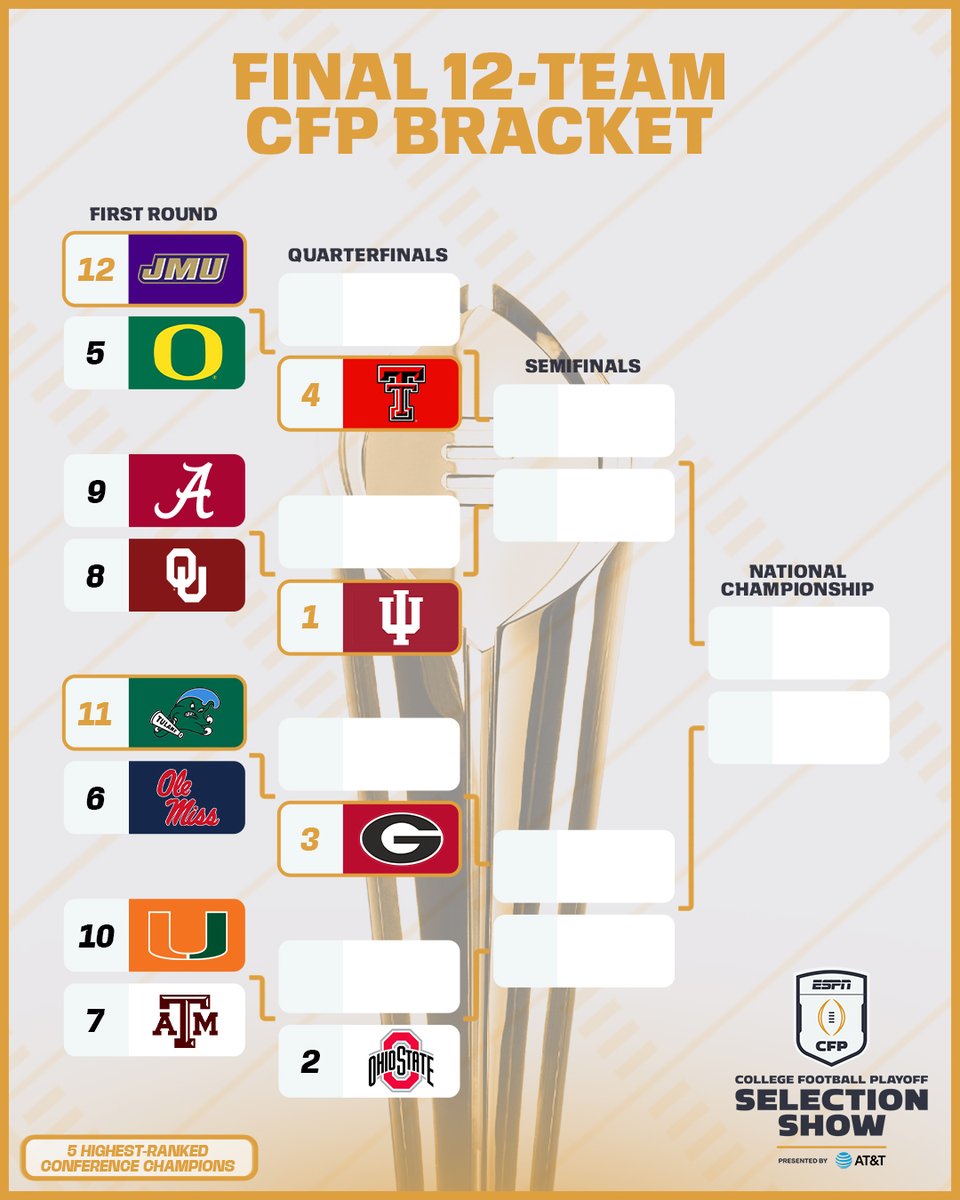
INDIANAPOLIS — The College Football Playoff selection committee unveiled the official 12-team bracket for the 2025-26 season on Sunday, marking the first full-year implementation of an expanded playoff format that includes the five conference champions plus seven at-large teams. Indiana University earned the No. 1 overall seed and a first-round bye after a dominant regular season, setting up a marquee quarterfinal matchup against the winner of No. 8 Oklahoma and No. 9 Alabama. Other top seeds—Ohio State at No. 2, Georgia at No. 3, and Texas Tech at No. 4—also earned byes into the quarterfinals.
The new structure, designed to reward regular-season performance and conference champions alike, expands the field in a move that continues a broader shift in college football toward more late-season meaningful games and a fuller national tournament atmosphere. The bracket was announced during a late-munday telecast from the CFP headquarters, accompanied by a broader analytics briefing that highlighted the committee’s emphasis on strength of schedule, wins against quality opponents, and a balance between traditional powerhouses and competitive mid-major programs.
First-Round Schedule and Matchups
The opening round of the expanded playoff commences Dec. 19, with Oklahoma hosting Alabama at 8 p.m. ET in Norman, Oklahoma. The SEC at-large selections renew one of college football’s most storied rivalries under the playoff lights, a pairing that immediately underscores the expanded format’s ability to pit high-profile programs in meaningful December games.
Three more games follow on Dec. 20:
- James Madison at Oregon (No. 5 vs. No. 12), Noon ET — Eugene, Oregon. The Ducks, who finished as Big Ten runners-up after joining the conference from the ACC, bring a high-powered offensive attack into a battle with the Sun Belt champions, James Madison, known for its explosive playmaking and disciplined scheme.
- Tulane at Ole Miss (No. 6 vs. No. 11), 3:30 p.m. ET — Oxford, Mississippi. The Green Wave’s underdog narrative and Tulane’s recent ascendancy in a crowded Group of Five landscape set this matchup up as a potential climate-change game in late December football.
- Miami at Texas A&M (No. 7 vs. No. 10), 7:30 p.m. ET — College Station, Texas. This pairing pairs ACC at-large Miami against a Texas A&M program that has rebooted its ceiling in the SEC era, offering a contrast in offensive tempo and defensive depth.
First-Round Notable Details
- No. 5 Oregon vs. No. 12 James Madison (Eugene, Ore.): A clash of offensive firepower and strategic versatility, this game doubles as a test of the Ducks’ development under a high-tempo system and James Madison’s continued ability to compete at a national stage after bolting the FBS’s traditional power conferences.
- No. 8 Oklahoma vs. No. 9 Alabama (Norman, Okla.): The SEC at-large pairings in the opening round bring a storied rivalry into the new playoff format, with Oklahoma looking to prove that its non-conference strength and conference success can translate in January implications.
- No. 6 Ole Miss vs. No. 11 Tulane (Oxford, Miss.): A tilt that emphasizes the SEC’s continued depth and Tulane’s ascent in the Group of Five, testing Ole Miss’s championship pedigree against a program known for underdog resilience.
- No. 7 Texas A&M vs. No. 10 Miami (College Station, Texas): A quintessential SEC-leaning showcase with the Aggies seeking to leverage home-field advantage into a step toward a national title bid.
Quarterfinal Pairings and Potential Pathways
- Fiesta Bowl (Dec. 31, Glendale, Ariz.): Texas Tech vs. Oregon or James Madison winner. This game is expected to feature a high-octane offense from Texas Tech against a versatile, multi-faceted contender from the Pacific Northwest or a Sun Belt success story now in the national spotlight.
- Peach Bowl (Jan. 1, Atlanta): Indiana vs. Oklahoma or Alabama winner. A regional backdrop with high fan turnout, this matchup positions Indiana in another national-stage game, highlighting the program’s athletic department stability and fan engagement after a historic seeding.
- Rose Bowl (Jan. 1, Pasadena, Calif.): Ohio State vs. Texas A&M or Miami winner. The Rose Bowl’s marquee status continues, with an Ohio State program that has maintained top-tier recruiting and on-field performance facing a versatile opponent from the SEC or ACC pipeline.
- Sugar Bowl (Jan. 1, New Orleans): Georgia vs. Ole Miss or Tulane winner. The Sugar Bowl’s traditional power aligns with a Georgia program that has demonstrated consistent playoff relevance, now contending in a broader field with the top seeds.
Semifinal and National Championship Venues
- The semifinals are scheduled for Jan. 9-10 at the Orange Bowl in Miami and the Cotton Bowl in Dallas, maintaining the tradition of rotating prestigious venues for the penultimate games of the season.
- The national championship is set for Jan. 19 at Mercedes-Benz Stadium in Atlanta, a metropolitan hub with a storied football culture and robust tourism infrastructure ready to host a national title game in the heart of the ACC-Big Ten and SEC dynamics that characterize this era of the sport.
Historical Context and Evolution of the Playoff
The 12-team bracket marks a watershed moment in college football’s evolution from a rigid national championship framework into a more expansive tournament that seeks to integrate academics, conference strategy, revenue sharing, and competitive balance. The expansion also mirrors a broader trend in American sports toward greater postseason opportunities, with proponents arguing that more teams retaining playoff hopes late in the season increases fan engagement, television viewership, and overall market value for conferences and universities.
Historically, the move to a larger field has been debated for years, with concerns about preserving the integrity of conference championships and the potential dilution of elite competition. Supporters point to the added value of marquee December games that drive ticket sales, booster engagement, and recruitment momentum. Critics worry about schedule quality control and the risk of injury with extended play.
Economic Impact and Regional Implications
The expanded playoff format promises measurable economic impact across host markets, participating universities, and broadcasting partners. For Indianapolis, the site of the CFP headquarters, the broader footprint of the playoff increases tourism, hospitality demand, and media operations during late December and early January, providing a regional economic boost akin to a major bowl cycle but spread over more dates and venues.
Hosting Alabama-Oklahoma, Indiana-Oklahoma/Alabama, and other first-round and quarterfinal games generates direct revenue for host cities through lodging, transportation, and venue operations. Local businesses from restaurants to entertainment venues benefit from the influx of fans, alumni groups, and media personnel, while universities gain exposure that can translate into long-term enrollment and fundraising momentum.
Broadcast rights arrangements tied to the expanded field also carry implications for national advertising revenues and regional advertising markets. Networks negotiating the expanded schedule stand to secure consistent prime-time slots across several days, increasing overall visibility for the participating programs and their corporate sponsors.
Regional Comparisons and Competitive Landscape
Indiana’s No. 1 seed reflects not only its regular-season success but also a broader regional strategy that leverages the Big Ten’s competitive depth and balanced schedule. The seed underscores the conference’s ongoing effort to remain relevant in a national playoff discourse, challenging the traditional power centers while highlighting the league’s emerging programs that can compete on a national stage.
Oklahoma and Alabama’s presence in the first round reinforces the historical relevance of the Big 12-SEC axis in shaping college football’s postseason dynamics. Alabama’s return to playoff contention after recent conference realignment chatter signals the SEC’s ongoing influence on the national championship conversation, even as other conferences attempt to recalibrate their paths to the semifinals.
Texas Tech’s position as a top-four seed illustrates the durability of the Big 12’s competitive resurgence, with the league seeking to elevate its market footprint through a high-powered offense and strategic recruiting. Ohio State and Georgia remain stalwart national powerhouses, reflecting the enduring strength of the Big Ten and the SEC, respectively.
Notre Dame’s absence from the field, despite a historically strong brand and a long-standing national profile, marks a notable shift in the criteria used by the committee as it weighs conference alignment, strength of schedule, and championship pedigree. BYU’s exclusion after a conference title loss also highlights the evolving dynamics of the Group of Five and Power Five interplay under the expanded format.
Public Reaction and Fan Engagement
Reaction across fan bases has been swift and varied. Indiana’s fan base embraced the No. 1 seed with a sense of vindication after a season-defining stretch that included pivotal late-game performances and a demonstrable ability to win on the road. Alabama and Oklahoma drew intense interest as the opening-round matchup, with both sets of fans ready to travel for a high-stakes December showdown.
In regions with longstanding playoff traditions, such as Ohio Valley and Southeast markets, the bracket’s configuration prompted a mix of excitement and debate about the balance between conferences and the perceived strength of the at-large picks. Analysts highlighted the potential for defensive battles and high-scoring shootouts as the tournament advances, noting the importance of health, depth, and late-season momentum as decisive factors in January.
Coaches’ Perspectives and Program Strategy
Coaches across participating programs indicated a combination of pride and pragmatic focus as they approach the expanded bracket. Teams with first-round byes emphasized rest and strategic preparation, while those in the opening round stressed the need to maximize every possession, control tempo, and minimize penalties in high-stakes environments.
The expanded format also elevates the importance of mid-season scheduling choices, investment in facilities and recruiting, and the ability to sustain performance across a longer postseason arc. Programs with robust depth charts and injury management protocols stand to gain the most, as the pathway to a national championship remains a grueling test of endurance.
What Comes Next
With the bracket now set, teams will shift focus to preparation, health maintenance, and strategic scouting in anticipation of the December matchups. Analysts will begin forecasting potential order-of-operations for the quarterfinals, examining matchup-specific advantages and potential coaching adjustments that could tilt outcomes in the later rounds.
As the season advances toward January, attention will pivot to ticket allocations, travel planning for traveling supporters, and the evolving media landscape surrounding the expanded playoff. For fans, the return on investment comes in the form of more meaningful games, higher stakes, and a clearer route to crowning a national champion in a playoff format that reflects a modern, highly competitive college football era.
Overall, the 2025-26 College Football Playoff bracket represents a landmark moment—one that blends tradition with expansion, rewards consistent performance, and elevates the college football postseason into a more inclusive, economically vibrant, and spectator-friendly spectacle. The season’s conclusion promises to deliver not just a national championship but a sustained period of intense, high-stakes competition that will shape recruiting, conference strategies, and fan culture for years to come.