Hedge Funds Accelerate Global Equity Selloff as Market Volatility Deepens
The global equity landscape faced another wave of turbulence last week as hedge funds sharply increased net selling at the fastest rate since April 2025, when trade tensions and tariff uncertainties briefly disrupted global markets. The latest data from February 13 through February 19 show a marked drawdown in risk exposure, driven primarily by higher short activity and reductions in long positions. Analysts say the intensity of selling underscores a growing unease about near-term earnings prospects, slowing growth in major economies, and persistent pressure on risk-sensitive assets.
Sharpest Net Selling Since Tariff Turmoil
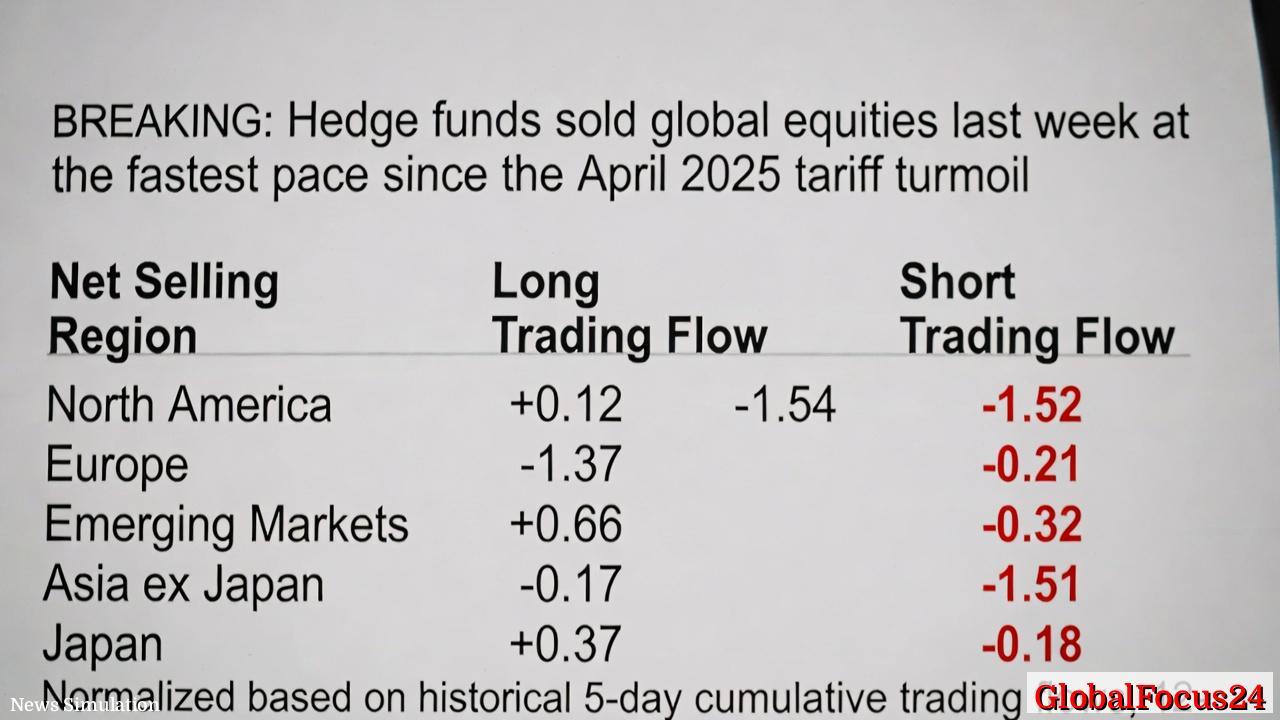
Net selling across hedge funds registered -1.54 standard deviations from typical levels—a significant deviation that indicates a broad retreat from equity exposure. In market terms, such a reading suggests selling pressure that is over one and a half times stronger than the average historical pattern for five-day trading periods.
Market strategists draw comparisons between this latest episode and the April 2025 tariff turmoil, when escalating export levies between major economies triggered a similar liquidation in global portfolios, pushing defensive assets sharply higher. Then, the pullback was temporary, followed by a recovery as trade barriers eased and monetary policy turned supportive. This time, however, investors face tighter financial conditions and fading hopes for early interest rate cuts, leaving fewer mechanisms to cushion against downside volatility.
Regional Breakdown Highlights Broad-Based Retreat
All major regions experienced net selling, reflecting the scope of investor caution.
- North America saw long trading flow of +0.12 and short trading flow of -1.52, suggesting that managers modestly maintained their long exposure but significantly expanded bearish bets.
- Europe recorded long trading flow of -1.37 and short flow of -0.21, indicating that trimming of long positions, rather than aggressive shorting, dominated regional activity.
- Emerging markets stood out with a relatively balanced picture: long flow of +0.66 against short flow of -0.32, showing selective positioning as funds sought value in countries less affected by global rate cycles.
- Asia ex Japan faced one of the heaviest hits, with long flow at -0.17 and short flow at -1.51, underscoring anxiety around manufacturing softness, export headwinds, and weaker currency dynamics.
- Japan was somewhat resilient, registering long flow of +0.37 and short flow of -0.18, supported by steady corporate earnings and renewed domestic investor activity.
Overall, total long trading flow stood at -0.12, while total short trading flow reached -1.54, confirming that the market’s selling bias came far more from short-side expansion than from unwinding previous long holdings.
The Mechanics Behind Hedge Fund Positioning
Trading flows in this analysis are normalized using a 12-month trailing basis of five-day cumulative flows. A value of 2.0 represents twice the historical volatility of regional positioning changes. Therefore, a reading of -1.54 signifies not only a sharp pivot in sentiment but also a statistically rare surge in risk-off behavior.
In practice, hedge funds use short positions to profit from declining equity prices or to hedge broader portfolio risk. When shorts increase and longs decrease simultaneously, it reflects growing conviction that market prices will weaken further. This week’s data show precisely that pattern, hinting that managers have become more defensive even in traditionally stable sectors.
Global Economic Context and Investor Sentiment
The turn toward caution comes amid lingering macroeconomic uncertainty. Growth across advanced economies slowed through late 2025, particularly in Europe and Asia, where industrial production and export volumes softened.
In the United States, recent inflation readings stabilized but remain above central bank targets, prompting policymakers to signal patience before adjusting rates. While U.S. corporate earnings have held firm, the deceleration in revenue growth and persistent input costs have kept profit margins under scrutiny. This mix of elevated borrowing costs and uncertain policy forecasts has made hedge funds less confident in holding long exposure across cyclical industries.
In Europe, sluggish demand and lower consumer sentiment continue to weigh on equities, especially among industrial and auto manufacturers. Meanwhile, in Asia, shifting capital flows and weaker currencies, particularly in South Korea and Taiwan, have prompted some funds to rebalance exposure toward more defensive or domestic-oriented stocks. Emerging markets, although volatile, have attracted selective buying, largely tied to commodity-linked economies that benefit from strong energy prices.
Comparing 2026 Market Dynamics to Past Cycles
Historically, rapid hedge fund deleveraging often signals rising short-term stress rather than a shift in long-term fundamentals. For instance, during the April 2025 tariff-driven selloff, similar patterns appeared, but markets rebounded within weeks as central banks intervened with liquidity support.
The difference now lies in the interest rate environment. In early 2026, borrowing costs remain elevated, leaving less room for leveraged strategies that depend on cheap financing. Hedge funds, traditionally among the first to adjust to tighter conditions, are now demonstrating a degree of prudence unseen since the mid-2020s tightening cycle.
Comparatively, the European equity markets are experiencing almost the same magnitude of institutional outflows as seen during the late 2018 bond selloff, while Asian exposures have retreated toward levels consistent with the pandemic-era risk reduction of 2020. These parallels underline how systemic caution can cycle across geographies even when underlying economic data remain mixed.
Implications for Broader Markets
If the current pace of hedge fund selling continues, it could exacerbate volatility across sectors, particularly in technology, small-cap, and cyclical stocks where leveraged participation is high. Short-term market dynamics may also intensify as algorithmic and momentum-based strategies react to rising bearish sentiment.
However, not all analysts view the data as alarming. Some suggest that hedge funds are “resetting exposure” rather than abandoning risk entirely, allowing them flexibility to re-enter markets at lower valuations. The typical pattern following such selloffs often includes stabilization once liquidity providers, such as long-only institutions and sovereign funds, step in to absorb discounted assets.
Economic and Policy Repercussions
Policymakers are likely to watch these developments closely. While hedge funds represent a fraction of total market trading volume, their actions can amplify trends. A prolonged period of deleveraging could tighten financial conditions indirectly by pressuring corporate funding channels and dampening investor confidence.
Central banks, already navigating a delicate balance between inflation control and growth support, may view heightened market volatility as a potential feedback loop into real economic activity. For instance, falling equity valuations can erode business investment appetite and consumer wealth effects, ultimately influencing spending and employment trends.
In contrast, sustained selling might ease speculative excesses built up over the past two years, leading to a more balanced market foundation heading into mid-2026. For long-term investors, such dislocations can create opportunities in undervalued sectors, particularly if earnings resilience persists.
Outlook for the Weeks Ahead
Market participants now look ahead to upcoming central bank meetings and corporate earnings season, both of which could either reinforce or reverse current sentiment. A dovish policy signal or stronger-than-expected profit data could quickly unwind short positions, fueling a short-covering rally similar to what followed the 2025 tariff crisis.
Conversely, continued uncertainty around monetary easing timelines or weaker global demand could prolong the selling streak. Hedge funds, their risk models increasingly data-driven, will likely maintain flexible positioning until volatility normalizes.
Conclusion
Last week’s data underscore how swiftly hedge fund sentiment can shift across regions when macroeconomic and policy uncertainties align. The broad-based net selling, led by significant short activity in North America and Asia ex Japan, marks one of the sharpest risk pullbacks since the tariff-induced turmoil of 2025. With all major regions participating in the downturn, global equity markets enter spring 2026 on cautious footing—balancing the headwinds of high financing costs, softening growth, and fragile investor confidence.
For now, the most striking message from the data is not panic, but prudence: hedge funds are trimming exposure and tightening risk management at a time when markets appear increasingly unforgiving of misplaced optimism. Whether this spells a deeper correction or a prelude to stabilization will depend on how swiftly economic signals regain clarity in the weeks ahead.