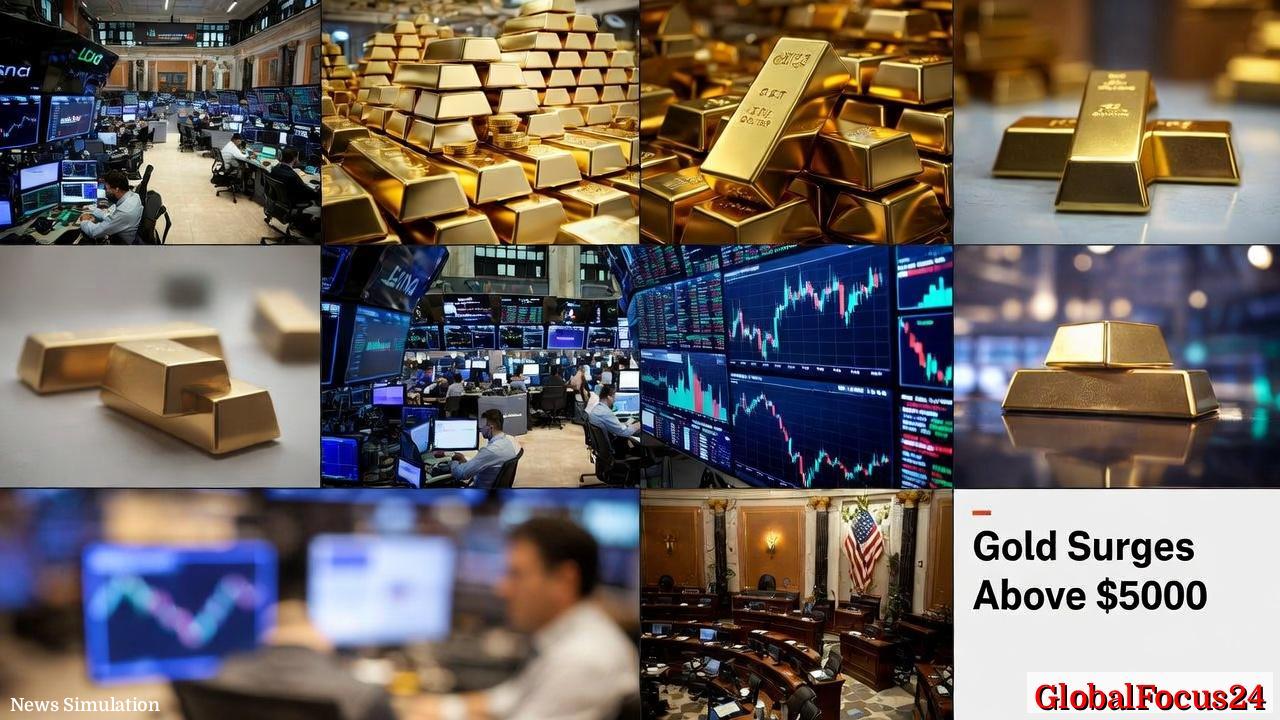
Gold Surges Beyond $5,000: A Global Market Snapshot and its Economic Ripples
Gold breached the $5,000-per-ounce level on Monday, marking a historic milestone as investors chased haven assets amid a shifting macro backdrop and renewed geopolitical frictions. The move underscores how a confluence of divergent forces—risk-off sentiment, dollar dynamics, central-bank behavior, and policy uncertainty—can propel precious metals into uncharted price territory. While the immediate trigger appears to be concerns over a U.S. government funding deadline, the broader narrative connects to longer-term themes shaping commodities, financial markets, and regional economies.
Historical context: gold as a barometer of stress Gold has long been viewed as a store of value and a hedge during periods of economic or geopolitical stress. Historically, spikes in uncertainty—whether tied to fiscal brinkmanship, tariff tensions, or regional conflicts—have tended to lift gold prices as investors seek liquidity, capital preservation, and diversification. The past year has been notable for a steady re-pricing of safe-haven demand, as inflation dynamics, monetary policy expectations, and geopoliticals intersected with shifts in global growth trajectories. The current ascent beyond $5,000 arrives within a longer arc of what many analysts describe as a structural bid for gold, driven by central-bank diversification, negative-yielding or low-yield environments in real terms, and a broader tilt toward strategic asset allocation in both public and private portfolios.
Economic impact: ripple effects across markets and industries
- Financial markets: A sustained ascent in gold prices often correlates with risk-off cycles, liquidity considerations, and shifts in investment positioning. Equities can experience mixed effects in the near term, as some investors rotate into gold while others view higher gold prices as a sign of persistent inflation or policy uncertainty. The related movement in silver, which hit multi-decade highs alongside gold, reflects broader appetite for precious metals as a paired store of value and industrial input.
- Mining sector: Escalating gold prices tend to lift mining equities, especially those with robust production profiles and hedging strategies. In regional markets, mining stocks frequently react to changes in both commodity pricing and currency volatility, as well as to local regulatory developments. The initial response in Asian markets highlighted how mining peers could benefit from a risk-off tilt, with notable gains among major producers.
- Central banks and reserves: The shift of reserve managers toward gold purchases can alter supply-demand dynamics over the medium term. In recent periods, central banks have signaled a desire to diversify holdings beyond traditional reserve currencies, using gold as a complement to foreign-exchange reserves and a potential shield against currency depreciation or macroeconomic shocks.
- Trade and policy channels: The gold rally can reflect concern about fiscal policy trajectories, debt sustainability, and geopolitical risk. If policy uncertainty persists or escalates, gold’s role as a non-fiat, portable store of value may become more pronounced, influencing longer-term planning for households, institutions, and sovereign wealth frameworks.
Regional comparisons: how different economies experience the shift
- United States: As a benchmark for pricing and policy expectations, the U.S. market often drives gold’s direction. A perceived risk of a funding lapse or government shutdown tends to amplify demand for safe-haven assets, even when domestic inflation and growth metrics remain mixed. Dollar strength or weakness interacts with gold pricing, shaping cross-border demand and hedging behavior.
- Europe and the United Kingdom: Gold often serves as a hedge against policy surprises and regional geopolitical tensions. In environments of fiscal strain or currency volatility, central banks and financial institutions in these regions may seek to balance exposure across a diversified asset base, including gold.
- Asia-Pacific: Regional demand for gold remains robust, supported by consumer demand, jewelry markets, and institutional buying. In addition, the mining sector in countries like China, Hong Kong, and Korea reflects how regional market sentiment can cascade into share-price movements for gold-linked equities and related commodities.
- Latin America and Africa: Gold prices can influence exploration activity, mine development timing, and export dynamics. Currency fluctuations in these regions may heighten the appeal of gold as a stabilizing asset for both government balance sheets and private-sector balance sheets.
Key drivers behind the move to record levels
- Safe-haven demand: Heightened concerns about geopolitical tensions and global political risk bolster the appeal of gold as a stable monetary asset amid uncertain macro conditions.
- Dollar and interest-rate landscape: A softer U.S. dollar or expectations of lower real interest rates can reduce the opportunity cost of holding gold, supporting price gains.
- Central-bank policy: Ongoing diversification into gold by central banks can provide durable demand support, reinforcing a floor under prices and contributing to a broader, multi-year uptrend.
- Inflation dynamics and growth expectations: Persistently elevated or sticky inflation, paired with slower global growth, tends to favor non-yielding or low-yield assets like gold, which can act as a strategic hedge.
Market psychology and public reaction Public sentiment often intensifies as prices cross significant round-number thresholds. The psychological dimension of breaking $5,000 can solidify investor narratives around a new paradigm for precious metals, even as market participants weigh the durability of such moves. Analysts emphasize that while thelevel is symbolic, the underlying fundamentals—supply constraints, central-bank demand, and policy uncertainty—will ultimately determine whether the rise is sustained or subject to retracement.
Analyst perspectives: forecasting the path ahead
- Short-term outlook: Market observers note that the trajectory will likely hinge on how geopoliticals evolve, how the U.S. budget process unfolds, and how monetary authorities respond to evolving inflation readings. In the near term, volatility may persist as traders reassess risk preferences and reassess hedging strategies.
- Medium-to-long-term considerations: Many forecasters incorporate scenarios with continued central-bank diversification into gold, potential shifts in global fiscal policy, and ongoing geopolitical frictions. Price targets for the year have been recalibrated by some institutions to reflect a persistent bid for gold, with expectations of higher highs if risk factors stay elevated.
Notable data points and indicators to watch
- Spot and futures prices: Movements in spot gold, as well as futures curves, can provide insights into market expectations for price direction, contango or backwardation, and the cost of carry.
- Currency implications: The performance of the U.S. dollar relative to major currency baskets influences gold-denominated quotes and cross-border demand patterns.
- Reserve management: Reports on central-bank gold purchases, official sector participation, and changes in official holdings can signal the durability of the secular shift toward gold as a reserve asset.
- Economic indicators: Inflation trends, wage growth, consumer demand, and manufacturing indicators shape the broader macro context within which gold prices navigate.
Conclusion: a pivotal moment with broad implications The surge past the $5,000-per-ounce milestone positions gold at the center of a complex web of macroeconomic, geopolitical, and financial dynamics. As markets evaluate the path forward, the metal’s appeal as a store of value, diversification tool, and risk hedge remains a core element of many investment strategies. While there is no single catalyst that guarantees perpetual ascent, the combination of ongoing policy uncertainty, currency dynamics, and the strategic behavior of central banks suggests that gold could remain a focal point for investors seeking resilience in an evolving global environment. For households and institutions alike, the current environment reinforces the importance of robust asset allocation that accounts for tail risks, liquidity considerations, and the evolving role of precious metals within diversified portfolios.