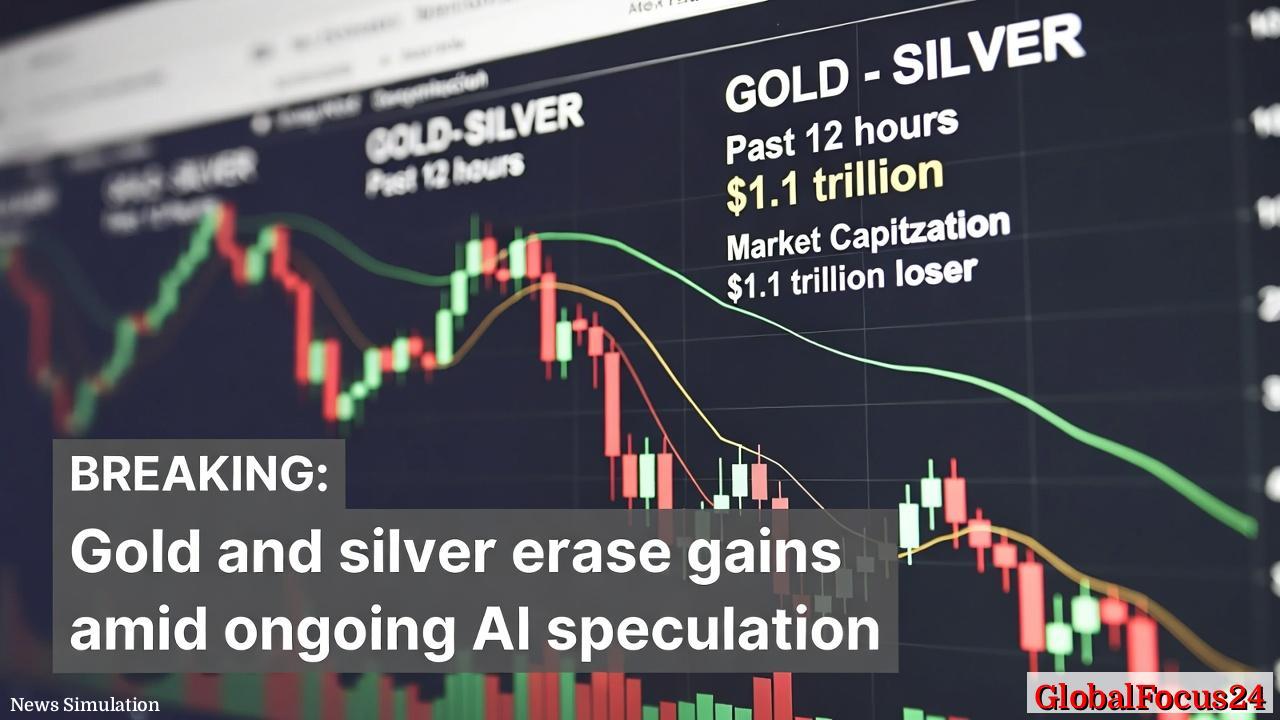
Gold and Silver Prices Slide as AI Stock Rout Wipes Out $1.1 Trillion
Precious Metals Retreat After Record-Breaking Rally
Gold and silver prices reversed sharply, erasing recent gains as a sudden $1.1 trillion selloff in artificial intelligence-linked stocks rippled through global markets over a 12‑hour window. The pullback marked a rare moment in 2026 when two of the year’s strongest-performing assets lost ground at the same time as high-flying technology shares.
Spot gold fell to about 5,174 dollars per troy ounce, down roughly 1.2 percent on the day, after trading above 5,200 dollars earlier in the week. Silver hovered near 87 dollars an ounce, having retreated from a recent peak around 87.54 dollars as volatility surged across commodities and equities.
Traders and analysts pointed to forced selling, margin calls and rapid portfolio rebalancing as key drivers of the move, with investors liquidating profitable bullion positions to cover losses in AI and technology names. Despite the setback, both gold and silver remain significantly higher year to date, reflecting strong underlying demand and a broader shift toward hard assets in an environment of inflation concerns, currency debasement fears and policy uncertainty.
AI Speculation and the New Volatility Link
The immediate catalyst for the latest downturn in precious metals was a sharp correction in AI-focused stocks that wiped out about 1.1 trillion dollars in market capitalization in less than a day. The reversal followed months of aggressive buying in companies tied to artificial intelligence, data centers and advanced semiconductor infrastructure, sectors that had come to symbolize the new growth engine of global markets.
As AI valuations stretched, some investors treated gold and silver as complementary hedges, both against macroeconomic risk and against the possibility that the AI narrative might falter. This created an unusual link: when AI stocks rallied, capital flowed into metals as part of a broader “hard asset” rotation; when AI stocks plunged, precious metals were sold to meet margin requirements and rebalance portfolios.
Market strategists have also described an “AI premium” in metals, especially silver, reflecting expectations for accelerating demand from data center builds, power infrastructure and electronics associated with AI deployment. That premium has added an extra layer of volatility, making price swings sharper when sentiment toward the technology sector abruptly changes.
Historical Context: Gold, Silver and Tech Booms
The turbulence arrives against a longer historical backdrop in which precious metals have often reacted in complex ways to technology-driven booms and busts. During the dot‑com bubble at the turn of the century, gold underperformed high-growth equities while valuations in technology soared, only to regain appeal as the bubble burst and investors re‑evaluated risk.
In the early 2010s, the rise of social media and smartphone platforms did not prevent gold from rallying; instead, it surged as the global financial crisis gave way to years of unconventional monetary policy and ultra-low interest rates. Silver, historically more volatile than gold, magnified those moves, posting outsized gains and sharp corrections as speculative flows moved in and out of the market.
The current cycle differs in one key respect: AI is both a source of speculative exuberance and a driver of real-world demand for metals through its dependence on energy-intensive data centers, high-performance computing hardware and advanced manufacturing. This dual role means AI-related news can affect precious metals simultaneously through macro-financial channels—such as risk sentiment and liquidity—and through fundamental industrial demand expectations.
Underlying Market Fundamentals
Even with the latest decline, gold is still up more than 20 percent so far in 2026, while silver has gained roughly 25 percent, outpacing major equity benchmarks. Those gains have been underpinned by several structural factors: persistent inflation concerns, ongoing central bank purchases of bullion, geopolitical tensions and questions about long-term currency stability.
Central banks have continued to diversify reserves away from sovereign bonds and toward physical gold, reinforcing the metal’s role as a store of value and providing a steady source of demand. At the same time, silver’s dual status as both a precious and industrial metal has kept it linked not only to risk sentiment but also to trends in manufacturing, renewable energy and high-tech applications.
Analysts note that while the most recent selling pressure has been concentrated in futures and paper markets, physical demand in key hubs such as Asia remains relatively resilient, with some investors viewing dips as opportunities to accumulate. That dynamic has often helped stabilize prices after abrupt corrections, though it does not eliminate the near-term impact of rapid deleveraging episodes tied to equity market stress.
Economic Impact of the $1.1 Trillion Shock
The combined effect of the AI stock rout and the precious metals pullback has raised new questions about financial stability, portfolio construction and the resilience of retail and institutional investors to sharp cross‑asset moves. The evaporation of 1.1 trillion dollars in AI-related market value in such a short span has the potential to dampen wealth effects, particularly in markets where technology shares make up a large portion of household and institutional portfolios.
For asset managers and hedge funds, the latest volatility underscores the risks of crowded trades and leveraged exposure to both AI equities and commodities seen as linked to the same macro themes. Rapid, correlated selloffs can trigger broader risk reduction, pressuring not only speculative technology names but also safe‑haven assets when they have recently delivered strong performance.
On the real-economy side, persistent turbulence in AI valuations could influence capital expenditure decisions in data centers, chip manufacturing and related infrastructure. Any slowdown in those sectors would feed back into demand for industrial metals, including silver and copper, complicating the outlook for producers, equipment manufacturers and mining companies that have ramped up investment in anticipation of sustained AI-driven demand.
Regional Market Reactions
Reactions to the gold and silver price reversal have varied across regions, reflecting different investor bases and market structures. In North America, where AI and large-cap technology stocks dominate major indices, the metals pullback has been closely tied to portfolio hedging dynamics and margin-related selling. Managers holding sizable gains in gold and silver after a strong start to the year were among the first to realize profits amid the equity drawdown, adding to downside pressure.
In Europe, precious metals remain a cornerstone for investors concerned about energy security, fiscal dynamics and geopolitical risks, with demand often concentrated in physical bars, coins and exchange-traded products. Price swings have been notable, but market participants in the region typically treat short-term volatility as part of a longer-term diversification strategy rather than as a reason to abandon positions.
Across Asia, particularly in China and India, the response has been shaped by cultural and long-standing retail demand for physical gold, as well as growing interest in silver for both jewelry and industrial applications. Trading volumes around the Lunar New Year period were lighter, amplifying price moves, but physical markets have remained active as consumers and investors adjust to the new price levels. The region’s role as a major consumer of physical bullion continues to provide a stabilizing counterweight to more speculative activity in Western futures markets.
Comparisons With Other Asset Classes
The divergence between precious metals and other major asset classes remains a central theme in 2026. While gold and silver have posted strong double‑digit gains, broad equity indices have delivered comparatively modest returns, and some segments—particularly outside AI and technology—have struggled to keep pace.
Bitcoin and other digital assets have also drawn attention as alternative stores of value, especially during episodes of equity market stress. In late January, a historic collapse in gold and silver prices erased trillions of dollars in market value even as Bitcoin held firm near record levels, highlighting shifting investor preferences and the growing role of digital assets in diversified portfolios. The latest episode, by contrast, shows traditional precious metals adjusting in tandem with high-growth tech exposures, underscoring how correlations can fluctuate as narratives evolve.
Fixed-income markets, meanwhile, continue to influence the metals outlook. Expectations around future interest rates and inflation remain critical for gold, which tends to benefit when real yields are low or negative. Shifts in rate expectations—whether due to changing views on AI’s potential deflationary impact or on the broader economic cycle—can quickly alter the balance between bonds and bullion in multi-asset portfolios.
Outlook: Volatility With a Structural Uptrend
Despite the abrupt loss of 1.1 trillion dollars in AI-related market value and the accompanying slide in gold and silver prices, many analysts view the latest move as a sharp correction within an ongoing structural uptrend for precious metals. Forecasts for the coming years still point to the possibility of higher average gold prices, supported by central bank buying, inflation anxiety and sustained geopolitical uncertainty.
Silver’s outlook remains more volatile but also potentially more leveraged to themes such as electrification, renewable energy build‑out and the infrastructure required to support advanced computing and AI workloads. That mix of industrial utility and monetary appeal is likely to keep the metal at the center of both speculative and long-term investment strategies.
In the near term, markets are bracing for further swings as participants reassess the durability of AI-driven equity gains and their implications for commodities tied to the same narrative. Episodes of forced selling and rapid repositioning may continue to test investor conviction, but the underlying drivers that lifted gold and silver to historic levels earlier in the year remain in place.
For now, the latest reversal serves as a reminder that in an era of rapid technological change, the fortunes of traditional safe-haven assets can be closely intertwined with the most speculative corners of the market. As AI speculation continues to evolve, so too will the complex relationship between digital innovation, financial risk-taking and the enduring appeal of tangible stores of value like gold and silver.