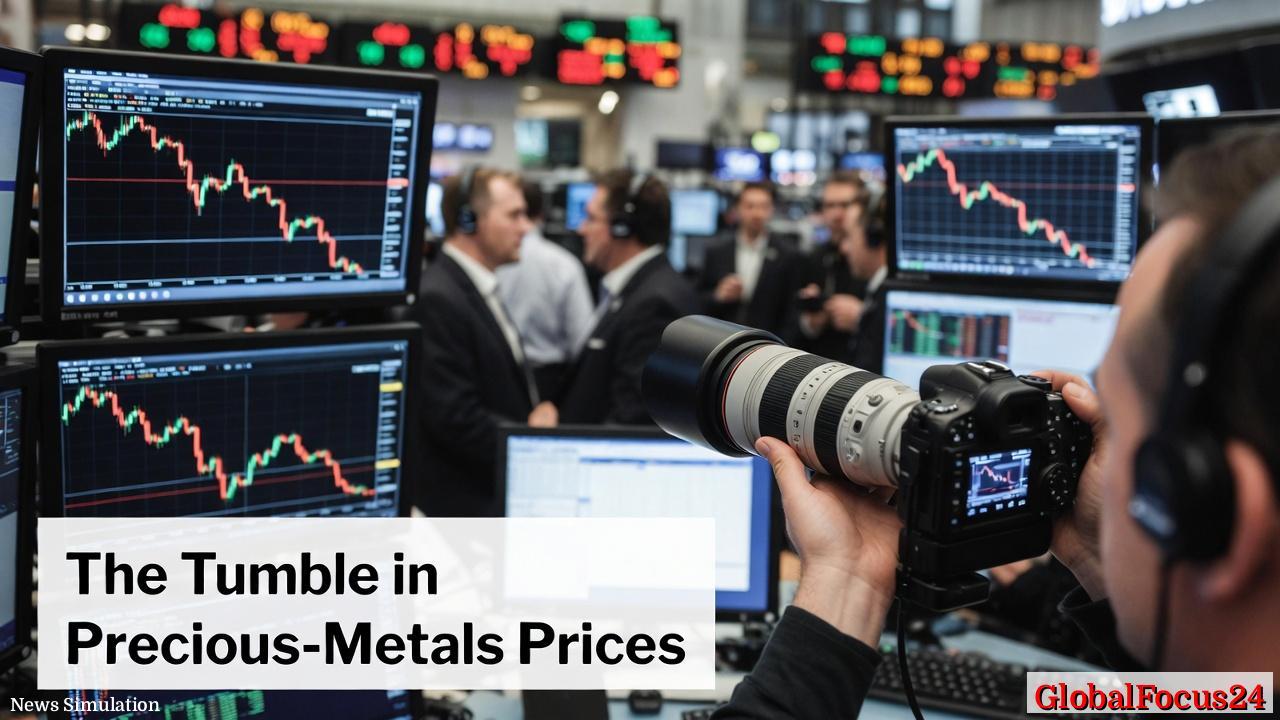
Gold and Silver Prices Plunge as Investors Reassess Inflation and Rate Outlook
Precious Metals Face Historic One-Day Declines
Global precious metals markets endured one of their sharpest selloffs in recent memory on Thursday, as both gold and silver futures tumbled from near-record levels. Gold for April delivery fell 5.9 percent, or $289.20 per ounce, marking one of the largest single-day dollar declines in the metal’s history. Silver fared even worse, dropping 8.2 percent to deepen a slide that has erased roughly a fifth of its value over the past two weeks.
The sudden downturn has sent ripples through commodities desks in New York, London, and Shanghai. Gold, which closed at an all-time high of $5,318.40 per ounce in late January, has now lost more than 13 percent from its peak. The retracement has surprised many traders who viewed the metal as a traditional safe haven during periods of global instability—particularly given the ongoing conflict in the Middle East and elevated energy prices.
Interest Rate Outlook Shifts Market Sentiment
The selloff underscores how rapidly sentiment in global markets can shift when inflation and central bank policy expectations collide. Precious metals typically benefit when real interest rates fall, as lower yields reduce the opportunity cost of holding non‑yielding assets like gold. But expectations for rate cuts have been fading since early March.
Officials at the U.S. Federal Reserve and the European Central Bank have both hinted that monetary easing may come more slowly than previously anticipated. Persistent inflation across energy, housing, and services sectors has made policymakers wary of premature rate reductions that could reignite price pressures. Prior to renewed geopolitical tensions earlier this year, traders had priced in at least two rate cuts by the Federal Reserve in 2026. Now, those forecasts have largely evaporated, with futures markets suggesting no cuts are expected before year’s end.
For investors, the resulting rise in real yields has fundamentally altered the calculus for safe‑haven assets. “Higher rates for longer” has become the prevailing market narrative—a shift that pressures gold prices, strengthens the U.S. dollar, and reshuffles portfolios across asset classes.
Hedge Funds and ETFs Signal Waning Enthusiasm
Investor flows reinforce the change in mood. The world’s largest gold exchange-traded fund logged outflows for six consecutive sessions, totaling roughly $10.5 million. Retail buyers, once enthusiastic participants in gold’s two‑year rally, have been noticeably absent. Meanwhile, professional investors—including trend‑following hedge funds and algorithmic trading firms—have been cutting long positions to limit exposure to further declines.
In commodity trading circles, the phrase “de‑leveraging event” has been used repeatedly this week. As gold and silver prices fell, several institutions were forced to meet margin calls on other declining assets, such as technology stocks, prompting additional liquidation in the metals complex. Others have rotated into sectors benefiting from current conditions—namely energy producers and companies profiting from a stronger U.S. dollar.
These cross‑market shifts have amplified volatility. Trading volumes on major exchanges surged to their highest levels since the initial outbreak of the pandemic in 2020, as both long‑term investors and short‑term speculators scrambled to adjust positions.
Historical Context: A Market Known for Sudden Reversals
Thursday’s drop ranks among the steepest since gold futures became widely traded on U.S. exchanges in the 1970s. Historical data show that large corrections are not unusual after extended rallies. The most notable comparable event occurred in January 1980, when gold fell nearly 7 percent in a day following a speculative surge fueled by inflation fears and geopolitical upheaval. More recently, in April 2013, the metal suffered a 9 percent two‑day crash after investors concluded that global central banks were tightening policy faster than expected.
Each prior downturn followed a similar pattern: rapid price increases driven by geopolitical stress or inflation concerns, followed by profit‑taking once monetary conditions shifted. Economists note that while gold remains a long‑term store of value, its short‑term volatility often mirrors shifts in macroeconomic expectations rather than physical supply or demand fundamentals.
As in past cycles, silver has moved in sympathy with gold but with greater intensity. The metal’s dual role as both a precious and industrial commodity means it is particularly sensitive to broader economic trends. When growth prospects dim or manufacturing demand softens—as current indicators suggest—silver prices tend to underperform.
Broader Metals Complex Under Pressure
The weakness in gold and silver has spilled over into other corners of the metals market. Platinum and palladium—both critical inputs for catalytic converters used in automotive manufacturing—have fallen 17 percent and 15 percent this month, respectively. Industrial metals such as copper and aluminum are also lower, reflecting investor concerns about slowing global growth and shifting demand patterns.
Copper, often viewed as a barometer for economic health, has slipped below $3.70 per pound after hitting a multi‑month high earlier this year. Analysts cite evidence of cooling construction activity in China and subdued manufacturing output in Europe as contributing factors. Aluminum prices have mirrored the decline, pressured by higher energy costs and weaker orders from the transport and packaging sectors.
The synchronized downturn across the metals complex highlights investor anxiety about a wider economic slowdown. Some strategists warn that if the conflict in the Middle East escalates or energy markets face further disruption, the resulting inflation and supply shocks could dampen industrial output while keeping interest rates elevated.
The Economic Ripple Effect
The slide in precious metals has implications beyond commodity markets. Gold is often used as a hedge within institutional portfolios, serving both as a diversifier and a measure of market sentiment. When gold prices drop sharply, it can signal reduced demand for hedging and an expectation that risks tied to inflation and geopolitical turmoil may be overstated—or that investors are prioritizing liquidity elsewhere.
In the jewelry markets of India, China, and the Middle East, price swings also affect consumer behavior. Retail buyers tend to delay purchases during rapid run‑ups and return when prices cool. Early indicators from Mumbai’s bullion dealers and Shanghai’s gold exchanges suggest a modest uptick in physical buying interest following Thursday’s sharp decline, a dynamic that could provide some stabilization in coming sessions.
At the macroeconomic level, the metals correction may ease some inflationary pressure. Central banks track commodity prices closely, as they often feed into consumer expectations. If sustained, the recent pullback could reinforce the case for stable rates—but policymakers have cautioned against reading too much into short‑term market movements.
Comparison With Regional Market Trends
Regional disparities are also shaping the current landscape. In Europe, the precious metals selloff has mirrored that in the U.S., though the weaker euro has cushioned some losses for continental investors. In Asia, demand dynamics look more mixed. China’s domestic prices, quoted in yuan, declined less sharply due to capital controls and a weaker currency, while futures in Japan logged one of the steepest one-day losses in over a decade.
Emerging-market central banks—key buyers of gold during the past two years—have so far held steady, but analysts note that persistent price weakness could alter official sector demand. Nations that increased gold reserves as a hedge against dollar volatility may reassess those positions if the U.S. currency continues to strengthen and yields rise.
Outlook: Volatility Ahead
Analysts remain divided on where gold prices go next. Some market strategists argue that the correction is a natural response to an overextended rally and that long-term fundamentals—rising geopolitical uncertainty, expansive fiscal spending, and elevated debt levels—still support higher valuations. Others believe the market has entered a new phase of normalization, with prices likely to settle closer to pre‑2025 averages.
In the short run, volatility is expected to remain elevated. Technical signals suggest that momentum-driven trading systems may continue to drive pronounced swings in either direction. Traders will watch closely for fresh data on inflation, employment, and manufacturing activity, all of which could influence the timing and magnitude of future interest-rate adjustments.
For now, the precious metals market finds itself at a crossroads—caught between competing forces of inflationary anxiety and monetary caution. As investors reassess their risk exposure in an uncertain global landscape, Thursday’s dramatic selloff serves as a reminder that even the safest of havens can tremble under the weight of shifting expectations.