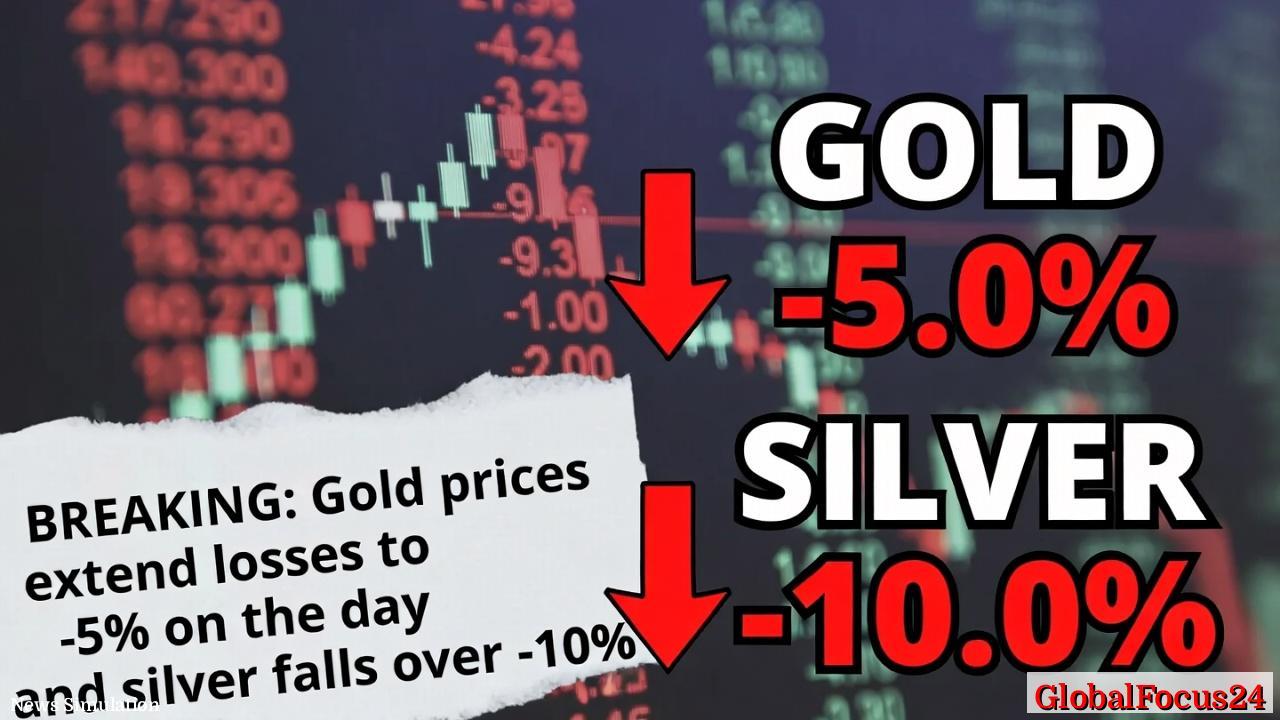
Gold Prices Plunge 5% as Inflation Concerns and Energy Costs Dampen Rate-Cut Hopes
Precious Metals Under Pressure Amid Shifting Economic Outlook
Gold prices tumbled 5% on Thursday, extending a week-long slide as renewed inflation fears and surging energy prices recalibrated traders’ expectations for central bank rate cuts this year. The sell-off marks one of the sharpest declines for gold in recent months, pushing the metal nearly $1,000 below its all-time high set late last year.
Silver also faced a steep setback, plunging more than 10% during the session as investors fled from precious metals into higher-yielding assets. The tandem drop highlights growing unease across commodity markets, where shifting monetary expectations are reshaping investment flows and liquidity.
Market Reaction and Investor Sentiment
The latest reversal in gold and silver prices comes after a volatile start to 2026. Futures data showed heavy liquidation in the metals markets, with hedge funds and institutional accounts trimming their long positions amid mounting evidence that central banks may hold interest rates higher for longer.
Analysts said rising energy costs — particularly crude oil prices, which have climbed nearly 20% since February — are stoking fears of a second wave of inflation. Higher fuel costs can reverberate through global supply chains, driving up prices in transportation, manufacturing, and essential goods.
With inflation appearing stickier than expected, traders have begun to scale back bets that the Federal Reserve and other major central banks will deliver rate cuts in the first half of the year. Instead, markets are now pricing in the possibility of prolonged monetary tightening — a stance that tends to strengthen the dollar and lift bond yields, both of which are negative for non-yielding assets such as gold and silver.
Gold’s Recent Decline in Context
The current fall in gold prices underscores a dramatic reversal from its record high reached in late 2025, when the metal briefly traded above $2,700 per ounce. That rally had been driven by geopolitical uncertainty, slowing global growth, and growing expectations of gradual monetary easing. At its peak, gold benefited from safe-haven demand as investors sought a hedge against market turbulence and a weakening dollar.
Now, however, the tone has shifted. As consumption rebounds and labor markets show resilience, inflation has remained above the 2% target across much of the developed world. Central banks, once expected to begin their rate-cut cycles in early 2026, have instead signaled caution, citing the need for more evidence that price pressures are subsiding.
Gold’s recent 5% slump brings its cumulative losses to nearly 15% over the past two months, erasing much of the gain accumulated during last year’s rally. Analysts attribute the sharp reversal to a rapid unwinding of speculative positions and rising real interest rates, which reduce the appeal of holding bullion.
Silver’s Steeper Fall and Industrial Implications
Silver’s downturn has been even more pronounced. The metal’s more than 10% drop on Thursday follows several weeks of steady declines, as industrial demand struggles to offset financial market weakness. Silver often behaves as both a precious and industrial metal, creating unique exposure to manufacturing trends, particularly in sectors such as electronics, solar energy, and automotive production.
Recent economic data from Asia and Europe has shown slower factory activity, weighing on industrial metals generally. With energy costs on the rise, manufacturers face increased input prices that may suppress production volumes. Combined with a strong U.S. dollar, these conditions have intensified the downward pressure on silver, which has now fallen more than 25% from its early-2026 highs.
Global Energy Prices Fuel Inflation Fears
A central factor behind the metals’ sell-off is the renewed surge in global energy prices. Brent crude futures touched $105 per barrel this week amid supply constraints in major producing regions and increased geopolitical tensions affecting shipping routes. Natural gas prices have also rebounded, particularly in Europe, where a colder-than-expected winter left inventories below seasonal norms.
Rising energy prices feed directly into inflation equations, raising costs for transportation, food, and industrial production. The persistence of these pressures has challenged earlier assumptions that inflation would ease steadily through 2026, forcing investors to rethink the timing of any central bank policy pivot.
Central Bank Policy Expectations Reassessed
The Federal Reserve, European Central Bank, and Bank of England have each signaled caution in recent weeks. Policymakers have expressed concern that premature rate cuts could reignite inflationary trends, especially if energy markets remain volatile. This stance has led many traders to delay expectations for the first cuts until late 2026 or early 2027.
In the bond market, yields have moved higher in response. The U.S. 10-year Treasury yield climbed above 4.6% this week — its highest level since December — reinforcing the dollar’s strength and further pressuring gold prices. Meanwhile, volatility indices across commodities have surged, highlighting investor uncertainty about the trajectory of monetary policy and global growth.
Historical Perspective on Gold Price Corrections
While steep, the current gold sell-off is not unprecedented. In the past two decades, gold has experienced several corrections of 10–20% following record highs. For example, after the surge to over $1,900 in 2011, the metal fell nearly 40% by 2013 as the U.S. economy recovered and interest rates began to rise.
Such reversals often accompany turning points in monetary cycles. When investors begin anticipating tighter policy, yield-bearing assets become more attractive, diverting capital away from metals. However, gold has historically rebounded once policy paths stabilize and inflation expectations moderate. Financial strategists note that the metal remains a long-term hedge against systemic risk, though short-term volatility can be pronounced during periods of shifting expectations.
Regional Comparisons: U.S., Europe, and Asia
Regional reactions to the downturn have varied. In the United States, miners and refiners with high production costs face mounting pressure, particularly as energy and labor expenses rise. Several mid-tier producers have hinted at potential cutbacks or temporary shutdowns if prices remain at current levels.
In Europe, where economic activity remains fragile and inflation is still elevated, the weaker euro has partially cushioned local gold prices, though investor demand for physical bullion has slowed. Conversely, in Asia — especially in India and China, two of the world’s largest gold consumers — retail demand has picked up slightly as lower prices attract jewelry buyers and long-term savers seeking bargains.
These regional divergences underscore gold’s complex role across economies: as a financial asset in the West, an inflation hedge in emerging markets, and a consumer commodity in regions with deep cultural traditions of gold ownership.
Broader Commodity Market Effects
The shock in precious metals markets has spilled over into other commodities. Platinum and palladium, commonly used in automotive catalysts, declined by around 3% each on Thursday, while copper fell modestly on concerns about slowing global manufacturing. The downward trend adds pressure on resource-linked economies that depend on metal exports for revenue, including South Africa, Chile, and Australia.
Commodity-linked currencies such as the Australian dollar and Canadian dollar weakened alongside metal prices. Economists warn that prolonged declines could curb fiscal revenues and widen trade deficits in export-focused markets if recovery in industrial demand lags.
Outlook for the Remainder of 2026
Market strategists remain cautious in their outlook for precious metals. With monetary policy signals pointing toward a longer period of higher interest rates, gold and silver may struggle to regain sustained upward momentum in the near term. However, unexpected shocks — such as renewed geopolitical tensions, financial instability, or a sharper-than-forecast economic slowdown — could restore safe-haven demand.
Investment firms have begun to emphasize diversification rather than concentration in gold holdings. Some analysts anticipate price stabilization around midyear if inflation begins to plateau and the dollar rally loses steam. Longer term, structural demand from emerging markets and central bank reserves could provide support, though near-term volatility is expected to persist.
Conclusion: A Shift in Market Sentiment
Thursday’s dramatic 5% drop in gold and the double-digit plunge in silver mark a turning point in global commodity sentiment. After months of optimism built on anticipated monetary easing, investors are now confronting a reality of persistent inflation and costly energy. The data point to a market recalibrating rapidly to new economic conditions — one where the direction of monetary policy, more than ever, dictates the fate of precious metals.
For now, traders and consumers alike are adjusting to a new phase of uncertainty. Whether this correction proves temporary or signals a longer downturn will depend on the trajectory of inflation, energy prices, and central bank resolve in the months ahead.