Gold Mining Stocks Hit Deep Oversold Levels as Market Enters Correction Phase
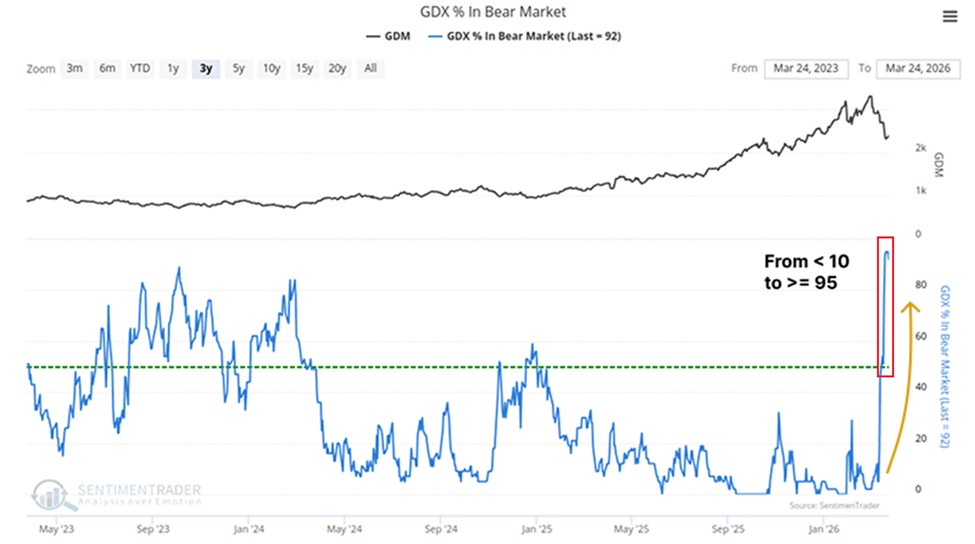
The gold mining sector has entered one of its most oversold phases in years, triggering renewed interest from traders and long-term investors alike. Approximately 95 percent of stocks in the popular VanEck Gold Miners ETF (GDX) are now trading in bear market territory—defined as a decline of 20 percent or more from recent highs. This marks the highest level of broad-based weakness among gold miners since at least April 2023.
The dramatic shift comes after a steep 25 percent drop in gold mining shares over the past four weeks. The selloff has pushed nearly the entire sector into a technical bear market for the first time since mid-2023, underscoring the volatility that often characterizes the precious metals industry.
A Swift Turn from Strength to Weakness
The reversal in gold mining stocks has been both rapid and severe. Just two months ago, the sector appeared resilient amid record-high gold prices and renewed interest from central banks accumulating bullion. But as global economic indicators pointed toward slower growth and a potentially stronger U.S. dollar, investors began trimming positions across the mining industry.
According to recent data, the share of GDX holdings in a bear market surged by 850 percent over the past four weeks. For perspective, roughly 90 percent of these stocks were in bear territory during October 2023—a low point that preceded one of the sector’s most powerful rallies in history. Following that trough, GDX surged 346 percent between late 2023 and March 2026.
At present levels, gold miners have rarely appeared so deeply oversold. Many equity analysts note that such extreme conditions often preludes either a significant rebound or a prolonged consolidation period.
Comparing Current Levels to Historical Cycles
Historically, the gold mining sector has experienced dramatic boom-and-bust cycles, often outpacing movements in the broader commodities and equity markets. The most recent example came in late 2023 when gold miners posted triple-digit returns in under 18 months, fueled by strong bullion prices, geopolitical tensions, and investor demand for inflation hedges.
The current downturn mirrors those earlier phases of sharp corrections that followed powerful rallies. In previous cycles, investors who accumulated shares during oversold phases often benefited when the next leg of the bull market emerged. For instance, during the 2018–2020 gold rally, GDX gained more than 180 percent after a nine-month bear stretch, while individual miners like Newmont and Barrick surged even higher.
What sets the current phase apart is the scale of collective weakness across the sector. With 95 percent of constituent stocks now in bear markets, the breadth of the decline surpasses anything seen in the last several years. That degree of correlation suggests broad-based selling pressure rather than company-specific weakness.
The Role of Gold Prices and the Strong Dollar
Gold prices themselves have remained relatively resilient compared to the miners. Although the spot price of gold declined modestly from recent highs near $2,500 per ounce, it has largely stayed above $2,200—a historically elevated level. The divergence between bullion and miners has puzzled some investors because, in theory, producers should benefit from solid gold prices that enhance profit margins.
However, a strengthening U.S. dollar has dampened sentiment across the materials sector. Since most gold transactions occur in dollars, a rising greenback tends to make the metal more expensive in other currencies, limiting foreign demand. Moreover, higher real yields—often viewed as competition to non-yielding assets like gold—have pressured both bullion and associated equities.
Energy prices have also played a role. Rising fuel costs directly increase the operating expenses of mining companies, eroding profitability even when gold prices remain elevated.
Investor Sentiment and Fund Flows
Investor sentiment toward precious metals equities has turned sharply negative in recent weeks. Exchange-traded funds tracking gold and mining companies have recorded net outflows since early March, reflecting waning confidence after an extended rally. Institutional investors, who had added exposure throughout 2025, are now rebalancing portfolios amid concerns about earnings revisions and weaker production forecasts.
The pattern of capitulation selling, where investors abandon even high-quality assets, is reminiscent of earlier market bottoms. Historically, such phases of extreme pessimism have sometimes coincided with multiyear buying opportunities. Yet analysts caution that timing such reversals remains challenging, especially given ongoing macroeconomic uncertainty.
Global Comparisons and Regional Context
The weakness in gold miners is not confined to U.S.-listed companies. Similar declines have been observed across Canadian, Australian, and South African mining indices. In Toronto, the S&P/TSX Global Gold Index has shed over 20 percent since early March, while Australian-listed producers like Newcrest and Northern Star have also entered bear market territory.
Regional factors further complicate the outlook. Canadian miners face persistent cost inflation driven by energy and labor constraints. Australian operations, though benefiting from currency weakness, remain exposed to fluctuating export costs and demanding environmental regulations. In South Africa, aging infrastructure and power disruptions continue to limit production capacity.
By contrast, Latin American producers—especially those operating in Peru and Mexico—have shown relative resilience thanks to lower production costs and ongoing investment in new projects. Still, even these firms have seen share prices fall alongside the global downtrend.
Economic Implications of a Weaker Mining Sector
The economic effects of a sustained downturn in gold mining stocks extend beyond the markets themselves. Mining remains a significant contributor to employment and fiscal revenue in multiple resource-dependent economies. A slowdown in capital expenditures could have ripple effects on equipment manufacturers, transportation providers, and regional suppliers.
For example, lower share prices may compel companies to delay new exploration and expansion projects. Historically, such pullbacks have constrained future supply, ultimately sowing the seeds for the next price upcycle. Analysts note that if the current correction persists, the reduced investment in new mines could tighten supply over the coming years, supporting a potential rebound in both gold prices and producer valuations.
From an investor perspective, the downturn also affects portfolio strategies. Gold mining equities, often purchased as leveraged bets on bullion, can amplify both gains and losses. This current episode serves as a vivid reminder of the inherent volatility in the sector.
Technical Outlook: Oversold Readings Flashing
Technical indicators across gold miner indices have fallen into deeply oversold territory. Relative strength indexes (RSI) on many large-cap names are below 30, a threshold that historically signals exhaustion in selling momentum. Some analysts now see parallels with late 2023, when similar technical conditions preceded a prolonged rebound lasting several quarters.
Despite these signals, traders remain cautious. Volume-weighted selling suggests institutional capitulation rather than opportunistic buying. Until broader market stability returns, most experts expect continued volatility and potentially sideways trading before a durable recovery emerges.
Still, contrarian investors are watching closely. A handful of hedge funds and long-term value managers have begun accumulating positions in tier-one producers with strong balance sheets. These firms, such as major North American and Australian miners, stand to benefit disproportionately when sentiment shifts.
Looking Ahead: Potential Paths Forward
The near-term outlook for gold miners depends on several key factors: the trajectory of the U.S. dollar, inflation expectations, and the pace of global economic growth. Should inflationary pressures return or central banks pivot toward renewed easing, gold prices could find fresh momentum—lifting the mining sector along with them.
Conversely, if economic growth stabilizes and yields remain high, investors may continue rotating out of commodities in favor of income-generating assets. In such a scenario, the oversold conditions in GDX could persist longer, testing the resilience of even the best-positioned producers.
For now, the extreme breadth of the current selloff—95 percent of GDX holdings in bear markets—marks a rare event that underscores the cyclical nature of mining equities. While history suggests such moments can precede powerful recoveries, they also highlight the risk inherent in a sector highly sensitive to macroeconomic tides.
As global markets await fresh direction from monetary policymakers and commodity flows, gold miners find themselves at a critical inflection point. Whether this proves to be a temporary correction or the start of a deeper restructuring phase will depend on how quickly investor confidence returns to one of the world’s oldest and most volatile industries.