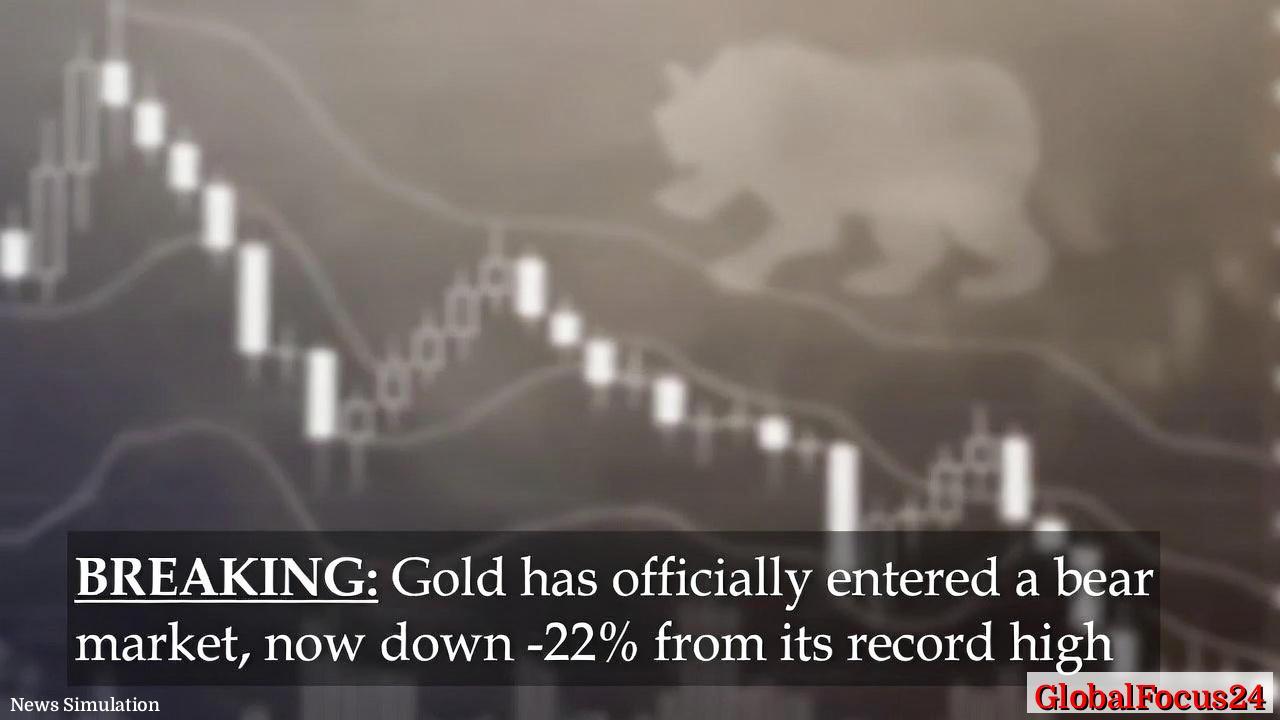
Gold Prices Enter Bear Market After Sharp 22% Decline from Record High
A Sudden Shift in a Once-Soaring Market
Gold, long viewed as a haven of stability in times of economic uncertainty, has officially entered a bear market following a dramatic 22% drop from its record high. The decline marks a striking reversal from the metal's meteoric rise in recent years, when investors flocked to precious metals amid inflation fears, central bank rate cuts, and global financial turbulence. Now, sentiment has turned. A combination of stronger global currencies, easing inflationary pressures, and shifts in interest rate expectations are weighing heavily on demand, driving prices below the symbolic bear-market threshold.
As of late March, gold futures have fallen to their lowest point in more than a year, erasing gains that once pushed the metal past the $2,600 mark in mid-2025. Analysts say the sustained price slide underscores a broader rebalancing in global markets, where traditional safe-haven assets are losing appeal as risk appetite returns and bond yields rise.
The Record High and the Road Down
Just nine months ago, gold reached an all-time high above $2,600 per ounce, propelled by surging inflation, geopolitical uncertainty, and robust central bank buying. But as major economies began to stabilize and inflation rates eased, the fundamental drivers that lifted gold began to fade.
The shift accelerated as the U.S. dollar strengthened and global bond yields climbed, providing investors with higher real returns on alternative assets. That trend eroded gold’s traditional advantage — its ability to preserve value when inflation is high or when real yields are low. Rising Treasury yields, in particular, have drawn away capital from commodity markets and into fixed-income investments.
Historically, gold has moved inversely to real rates. During the pandemic-era stimulus boom of 2020–2022, low or negative real yields made gold highly attractive as a store of value. When yields rise, however, the opportunity cost of holding a non-yielding asset like gold becomes harder to justify. The current market dynamic reflects precisely that long-standing relationship.
Economic Forces Behind the Slide
Economists point to several factors behind gold’s recent downturn:
- Stronger Dollar: The U.S. dollar index has climbed to its highest level since 2022, steadily appreciating against major currencies like the euro and yen. A stronger dollar makes dollar-priced commodities more expensive for international buyers, suppressing global demand for gold.
- Lower Inflation Expectations: Global inflation has cooled sharply from its peaks. In the United States, consumer prices have stabilized, and energy costs have retreated from earlier highs. This has lowered demand for inflation hedges, traditionally a key role for gold.
- Interest Rate Policy Shifts: While central banks were once in an aggressive tightening phase, now many are signaling cautious rate cuts or pauses, reflecting confidence in economic recovery. However, despite these signs, real yields remain elevated compared to earlier periods, keeping pressure on gold prices.
The World Gold Council reports that retail investor demand softened notably in Asia and Europe during the first quarter of 2026. Meanwhile, gold-backed exchange-traded funds (ETFs) have experienced consistent outflows, indicating institutional investors are reallocating toward equities and bonds.
Historical Context: Echoes of Past Downturns
The current bear market bears resemblance to past gold downturns. After peaking in 2011 at around $1,920 per ounce amid post-crisis monetary easing, gold prices slid nearly 30% over the following two years as global growth recovered and the Federal Reserve began tapering asset purchases. Likewise, in the late 1970s, an earlier surge tied to oil shocks and inflation gave way to a prolonged correction as interest rates climbed under then-Fed Chair Paul Volcker.
Each of these episodes reflects the cyclical nature of gold demand — driven heavily by macroeconomic tides rather than consistent long-term fundamentals. When fear subsides and yields rise, gold’s place in portfolios often diminishes, paving the way for bear markets like the one now taking shape.
The Global Impact on Gold Producers and Economies
The price slump is already rippling through major mining economies. In South Africa, where gold once anchored national exports, the lower price is squeezing margins for producers still grappling with power shortages and rising labor costs. Australia, now the world’s second-largest gold producer, faces a similar challenge as companies reassess exploration spending and project viability.
In North America, mining firms in Nevada and Ontario have begun revising earnings guidance for 2026, anticipating weaker sales. Smaller exploration firms, often dependent on investor confidence and favorable pricing, could face consolidation pressures if bearish conditions persist.
For emerging markets where gold production is a key source of foreign exchange — such as Ghana and Uzbekistan — the effects could extend to government revenues and local employment. A prolonged downturn might also dampen capital investment in new projects, curbing output growth over the next few years.
Regional Comparisons: Asia’s Shifting Role
Asia, traditionally the world’s largest consumer of gold, is showing evidence of demand normalization rather than outright collapse. In India, seasonal jewelry demand remains resilient, though consumers are increasingly price-sensitive. Spring festival sales were softer than last year, reflecting higher borrowing costs and cautious household budgets.
China’s gold market tells a slightly different story. While demand has eased from last year’s highs, retail buyers continue to view gold jewelry and bars as a safe household asset amid uncertainty in the domestic property market. Still, broader Chinese investment demand has cooled, with investors redirecting capital to equities after Beijing unveiled stimulus measures to rejuvenate the financial sector.
In Japan and South Korea, demand for physical bullion has slowed, while currency strength against the dollar has further moderated local gold prices. Analysts suggest that a regional rebound in equities and new technology investment themes may continue to divert attention from precious metals throughout 2026.
Investor Behavior and Sentiment Shift
Investor psychology plays a critical role in gold’s trajectory. In periods of financial stress, gold serves as a refuge; in stability, it loses its urgency. Over the past few months, equity markets have surged on stronger corporate earnings and improving global growth forecasts. That optimism has drained capital from safe-haven assets — a common pattern during market recoveries.
Fund managers now view gold as part of a broader rotation story rather than a standalone hedge. Diversification strategies are shifting toward a mix of commodities with clearer industrial demand, such as copper or lithium, both of which benefit from clean-energy policies and infrastructure investment trends.
Even central bank purchases — which were a backbone of gold’s rally in 2023 and 2024 — have softened. Recent data suggests that several key central banks, including those in Turkey and India, have trimmed their gold reserves to manage currency stability and liquidity amid changing monetary conditions.
Outlook for the Remainder of 2026
Market strategists are divided on whether gold’s decline has reached its floor. Some believe that the current correction will stabilize once prices approach the $1,900 to $2,000 range, a level historically supported by production costs and physical demand. Others caution that without renewed inflation pressures or geopolitical risk, the path of least resistance could remain downward.
Industrial demand, though modest compared to jewelry or investment, might offer limited support. Gold’s use in high-end electronics and medical devices remains steady, but it is unlikely to offset weakness in the financial sector.
If global growth continues to firm and bond yields remain attractive, analysts anticipate gold could trade under pressure well into 2027. Conversely, any sudden resurgence in inflation, conflict, or financial instability could quickly restore its defensive appeal — a hallmark characteristic of the metal’s cyclical behavior.
A Transitional Period for Precious Metals
The bear market in gold arrives at a pivotal moment for broader commodities. Silver and platinum have also softened, though less dramatically, reflecting fading fears of sustained inflation. Industrial metals tied to the clean energy revolution — such as copper and nickel — are showing relative resilience, suggesting capital rotation rather than total withdrawal from the commodities complex.
For investors, the message is clear: the era of easy gold gains has ended, replaced by a more nuanced environment that rewards diversification and attention to macroeconomic signals. Gold remains a powerful hedge against long-term uncertainty, but in the short term, the gleam that once defined its rally has undeniably dimmed.
As the world navigates a new phase of economic normalization, the metal that for centuries symbolized stability now finds itself reflecting a different kind of uncertainty — not one of crisis, but of recalibration.