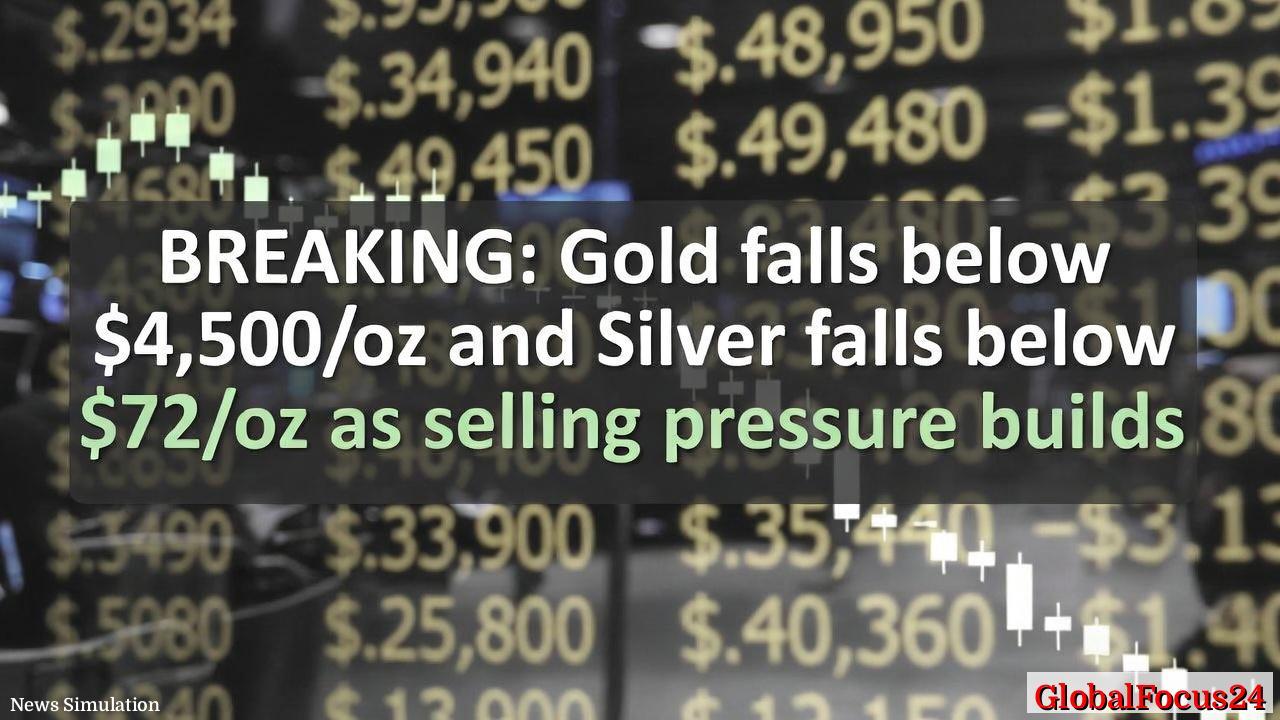
Gold Prices Plunge Below $4,500 per Ounce as Selling Intensifies
In a rapid shift that has rattled investors and reshaped the terrain of the precious metals markets, gold dipped decisively below $4,500 per ounce, while silver also extended declines to fall under $72 per ounce. The swift move amplified a broader retreat across the commodities complex and underscored a period of heightened risk-off sentiment among traders. Over the past three trading sessions, the combined market capitalization of gold and silver has contracted by more than $10 trillion, a striking figure that highlights the scale of the selloff and the reach of momentum-driven selling across asset classes.
Historical context and drivers of the decline
To understand the current movement, it helps to look at the longer arc of gold’s price history. Gold has long served as a hedge against inflation and a store of value during times of economic uncertainty. However, periods of rising real yields, strengthening U.S. dollar momentum, and shifts in global demand can disproportionately weigh on bullion prices. In recent months, several factors have aligned to pressures gold lower. First, a notable uptick in real interest rates—adjusted for expected inflation—has reduced the opportunity cost of holding cash or interest-bearing assets, which competes with non-yielding gold. Second, a firmer greenback has made dollar-denominated commodities relatively more expensive for holders of other currencies, helping to compress demand in international markets. Third, improved risk appetite in certain segments of the global economy has drawn capital toward equities and other growth-oriented assets, undermining safe-haven demand.
The allure of diversification versus liquidity dynamics remains central. While many investors still view gold as a defensive portfolio component, large-scale liquidations can occur when margin calls, hedging adjustments, or rebalancing efforts prompt rapid turnover. In parallel, physical demand from major consumers—such as central banks and industrial users—has faced shifts due to evolving macroeconomic signals, including inflation trajectories, fiscal policy expectations, and geopolitical considerations. The net effect has been a repricing of gold’s role in portfolios that blends traditional safe-haven appeal with a more nuanced assessment of opportunity costs in a high-rate, high-dollar environment.
Regional context and comparisons
Across key regional markets, the price declines have produced a mosaic of responses. In North America, traders have emphasized liquidity and price discovery, with futures markets reflecting swift adjustments to new levels of support and resistance. In Europe, the onset of renewed risk sensitivity has intersected with regulatory developments and energy-price dynamics, complicating the interplay between currency movements and gold valuations. In Asia, where physical demand often lags or leads futures activity depending on price levels, central-bank behavior and jewelry demand continue to influence longer-term trends, even as short-term volatility remains pronounced.
Historically, gold cycles have shown episodes of sharp selloffs followed by renewed interest when macroeconomic uncertainty reasserts itself. The current move resembles, in speed and magnitude, past episodes where shifts in monetary policy expectations or global growth signals precipitated rapid price adjustments. Yet, market participants note that the speed of the decline raises questions about liquidity conditions, appetite for risk, and the persistence of bearish momentum. In addition, gold’s price sensitivity to U.S. dollar movements means that any reversal in currency trends could exert a meaningful upward pressure, potentially anchoring a new support level as buyers re-enter the market.
Economic impact and market psychology
The decline in gold and silver prices reverberates through a broad spectrum of economic actors. For institutional investors, the move may compel a reassessment of risk budgets, hedging programs, and long-horizon asset allocations. The metals complex often serves as a barometer for inflation expectations and macroeconomic confidence; thus, a sustained break below key price thresholds can influence sentiment, prompting reconsideration of longer-duration trades and portfolio diversification strategies.
From a manufacturing and consumer perspective, cheaper gold and silver can reduce the cost of industrial applications where precious metals serve as catalysts, catalysts, or specialty materials. For sectors reliant on precious metal inputs, lower prices may support margins or prompt substitution toward alternative materials, depending on price elasticity and supply chain considerations. Central banks, traditionally conservative buyers of bullion, may adjust their reserve management strategies in response to price swings, balancing the desire for stability with the opportunity costs of holding precious metals in a tightening monetary landscape.
Public reaction to the price move has been notable in markets that monitor commodity prices closely for cues about inflation, growth, and financial stability. Analysts highlight a sense of urgency among traders who are watching for rotation into or out of risk assets, interpretable through shifts in open interest, volatility indices, and benchmark futures curves. Retail investors, often more exposed to sentiment-driven moves, may experience amplified price swings as short-term narratives take root and influence trading behavior.
Technical outlook and near-term considerations
From a technical perspective, the break below critical support levels has reinforced a bearish tilt in the near term. Traders are watching for key price levels that could function as potential anchors if buyers return. Momentum indicators and volatility traces suggest a market that remains sensitive to new information, whether it be macroeconomic data releases, corporate earnings surprises, or shifts in geopolitical risk assessments. The pace of subsequent moves will likely hinge on incoming data on inflation, employment, and global growth, as well as central-bank commentary that can alter expectations for future policy paths.
Looking ahead, the most significant drivers for gold and silver will include real yield trajectories, currency movements, and the broader risk appetite in financial markets. If real yields continue to climb, or if the dollar strengthens further, bullion prices may struggle to stabilize in the near term. Conversely, any signs of cooling inflation, dovish shifts in policy expectations, or renewed demand from physical-market participants could help establish a bottom and enable a rebound.
Market structure and liquidity considerations
A key aspect of the current environment is liquidity. In stressed market conditions, liquidity tends to deteriorate for precious metals, particularly when prices move swiftly on the back of sizable selling. Market participants should monitor slippage, bid-ask spreads, and the depth of order books as indicators of how orderly a price discovery process remains. Exchange-traded products linked to gold and silver can offer convenient access points for investors, though they also carry risks associated with tracking error and counterparty exposure. For those seeking to express views on the metals complex, a blend of futures, options, and physical-market signals can provide a more nuanced perspective on risk and reward.
Global supply considerations
On the supply side, mining output and concentrate shipments influence long-run price dynamics, but near-term price action is often dominated by demand shifts and macroeconomic policy. Technological advances in mining efficiency, along with geopolitical developments affecting trade routes and export restrictions, can shape the supply constraints that underpin bullion markets. While the immediate focus is on price levels, a sustainable recovery will likely require a balance of demand resilience and supply-side stability across major hubs of production and consumption.
Strategic takeaways for investors and readers
- Diversification remains a core principle: In a portfolio context, gold and silver can still play a role, especially when viewed as part of a broader set of hedges against inflation and macro risk. However, the current price action underscores the importance of evaluating liquidity, correlation dynamics, and the cost of carry in a high-rate environment.
- Policy signals matter: Central-bank commentary and inflation data will likely be decisive in shaping the next leg of price movement. Investors should monitor statements from major central banks and any shifts in expectations regarding interest rate paths.
- Regional nuance matters: Local currency strength, demand patterns, and regulatory landscapes can mute or amplify global price impulses. Investors and readers should consider regional factors when assessing bullion-market prospects.
- Risk management is crucial: For those exposed to leveraged positions or margin-based trading, the price moves highlight the importance of robust risk controls and clear exit strategies to navigate volatility.
Notable historical parallels
While every price cycle has its unique features, the current trend has echoes in past decades when gold and silver traded under pressure during periods of robust economic growth paired with rising interest rates. In those episodes, selling pressure often eased as market participants recalibrated expectations around inflation trajectories and monetary policy. The memory of past recoveries can provide a reference point for investors seeking to assess whether the current decline represents a temporary pullback or the onset of a more protracted market adjustment. Historical comparisons also shed light on the resilience of precious metals demand in situations where geopolitical tensions reemerge or where sovereign balances shift, underscoring the cyclical nature of the asset class.
Public and market reaction
Public sentiment around the price move has ranged from cautious optimism about buying opportunities to concerns over continued volatility. Analysts note that the speed of the drop has elevated attention on risk management and portfolio reallocation. Market watchers emphasize that while the near term may remain unsettled, longer-run fundamentals—such as hedging demand and the role of precious metals in diversified portfolios—continue to influence strategic decisions.
Bottom line
The plunge in gold below $4,500 per ounce and silver under $72 per ounce marks a pivotal moment in the precious metals market. The move reflects a confluence of rising real yields, a firmer dollar, and shifting risk appetites that have driven a swift, sizable retreat. As market participants digest the implications, the focus will turn to upcoming data releases, central-bank communications, and evolving macroeconomic conditions. Whether the current decline sets the stage for a durable low or a rapid rebound remains a question that investors will answer in the coming weeks and months, as the market weighs inflation dynamics, currency trends, and the enduring appeal of precious metals as a potential hedge in an uncertain world.