Gold Prices Break $5,000 Barrier as Geopolitical Tensions Ignite Global Safe-Haven Demand
Gold Surges to Record Highs Amid Escalating US-Iran Friction
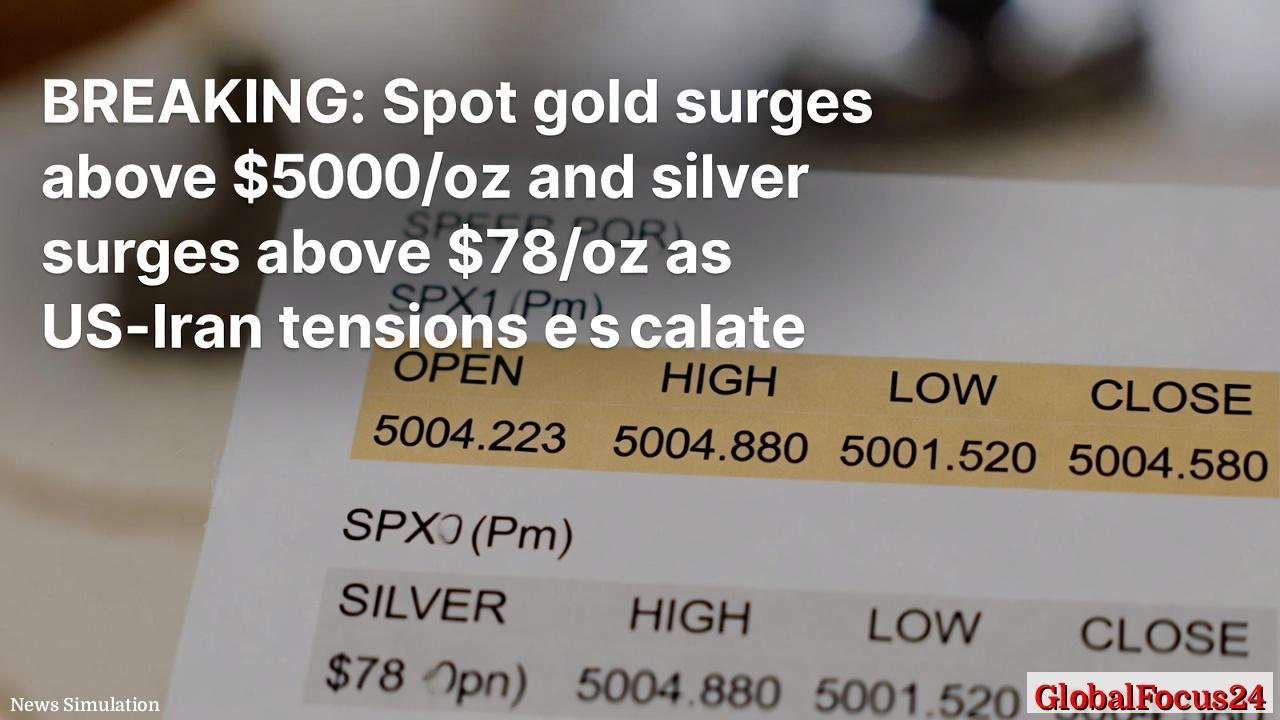
Gold prices have soared to unprecedented levels, pushing past the $5,000 per ounce threshold for the first time in history as escalating geopolitical tensions between the United States and Iran drive investors toward traditional safe-haven assets. In early Wednesday trading, spot gold opened at $5,004.22 per ounce, reached a session high of $5,004.88, and closed slightly higher at $5,004.58. The metal’s intraday chart reflected a consistent upward trajectory from around $4,910 earlier in the session, underscoring strong and sustained investor demand for security amid mounting global uncertainty.
Silver also rallied in sympathy, rising above $78 per ounce, continuing its sharp performance from recent sessions and extending gains that have positioned it as one of the year’s best-performing commodities. Analysts suggest that the rally in both precious metals underscores the broader shift toward risk aversion as markets digest a series of aggressive statements and possible military escalations in the Middle East.
Market Drivers: Safe-Haven Flows Intensify
The rapid appreciation in gold prices comes as investors seek refuge from mounting geopolitical instability. Renewed US-Iran tensions have sparked fears of a wider regional conflict, prompting global investors to de-risk their portfolios and move into assets historically recognized for preserving value during crises.
Gold, the quintessential safe-haven, has historically rallied during periods of war, monetary instability, or geopolitical uncertainty. The latest rally mirrors those seen during previous flashpoints—such as the 1979 Iran hostage crisis, the 1990 Gulf War, and the 2020 surge at the onset of the COVID-19 pandemic. This current acceleration, however, is notable both for its speed and for pushing the price to psychological highs that many analysts previously considered unattainable in the short term.
Currency markets and global equities reacted sharply as well. The US dollar index, after weeks of relative stability, softened slightly as the gold rally built momentum, while yields on US Treasuries continued their downward drift amid increased demand for safe assets. Equity markets in Europe and Asia experienced mixed reactions, with resource-heavy indices benefiting from metal price gains while broader exchanges faced pressure due to rising risk premiums.
Inflation Hedge and Monetary Context
Beyond geopolitical catalysts, structural economic factors have supported gold’s march above $5,000. Persistent inflationary pressures, subdued growth forecasts, and evolving central bank policies have reinforced the metal’s appeal as a hedge against purchasing power erosion.
Over the past three years, global central banks—particularly in emerging markets—have expanded their gold holdings to diversify reserves away from traditional fiat currencies. According to analysts, official sector demand significantly contributed to the sustained floor in gold prices throughout 2025. Meanwhile, retail demand surged across Asia, led by robust consumption in China and India, as households sought protection against local currency volatility and persistent inflation.
In the United States, inflation remains above the Federal Reserve’s long-term 2% target, despite a gradual tightening cycle and a cooling labor market. With bond yields under pressure and real interest rates hovering near zero, investors have found few viable alternatives to gold’s stability. This combination of economic uncertainty and constrained monetary flexibility has provided ideal conditions for a breakout rally.
Historical Context: Gold’s Long Journey to $5,000
Gold’s rise past $5,000 marks the culmination of a decades-long trajectory shaped by evolving global dynamics. In 1971, when the United States abandoned the gold standard, the metal traded at about $35 per ounce. By 1980, amid surging inflation and geopolitical unrest, prices had climbed above $800. Another major rally came in 2011, following the global financial crisis, when gold briefly touched $1,900. Its next major peak occurred in 2020, at the height of pandemic-driven uncertainty, near $2,075.
The current rally, however, eclipses all previous milestones in both nominal and inflation-adjusted terms. Even accounting for inflation, gold’s new highs surpass the real equivalent of the 1980 peak. Economists note that this reflects both a structural revaluation of gold’s role in the financial system and a potential reassessment of global risk amid a changing geopolitical order.
Silver Joins the Rally: Industrial and Investment Boost
Silver prices surged above $78 per ounce, benefiting from parallel investor interest in precious metals. Known as both a monetary and industrial metal, silver has found support from strong demand in the clean energy and high-tech sectors, where it plays a critical role in solar panels, electronics, and electric vehicles.
Silver’s dual nature has amplified its price momentum, as investors balance expectations of slower global growth with optimism about renewable infrastructure expansion. The gold-to-silver ratio—a measure of how many ounces of silver equal one ounce of gold—has tightened markedly, reflecting silver’s relative outperformance and signaling robust investor appetite across the precious metals complex.
Regional Reactions and Comparisons
In Asia, where physical gold demand traditionally dominates, major markets saw heightened buying activity. In Shanghai, traders reported brisk volumes through the Shanghai Gold Exchange, while Indian jewelers highlighted rising inquiries despite higher local prices. Southeast Asian buyers, particularly in Thailand and Vietnam, accelerated purchases as domestic currencies showed renewed weakness.
European markets also demonstrated resilience, with investors reallocating from equities into physical gold ETFs and bullion-backed securities. In contrast, North American trading focused on futures and options activity, with the New York market experiencing record-high contract volumes through the day.
Analysts have drawn comparisons with gold’s recent movements in other major economies. In Japan, where the yen has strengthened slightly, the local gold price reached record highs in yen terms, emphasizing both the global and currency-specific drivers of the current rally. Similar trends appeared in the eurozone, where gold priced in euros breached previous records, reflecting widespread investor anxiety toward inflation and regional instability.
Economic Fallout and Investor Sentiment
The economic implications of this surge are multifaceted. Rising gold prices, while bolstering mining stocks and supporting resource economies, can also signal waning confidence in financial stability. For import-dependent nations with limited gold reserves, higher prices could strain trade balances and complicate central bank interventions.
Domestically, US-based gold mining firms have already seen substantial equity gains in pre-market trading. Exploration companies and refining groups anticipate improved margins as gold continues its ascent. Conversely, industries reliant on stable precious metal costs—such as electronics and medical manufacturing—face growing input price pressures that may translate into higher consumer prices.
Investor sentiment across the global financial landscape has pivoted sharply toward preservation and caution. Risk premiums have widened across multiple asset classes, from corporate bonds to equities, as investors recalibrate expectations around interest rates, geopolitical continuity, and energy market volatility. While analysts caution that corrections are always possible after rapid surges, many predict that gold could remain elevated so long as diplomatic uncertainty persists.
Outlook: What Comes Next for Gold
The path forward depends heavily on how geopolitical tensions unfold and how central banks respond to persistent inflation and softening economic growth. Should diplomacy defuse regional tensions, markets may stabilize and gold could consolidate below its current highs. Conversely, any escalation could extend the flight to safety, pushing prices toward even loftier milestones.
In broader terms, the $5,000 breakthrough carries substantial psychological weight. It reaffirms gold’s position not merely as a commodity, but as a global barometer of uncertainty and trust. Whether this level marks the peak of speculative momentum or the beginning of a new valuation era remains to be seen, but few dispute the metal’s enduring significance in times of turmoil.
For now, the precious metals markets stand as a vivid reflection of global anxiety—and a reminder that in moments of geopolitical strain, the allure of gold’s enduring safety still shines brighter than ever.