Global Money Supply Surges to Record $144 Trillion Amid Broad-Based Monetary Expansion
A Historic Surge in Global Liquidity
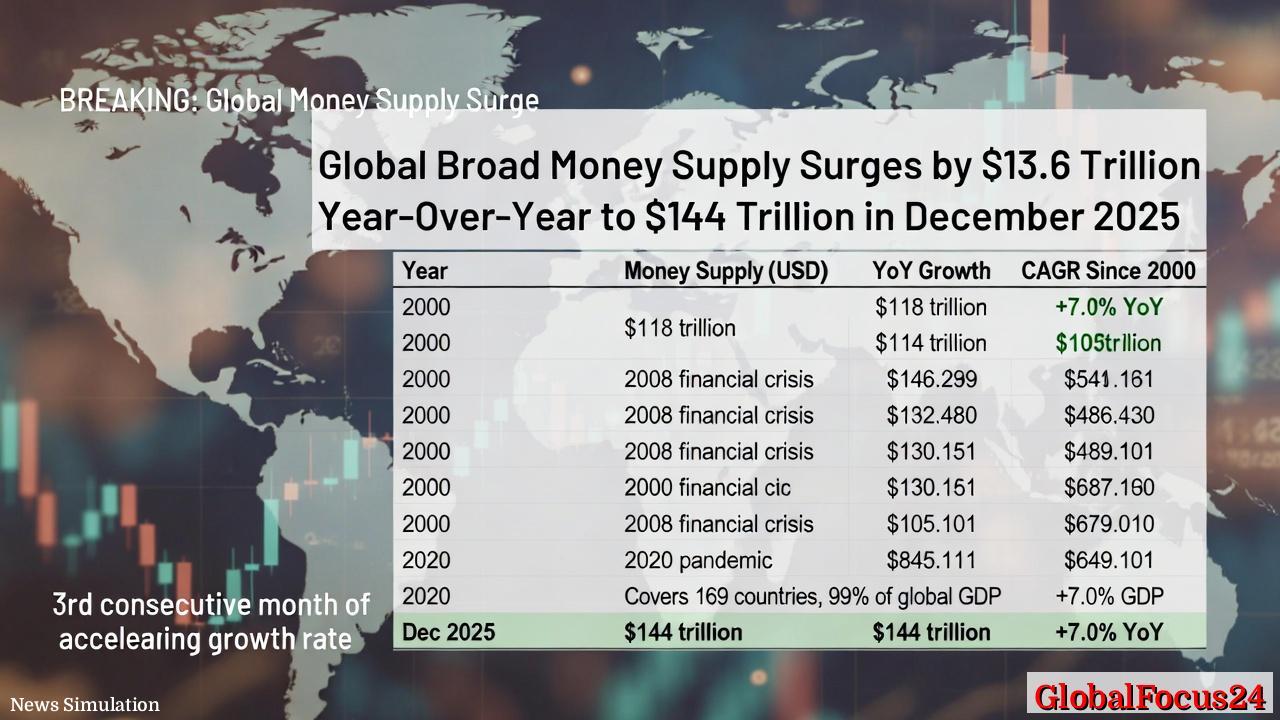
The global broad money supply reached a record $144 trillion in December 2025, marking a $13.6 trillion increase from the previous year. This 10.4% annual rise represents the third consecutive month of accelerating growth and highlights a powerful resurgence in monetary expansion across nearly all major economies. The data, encompassing 169 countries and territories that together represent 99% of global GDP, underscores the scale and uniformity of global liquidity conditions entering 2026.
Measured in U.S. dollar equivalents through M2 and M3 aggregates, this rise in money supply reflects both nominal increases in local currencies and the continued depreciation of the U.S. dollar throughout 2025. The result is one of the fastest paces of global money creation since the early 2010s, mirroring moments of extraordinary monetary response in the past quarter century.
Long-Term Expansion Since 2000
Since the start of the new millennium, global money supply has expanded by $118 trillion, growing at a compounded annual rate of roughly 7%. That long-term trajectory tracks major structural shifts in global finance—from the proliferation of digital money and financial globalization to the rise of emerging-market credit systems.
To put this in perspective, in 2000 the global money stock was under $30 trillion. By 2008, it had already doubled, driven by rapid credit expansion in developed economies and early signs of China’s industrial financialization. The 2008 Global Financial Crisis (GFC) interrupted that trend briefly but soon led to an unprecedented wave of monetary stimulus. By 2015, the world’s money supply had reached nearly $90 trillion, as central banks across the United States, Europe, and Asia implemented quantitative easing, record-low interest rates, and aggressive liquidity programs.
Key Drivers of the 2025 Acceleration
The surge through 2025 reflects a confluence of factors that collectively expanded both public and private sector liquidity:
- Ongoing Monetary Accommodation: Many central banks maintained accommodative stances through much of 2025, even as inflation pressures gradually eased. Rate cuts in Asia and Europe, combined with continued balance sheet expansion in several emerging markets, fueled additional credit and deposit creation.
- U.S. Dollar Depreciation: The greenback’s weakness—driven by narrowing interest rate differentials and declining reserve demand—amplified the dollar value of foreign monetary aggregates when converted for global comparisons.
- Fiscal Expansion and Sovereign Borrowing: Government spending in response to slowing global growth and efforts to bolster investment in infrastructure, green energy, and technological modernization further contributed to higher money creation across major economies.
- Private Credit Growth: In the world’s largest emerging economies, including China, India, and Brazil, private credit growth strengthened as domestic financial reforms encouraged broader lending channels and household consumption.
This combination of stimuli lifted the global monetary base at a faster clip than most analysts had forecast. The loosening of financial conditions and broad access to liquidity are expected to influence global capital flows and asset valuations well into 2026.
Echoes of the 2008 and 2020 Monetary Waves
Patterns from 2025 echo those observed during earlier moments of large-scale global liquidity infusion. The 2008 Global Financial Crisis saw synchronized money creation intended to stabilize credit markets and backstop collapsing asset classes. Then, the 2020 COVID-19 pandemic triggered an even more dramatic response, as central banks worldwide created trillions in new liquidity to support households, firms, and governments under lockdown conditions.
Each of those periods reshaped the global financial landscape—and the current expansion may prove similarly transformative. However, the present wave differs in character: it comes amid relatively stable (though slowing) growth, moderate inflation, and shifting geopolitical alignments. The result is a less crisis-driven but more structural form of monetary growth, linked to the ongoing reconfiguration of global capital markets rather than emergency stabilization.
Regional Dynamics: Diverging Sources of Growth
Although global aggregates show a unified acceleration, regional patterns remain diverse.
- North America: The U.S. money supply stabilized after earlier contractions in 2023–2024, but renewed Treasury issuance and liquidity injections late in 2025 helped reverse tightening trends. Canada’s broad money also expanded modestly as mortgage lending reaccelerated and capital inflows strengthened.
- Europe: The eurozone saw broad money growth of nearly 6%, driven by strong lending in Germany and France and large fiscal outlays under EU investment programs. The United Kingdom, having completed several rounds of monetary easing to support sluggish output, contributed notably to global totals.
- Asia-Pacific: China’s M2 aggregate surged by more than 9%, supported by targeted credit expansion to local governments and state-linked enterprises. Meanwhile, India continued its multi-year trend of double-digit money growth, reflecting rapid digital payment adoption and credit deepening. Japan’s figures, while more subdued, still rose slightly as yen weakness inflated nominal money totals.
- Latin America and Africa: These regions benefited from a combination of commodity inflows, foreign investment, and local-currency depreciation against the dollar. Broad money aggregates rose sharply in Brazil, Mexico, Nigeria, and South Africa—indicating ongoing balance-sheet expansion despite tighter financial conditions in some markets.
Together, these regional patterns capture a complex but synchronized picture of monetary expansion that spans continents and economic systems.
The Economic Impact of Expanding Liquidity
In the short term, heightened money supply growth can boost nominal GDP by stimulating consumption, investment, and asset prices. Many analysts see the current momentum as a sign of resilience—an indication that central banks are maintaining policy flexibility amid uncertain global growth prospects. However, the longer-term implications depend on the interaction between liquidity, inflation expectations, and real economic productivity.
Historically, periods of rapid money creation have carried mixed outcomes. After the GFC, unprecedented liquidity helped avert deflation and supported asset markets, but it also widened wealth gaps through rising real estate and equity valuations. The post-2020 expansion fueled a similar asset boom, followed by inflationary pressures in mid-decade.
Today’s acceleration occurs under milder inflation, though risks remain. A sustained rise in global money could reignite consumer price pressures if demand rebounds faster than output capacity. Conversely, some economists argue that large liquidity buffers are necessary to support aging populations, climate investments, and the energy transition—all of which require deep funding reservoirs within stable financial systems.
Comparing Past and Present Monetary Environments
Over the last twenty-five years, the composition and function of global liquidity have evolved dramatically. In 2000, broad money primarily reflected bank deposits in advanced economies. By 2025, the landscape had diversified: digital platforms, mobile banking, and central bank digital currency pilots expanded the definition and accessibility of broad money. Cross-border capital channels have become more fluid, allowing liquidity shocks in one region to transmit globally in near real time.
Another distinction lies in coordination. After 2008 and 2020, global monetary stimulus was overtly synchronized. The recent expansion, however, has been decentralized—arising from domestic policy choices responding to national circumstances. Yet the cumulative effect has been the same: a surge in global liquidity that tightens global financial interdependence even further.
Outlook for 2026 and Beyond
As 2026 unfolds, several factors will determine whether the record growth in money supply stabilizes, accelerates, or reverses. Key variables include:
- Central Bank Policy Decisions: With inflation moderating in many regions, some central banks may begin to normalize rates or reduce balance sheets. How aggressively they do so will affect liquidity availability and credit creation.
- Exchange Rate Movements: The U.S. dollar’s path remains central. A stabilization or rebound could temper global money measurements in dollar terms, even if local aggregates continue to rise.
- Fiscal Policy and Government Debt: High sovereign debt burdens in both advanced and emerging economies make full monetary tightening politically and economically challenging. Fiscal-monetary coordination may thus keep liquidity growth elevated.
- Asset Market Behavior: Continued strength in global equities, housing, and commodities could reinforce positive income and wealth effects, supporting deposits and lending growth alike.
While precise forecasts vary, most analysts expect broad money expansion to continue into early 2026, albeit at a slower pace than the extraordinary rise of late 2025. Economic policymakers will likely seek a delicate balance—sustaining credit availability while containing potential overheating risks.
A Defining Indicator of Global Financial Conditions
The $144 trillion milestone serves as more than a statistical landmark—it is a reflection of how the global financial architecture continues to evolve. From the early 2000s to the post-pandemic decade, the world has repeatedly demonstrated its capacity to generate liquidity under shifting macroeconomic pressures. Whether that liquidity translates into sustainable growth or renewed financial imbalances will depend on the next phase of policy responses and market adaptation.
In the meantime, the record expansion underscores one clear reality: the global economy remains deeply shaped by the tides of money creation. As long as liquidity flows remain abundant and interconnected, global financial conditions will be defined not merely by interest rates or inflation, but by the sheer scale of money circulating through the world’s economies.