Foreign Investors Pour Billions into Brazil's Stock Market
Surging Inflows Highlight Renewed Confidence in Brazil’s Economy
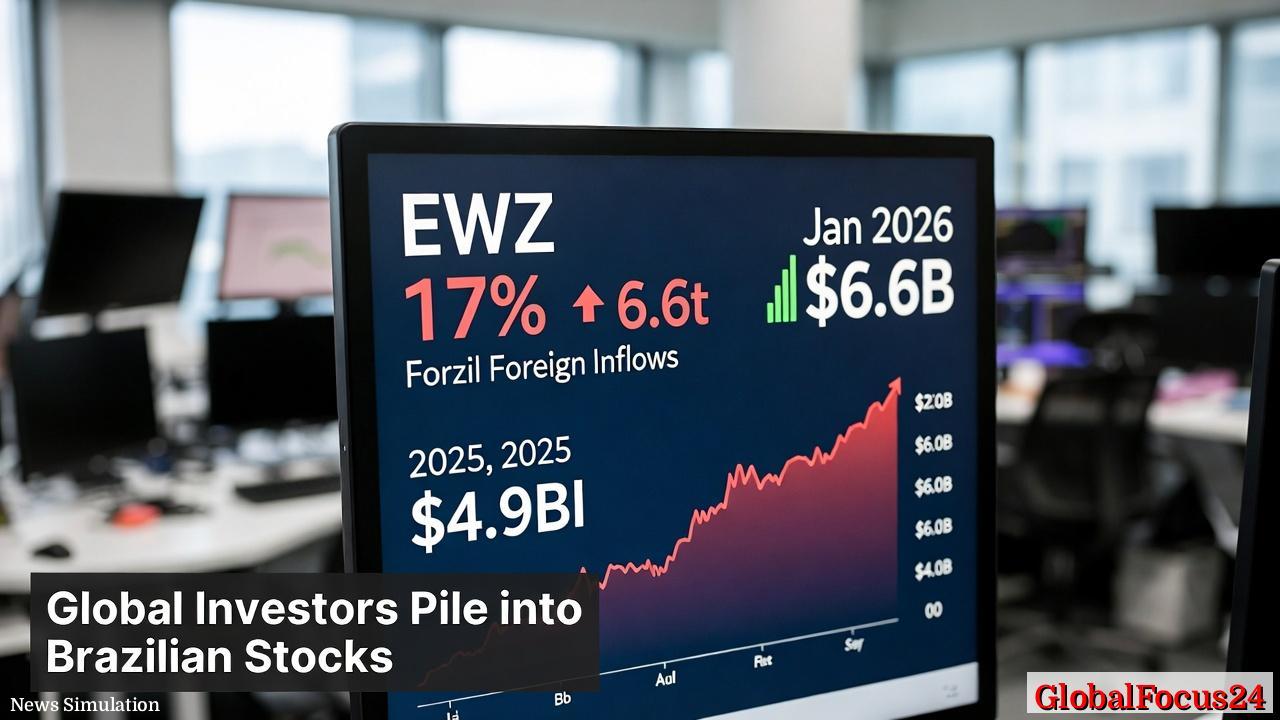
Foreign investors are pouring capital into Brazil’s stock market at a pace not seen in years, signaling renewed global confidence in Latin America’s largest economy. Net inflows into Brazilian equities have reached approximately $6.6 billion in the first six weeks of 2026, already surpassing the total of $4.9 billion recorded in all of 2025.
The surge has propelled local markets to multi-year highs, with the benchmark Bovespa index and related exchange-traded funds (ETFs) rallying sharply since the start of the year. The iShares MSCI Brazil ETF (EWZ), which represents roughly 85% of the country’s listed market capitalization, jumped 17% in January, marking its strongest monthly performance since mid-2020.
Global Conditions Favor Emerging Markets
The renewed enthusiasm for Brazilian equities comes amid a shifting global economic landscape. A weaker U.S. dollar, combined with elevated commodity prices, has rekindled investor interest in emerging markets—particularly those rich in natural resources.
For Brazil, whose exports rely heavily on iron ore, crude oil, soybeans, and agricultural goods, higher commodity prices translate directly into stronger corporate earnings and a healthier trade surplus. Analysts note that the Brazilian real has gained around 4% against the dollar since January, reflecting the improved sentiment from both domestic and global investors.
Low interest rates across major economies, especially in the U.S. and Europe, have also encouraged global funds to seek better returns in higher-yielding markets like Brazil. As risk appetite returns, emerging-market equities are once again drawing capital away from lower-growth, lower-yield alternatives.
Record Trading Volumes Signal Market Depth
Investor enthusiasm is not only visible in price movements but also in market liquidity. The average daily trading volume for Brazilian equities reached $6.1 billion in recent weeks—the highest level since November 2022.
Institutional fund managers have increased exposure to blue-chip Brazilian companies in energy, materials, and financials. Among the most heavily traded stocks are Petrobras, Vale, and major domestic banks, all of which have benefited from robust earnings and improved governance perceptions in recent quarters.
Market strategists view this surge in liquidity as a healthy sign of market depth and resilience, reflecting renewed confidence in Brazil’s corporate sector and its ability to weather global uncertainties.
Historical Context: Cycles of Capital Flows
Brazil’s stock market has long experienced waves of capital inflows tied to global commodity cycles and U.S. monetary policy. In the early 2000s, a commodities boom led to record foreign investment and GDP growth rates exceeding 5% per year. That period also saw widespread infrastructure expansion and surging demand from China.
However, successive downturns followed. Between 2014 and 2016, Brazil faced a combination of political instability, rising inflation, and a collapse in commodity prices, which prompted foreign investors to withdraw billions. By 2020, the COVID-19 pandemic compounded these challenges, triggering one of the steepest sell-offs in the Bovespa’s history.
Today’s revival bears echoes of those earlier boom cycles, but analysts argue that fundamental conditions differ significantly. Inflation has stabilized below 4%, central bank reserves exceed $350 billion, and the current account remains positive. These metrics support the view that Brazil’s markets are on firmer footing than during previous speculative upswings.
The Role of Commodities and Export Demand
A key driver of the rally is the ongoing global commodities upcycle. Iron ore prices have climbed more than 12% since December 2025, while agricultural commodities like soy and corn remain near multi-year highs due to strong demand from Asian markets and supply constraints elsewhere.
Brazil, the world’s largest exporter of soybean products and one of the top three suppliers of iron ore, stands to profit enormously from these dynamics. The resulting trade surplus has bolstered government revenues, improved fiscal balances, and increased liquidity available for domestic investment—all contributing to a more favorable environment for equities.
Comparisons Across Latin America
Regionally, Brazil’s performance outshines most of its neighbors. Argentina continues to grapple with inflation exceeding 80% annually, dampening investor confidence. Mexico’s stock market, while more stable, has not matched Brazil’s rally, rising roughly 4% year-to-date compared to Brazil’s double-digit gains.
Chile and Colombia have also attracted moderate inflows, particularly in copper and energy sectors, but neither has seen the magnitude of international engagement currently directed toward Brazil. Analysts attribute this divergence to Brazil’s larger market size, diversified export base, and relatively predictable regulatory framework.
Domestic Drivers: Policy Stability and Corporate Earnings
Domestically, several factors have reinforced investor optimism. Brazil’s central bank has maintained a cautious but transparent approach to monetary policy, gradually reducing its benchmark rate from the pandemic-era peak while keeping real yields attractive by global standards. This policy balance—tight enough to contain inflation but loose enough to support growth—has reassured both local and international investors.
Corporate profits have also shown steady improvement. Publicly listed companies reported average earnings growth of over 8% in late 2025, a trend expected to continue in 2026 as domestic demand strengthens and export revenues remain high. Dividend payouts by large-cap firms such as Petrobras and Vale have also been a strong magnet for foreign capital seeking income stability in volatile markets.
Structural Advantages and Long-Term Potential
Beyond short-term market movements, Brazil retains several long-term advantages that appeal to foreign investors. These include a vast consumer base of over 200 million people, abundant natural resources, advanced agricultural technology, and a growing renewable energy sector.
Investment is also accelerating in digital infrastructure, with fintech and e-commerce sectors expanding rapidly. By 2030, Brazil aims to rank among the top 10 global economies for clean energy generation, a target supported by record solar and wind installations across the northeast.
Such developments suggest that the inflow of capital in early 2026 may represent not just a cyclical rebound, but part of a structural reallocation of global portfolios toward sustainable emerging markets.
Currency and Inflation Risks Remain
Despite the strong inflows, analysts caution that potential risks persist. Currency volatility could reemerge if the U.S. Federal Reserve unexpectedly tightens policy or if commodity prices retreat. Brazil also faces lingering structural challenges, including income inequality, infrastructure bottlenecks, and public debt surpassing 75% of GDP.
Moreover, while inflation has moderated, consumer prices could rise if fiscal expansion intensifies or if the real depreciates in response to external shocks. Such dynamics could force the central bank to reverse its current easing cycle, weighing on growth prospects and market sentiment.
International Perspective and Future Outlook
The global investment community is closely watching whether Brazil can sustain this momentum throughout 2026. Many asset managers view the current rally as part of a broader repositioning into emerging markets, spurred by expectations that global interest rates will remain relatively low through the year.
If that scenario holds, Brazil could continue attracting tens of billions in new equity and bond investments, reinforcing its position as the financial hub of South America. Strong governance, transparent fiscal management, and continued policy stability will be essential to maintain investor confidence and avoid repeating past boom-bust cycles.
A Market Poised for Resilience
As of late February 2026, the surge of foreign investment into Brazil’s stock market underscores a new phase of opportunity—one built on pragmatic reform, competitive exports, and improved macroeconomic stability. While global conditions will inevitably fluctuate, Brazil’s financial markets appear better prepared to absorb volatility than in prior decades.
For investors seeking both diversification and high-growth potential, Brazil’s resurgent equity market is once again commanding global attention—this time with firmer fundamentals and a cautiously optimistic outlook for the years ahead.