Federal Reserve Records Third Straight Annual Loss as Interest Costs Outpace Earnings
Federal Reserve Posts Continued Operating Deficit
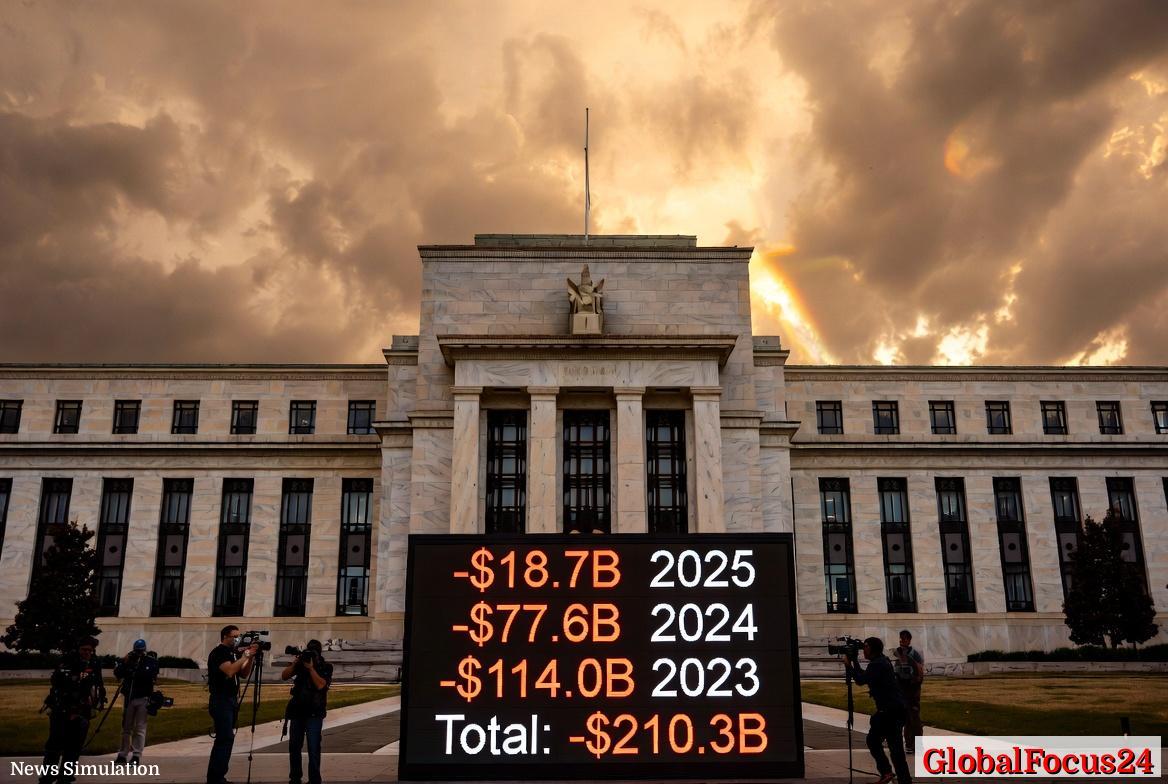
The Federal Reserve reported an operating loss of $18.7 billion for 2025, marking its third consecutive year in deficit and extending a sharp reversal from more than a decade of steady profitability. The central bank’s cumulative losses now total $210.3 billion over the three-year period, following deficits of $114.0 billion in 2023 and $77.6 billion in 2024.
The losses reflect a fundamental shift in the Fed’s financial position, driven by rising interest expenses tied to its efforts to combat inflation. For years, the central bank generated substantial income from its large portfolio of Treasury securities and mortgage-backed bonds. That dynamic has now flipped as the cost of maintaining higher interest rates outweighs returns on those holdings.
Why the Federal Reserve Is Losing Money
At the core of the losses is the Fed’s policy response to elevated inflation that began in the early 2020s. To slow price growth, the central bank raised short-term interest rates aggressively. While those higher rates are intended to curb borrowing and spending, they also increase the Fed’s own expenses.
The Federal Reserve pays interest on reserves held by commercial banks as well as on reverse repurchase agreements, which are widely used by money market funds. As policy rates climbed, so did the interest payments to these institutions.
At the same time, the income generated from the Fed’s balance sheet has remained relatively fixed. Much of the central bank’s bond portfolio was acquired during years of low interest rates, meaning the yields on those securities are comparatively modest. This mismatch—higher interest paid out versus lower income received—has produced sustained operating losses.
Historical Context of Federal Reserve Earnings
The current losses mark a significant departure from the Fed’s financial performance over the previous decade. Following the 2008 financial crisis, the central bank expanded its balance sheet dramatically through large-scale asset purchases, commonly known as quantitative easing.
These programs generated substantial income because the Fed held large volumes of higher-yielding securities while paying minimal interest on bank reserves. Between 2008 and 2022, the central bank transferred approximately $1.36 trillion in profits to the U.S. Treasury, effectively reducing the federal deficit during that period.
That stream of remittances came to an abrupt halt in September 2022, when rising interest costs began to exceed earnings. Since then, instead of sending excess income to the Treasury, the Fed has recorded deferred losses on its balance sheet.
What Happens When the Fed Operates at a Loss
Unlike private institutions, the Federal Reserve does not face insolvency in the conventional sense. As the issuer of the U.S. dollar, it has the unique ability to create money, allowing it to continue operating regardless of its accounting position.
When the Fed incurs losses, it does not require a bailout or additional funding from taxpayers. Instead, it records a “deferred asset,” representing future earnings that will offset current losses. Once the central bank returns to profitability, those earnings will first be used to eliminate the accumulated deficit before remittances to the Treasury resume.
This accounting mechanism ensures continuity of operations but has broader fiscal implications. The absence of Fed remittances means the federal government must rely more heavily on other revenue sources or borrowing, potentially affecting overall budget dynamics.
Economic Impact and Fiscal Implications
The Fed’s losses do not directly impair its ability to conduct monetary policy, but they carry indirect economic consequences. One of the most immediate effects is the suspension of transfers to the Treasury, which had previously provided tens of billions of dollars annually.
Without those contributions, federal deficits may appear larger than they otherwise would have been. While this does not change the underlying economic conditions, it alters fiscal projections and could influence long-term budget planning.
There is also a psychological component. Persistent losses may draw public attention and raise questions about the costs associated with monetary policy decisions, particularly in a high-rate environment. However, economists generally emphasize that these losses are a byproduct of necessary actions to stabilize prices and are not indicative of operational weakness.
Comparison With Other Central Banks
The Federal Reserve is not alone in experiencing financial strain. Central banks in other advanced economies have faced similar challenges as interest rates have risen globally.
The European Central Bank and the Bank of England, for example, have also reported losses or reduced profits tied to higher interest payments on reserves. Like the Fed, these institutions expanded their balance sheets during periods of low inflation and low rates, leaving them exposed when policy tightening began.
However, there are regional differences. Some central banks operate under frameworks where governments explicitly cover losses, while others, like the Fed, rely on internal accounting mechanisms. The scale of losses also varies depending on the size of asset holdings and the structure of financial systems in each region.
The Role of Monetary Policy in Shaping Outcomes
The Fed’s current financial position underscores the trade-offs inherent in monetary policy. Raising interest rates is a key tool for controlling inflation, but it comes with financial side effects, including higher costs for the central bank itself.
During periods of economic expansion and stable inflation, central banks typically generate profits. In contrast, periods of tightening often produce losses as policy rates rise faster than returns on existing assets.
This cyclical pattern is not unusual, but the magnitude of recent losses reflects the unprecedented scale of the Fed’s balance sheet following years of quantitative easing. As of the mid-2020s, the central bank’s holdings remain historically elevated, amplifying the impact of rate increases.
Public Perception and Market Response
Financial markets have largely taken the Fed’s losses in stride, viewing them as a predictable outcome of its policy actions rather than a cause for concern. Investors tend to focus more on inflation trends, employment data, and future rate decisions than on the central bank’s accounting results.
Public reaction has been more varied. While some observers express concern about the optics of large losses, others point to the broader context, noting that the Fed’s earlier profits significantly benefited taxpayers.
The central bank has emphasized that its primary mandate—maintaining price stability and maximum employment—remains unchanged. Financial results, while notable, are considered secondary to these core objectives.
Outlook for Future Earnings
The trajectory of the Federal Reserve’s finances will largely depend on the path of interest rates and the composition of its balance sheet. If rates begin to decline, the cost of paying interest on reserves would decrease, potentially restoring profitability.
Additionally, as higher-yielding securities gradually replace older, lower-yielding assets, the income generated by the Fed’s portfolio could improve over time. This process, however, is gradual and may take several years to fully materialize.
Until then, the central bank is expected to continue operating with deferred losses, with remittances to the Treasury remaining suspended.
A Structural Shift in Central Banking Finances
The Fed’s multi-year losses highlight a broader shift in how central bank finances interact with monetary policy. The era of large, consistent profits driven by low interest rates and expansive asset purchases has given way to a more complex environment.
This shift does not diminish the effectiveness of monetary policy but reflects the evolving challenges of managing a modern economy. As inflation dynamics, interest rates, and financial systems continue to change, central banks are likely to face similar financial fluctuations in the future.
For now, the Federal Reserve’s losses stand as a reminder that the tools used to stabilize the economy can carry significant financial consequences, even for the institution at the center of the global financial system.