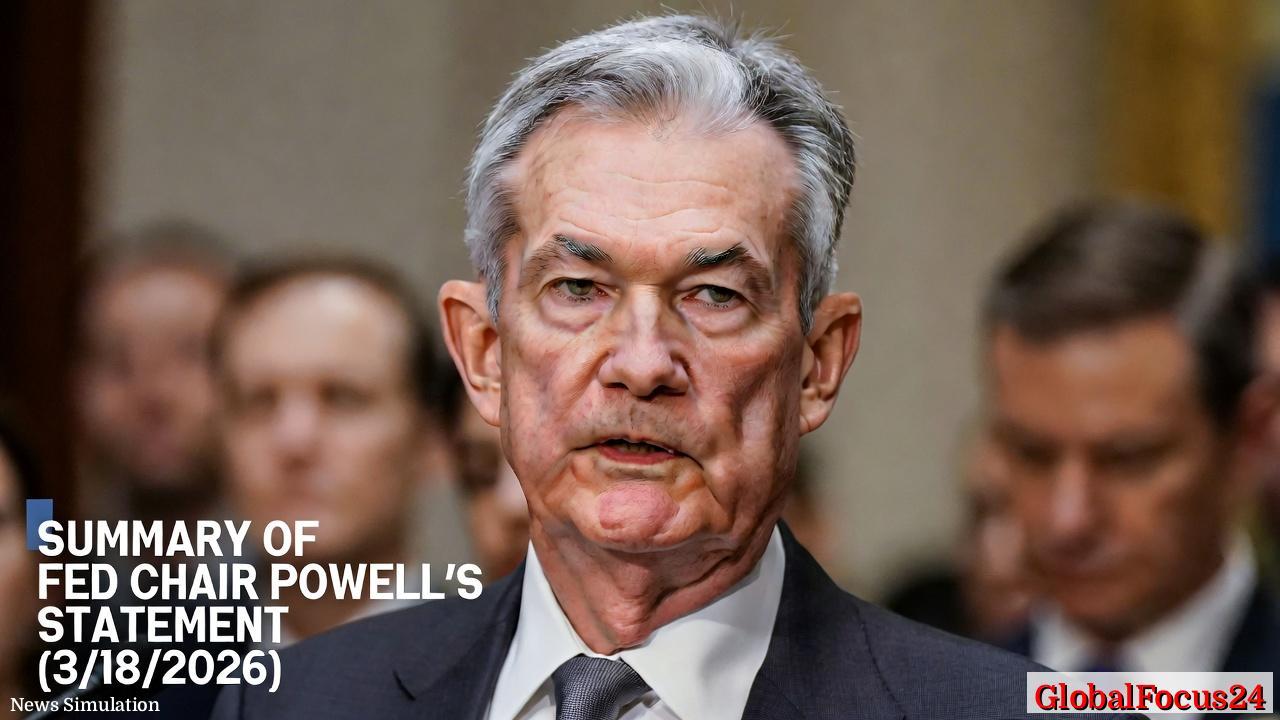
Federal Reserve Signals Extended Pause Amid Inflation and Global Uncertainty
Inflation Pressures Persist as Energy Costs Rise
Federal Reserve Chair Jerome Powell said Wednesday that U.S. inflation remains somewhat elevated, citing persistent price pressures linked to rising energy costs and global geopolitical instability. Speaking in Washington, Powell noted that the economic implications of the ongoing Iran War remain uncertain, but higher oil prices are already beginning to feed through to consumers and businesses.
He emphasized that while the Federal Reserve’s long-term inflation target remains firmly set at 2 percent, recent data suggest that near-term inflation expectations have edged higher. “Higher energy prices are likely to push overall inflation higher in the coming months,” Powell said, indicating that the central bank’s campaign to stabilize prices has entered a new phase defined by patience and vigilance.
The End of the Rate-Cutting Cycle
Powell’s comments mark a clear signal that the central bank intends to maintain current interest rates for an extended period. After a series of rate cuts last year—intended to cushion the economy from slowing growth and previous disinflationary trends—the benchmark federal funds rate now stands near what Powell described as “plausible estimates of neutral.”
This shift represents a strategic pause after nearly a year of monetary easing. A neutral rate, in Fed terminology, is one that neither stimulates nor restrains economic growth. Powell noted that this positioning gives policymakers the flexibility to respond to evolving economic conditions, especially as global shocks such as the Iran conflict and fluctuating commodity prices complicate the inflation outlook.
Energy Market Volatility Reshapes the Outlook
The latest spike in oil prices, driven by heightened tensions in the Middle East, has rekindled fears of a broader supply shock reminiscent of the energy crises of the 1970s and early 2000s. Crude oil prices have climbed steadily since late February, surpassing $100 per barrel in global markets.
Economists warn that while the U.S. economy is less energy-intensive than in previous decades, higher oil prices can still ripple across sectors—raising transportation costs, pressuring manufacturing, and driving up consumer prices for food and essential goods. For households already managing tight budgets, the resurgence of fuel inflation is likely to weigh on disposable income and sentiment in the months ahead.
Historical Context: Parallels and Differences
The current economic posture bears some resemblance to the early 2010s, when the Fed held rates steady for several years amid slow but steady recovery. However, today’s inflation backdrop differs sharply. Whereas the post-financial-crisis era faced persistently low inflation, the current moment reflects lingering price imbalances from the COVID-era disruptions and subsequent supply chain realignments.
The 1979–1981 energy crises also inform today’s policy debate. Then, geopolitical turmoil in the Middle East sent oil prices soaring, triggering prolonged inflation and forcing the Federal Reserve—under Chair Paul Volcker—to raise interest rates aggressively, pushing the U.S. into recession. While Powell has emphasized that inflation dynamics today are more contained, he acknowledged that persistent energy shocks could revive inflationary momentum if expectations become unanchored.
Economic Impacts on Businesses and Consumers
For businesses, a prolonged period of elevated inflation poses strategic challenges. Companies face mounting input costs, particularly in energy-intensive industries such as shipping, manufacturing, and construction. Some firms have begun to pass on higher prices to consumers, while others seek ways to absorb costs through efficiency gains or supply-chain diversification.
Consumer confidence, while still resilient, shows early signs of fatigue. According to recent survey data, inflation remains the top concern for American households, outpacing worries about employment or financial markets. Many families are adjusting spending habits—cutting discretionary purchases, delaying travel, and switching to lower-cost goods—as they cope with higher prices for essentials.
In the housing sector, the Fed’s signal of a rate pause may bring a measure of stability. Mortgage rates, which fell slightly following last year’s cuts, have leveled off in recent weeks. Real estate analysts say that predictability in borrowing costs could encourage moderate recovery in home sales later this year, though affordability challenges remain.
Regional Comparisons: United States vs. Global Trends
Compared with other advanced economies, the United States remains better positioned to weather inflationary shocks. The labor market remains strong, with unemployment near historic lows, and wage growth has moderated without collapsing. Meanwhile, major central banks in Europe and Asia face their own balancing acts as energy costs surge and export demand cools.
In Europe, inflation has also accelerated due to higher natural gas and petroleum prices linked to the Iran conflict. The European Central Bank has signaled caution, unwilling to tighten policy too soon amid lingering growth concerns. In Asia, nations such as Japan and South Korea are confronting weaker export orders, while commodity-heavy economies like Australia and Indonesia have benefited from higher energy revenues.
The U.S. dollar has strengthened slightly against major currencies, reflecting investor confidence in the Federal Reserve’s steady approach. However, a stronger dollar may complicate the trade balance by making U.S. exports less competitive abroad.
The Path Ahead: Data Dependence and Policy Flexibility
Powell reiterated that the Federal Reserve remains highly data-dependent, carefully monitoring inflation trajectories, labor market indicators, and global developments. “We are prepared to adjust policy as needed should risks to inflation or growth evolve materially,” he said.
Analysts interpret the Fed’s messaging as an effort to preserve optionality—keeping open the possibility of tightening if inflation reaccelerates or easing if economic conditions deteriorate. Most economists expect the Fed to hold rates steady through at least the summer, with a possible reassessment later in the year depending on how energy and commodity prices evolve.
Market Reaction and Investor Sentiment
Following Powell’s remarks, U.S. financial markets showed muted but steady movement. Treasury yields ticked slightly higher, reflecting expectations that rates will remain elevated for longer. Equity markets held firm, suggesting that investors see stability rather than immediate risk in the Fed’s position. The U.S. dollar index strengthened modestly, underscoring investor confidence in the central bank’s commitment to price stability.
Commodity traders, by contrast, remain cautious. Oil futures continue to price in additional supply risk tied to the conflict in the Middle East. Analysts warn that if tensions escalate further, energy markets could experience renewed volatility, keeping inflation elevated and complicating central bank strategies globally.
Lessons from the Fed’s Balancing Act
The Fed’s current challenge is balancing the twin goals of price stability and economic growth while global uncertainty clouds the outlook. By signaling an extended pause, Powell is effectively betting that time and supply adjustments will help ease inflationary pressures without derailing the labor market or triggering a contraction.
Economists often describe this balancing act as walking a “policy tightrope.” Tightening too much could undermine growth, while easing too soon could reignite inflation expectations. The neutral stance seeks to maintain economic momentum while guarding against overheating—a position many see as prudent amid unpredictable global developments.
Public Perception and Political Sensitivity
While the Federal Reserve maintains independence from political influence, its decisions inevitably ripple into public discourse. For most Americans, policy actions translate into tangible changes in borrowing costs, investment opportunities, and household budgets. The persistence of elevated prices—especially for essentials such as food, fuel, and housing—has kept inflation at the forefront of public concern.
Recent surveys show that Americans remain skeptical about the pace of inflation’s moderation, despite improvements in some sectors. Powell’s message sought to reassure the public that the Fed remains committed to its mandate. “We continue to aim for price stability and maximum employment,” he said, emphasizing that progress may be uneven but is ongoing.
Outlook for the Remainder of 2026
Looking ahead, the path of U.S. inflation will hinge largely on external variables—chief among them, the duration and scale of the Iran conflict and movements in global energy markets. Domestically, productivity gains and moderating wage pressures could help offset some inflationary forces.
If inflation continues to gradually slow in the second half of the year, economists predict the Fed could start discussions about future rate adjustments in 2027. For now, the emphasis remains on stability and risk management. The U.S. economy, though facing headwinds, continues to demonstrate resilience through strong employment, steady consumer spending, and robust business investment in technology and energy infrastructure.
As Powell concluded his remarks, markets appeared to absorb a clear message: the era of rapid policy shifts has ended, replaced by careful observation and measured response. In an uncertain global environment, the Federal Reserve’s calm stance may prove to be its most powerful instrument of stability.