China's Private Capital Surge Reshapes Global Asset Flows in 2025
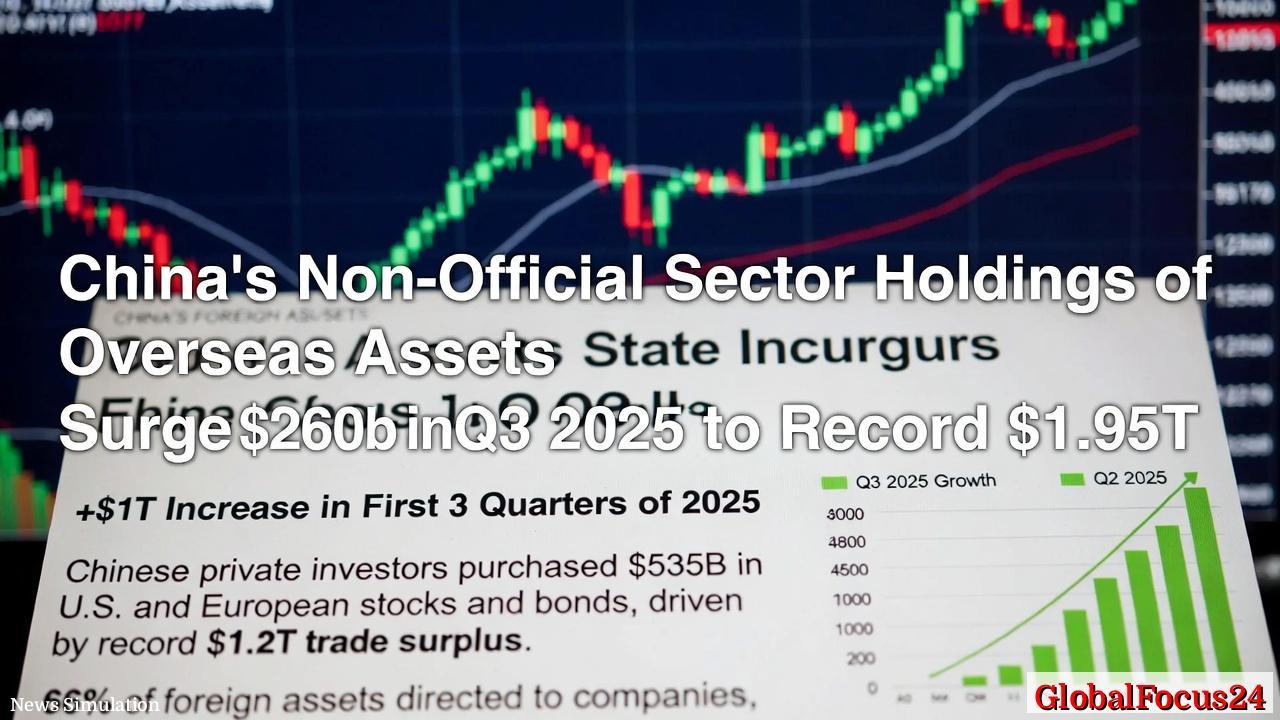
In the third quarter of 2025, China’s non-official sector holdings of overseas assets surged to a record $1.95 trillion, marking a notable shift in how the world’s second-largest economy interacts with global markets. The jump—an increase of $260 billion in just three months—helped push total overseas private assets higher by $1 trillion for the first nine months of the year. This rapid accumulation, which more than doubles the average annual growth rate seen over the preceding decade, signals a significant recalibration of China’s external financial posture and has broad implications for global liquidity, investment patterns, and economic policy dynamics.
Historical context: from official reserves to a broader private footprint For much of the post-2000 era, China’s international financial footprint was anchored in its official reserves. Export earnings, exchange rate management, and macroprudential considerations largely funneled surplus capital into the central bank’s reserve assets, providing a buffer against financial shocks and aiding monetary stability. Over time, however, the composition of China’s external asset holdings began to shift. The third-quarter 2025 data underscore a pronounced transformation: private sector entities—ranging from state-backed lenders to individual and corporate investors—are increasingly channeling capital into overseas markets, diversifying away from the traditional emphasis on official reserve accumulation.
Private sector momentum: a $535 billion inflow into Western equities and bonds A standout feature of the 2025 cross-border flow is the private sector’s appetite for foreign securities. Chinese private investors deployed roughly $535 billion into U.S. and European stocks and bonds during the year’s first three quarters, signaling a level of risk tolerance and diversification that far exceeds historical norms. This activity contrasts with the more conservative posture associated with official reserves and official sector financing. The acceleration in private allocations aligns with a broader global environment characterized by yield chasing in advanced markets, relative valuation attractiveness, and perceived opportunity in technology, financial services, and diversified income streams.
Drivers of the shift: trade surpluses, diversification, and market access Several interlocking factors help explain this shift. First, China’s record trade surplus—reported at roughly $1.2 trillion—has supplied a substantial pool of foreign exchange earnings that can be allocated beyond traditional reserve accumulation. The data indicate that about two-thirds of foreign assets in the period were directed to private sector actors—companies, individuals, and state lenders—rather than the central bank. This distribution reflects a strategic reallocation toward private channels, seeking higher returns, geopolitical diversification, and exposure to foreign capital markets.
Second, a broad push toward diversification is evident. By broadening holdings across equities, bonds, and other financial instruments in major economies, Chinese private investors gain exposure to global growth opportunities and hedge against domestic macroeconomic risks. This approach can also be viewed as a response to a more complex, multi-polar global economy in which capital seeks to optimize risk-adjusted returns across borders.
Third, the accessibility and depth of international markets have improved. Financial products, brokerage platforms, and regulatory coordination over the past decade have lowered barriers to entry for large, sophisticated investors. While official reserves prioritize stability and liquidity, private sector participants are more willing to take on currency and market risk in pursuit of higher income streams and capital appreciation.
Economic impact: implications for markets, credit, and growth dynamics The expansion of private overseas assets has several meaningful economic implications, both domestically in China and globally.
- Global liquidity and market breadth: Private flows from China add to the pool of global liquidity, particularly in securities and cross-border investment channels. With official reserves remaining relatively flat around $3 trillion, private capital can become a more important engine of liquidity, potentially influencing asset valuations, volatility, and benchmark yields in advanced economies.
- Asset allocation and yield dispersion: As Chinese private investors seek overseas exposure, demand for U.S. and European equities and bonds can support higher valuations in those markets, while potentially compressing yields on core government bonds if flows are sizable relative to risk. This dynamic can influence global risk premia and the cost of capital for multinational corporations.
- Currency implications: Large private outflows in pursuit of foreign assets can exert downward pressure on the renminbi in the short term, depending on the mix of holdings and hedging strategies employed by investors. Over time, if the private sector consistently diversifies outward, the currency dynamics may stabilize through improved current account balances and capital account management.
- Domestic investment and innovation: Capital that leaves the domestic economy via private overseas investment could raise concerns about the financing of domestic growth, but it can also reflect a sophisticated, outward-looking investor base seeking to balance risk. The net effect depends on whether domestic channels remain accessible and whether foreign investments feed back into Chinese lending, technology, or infrastructure through joint ventures, domestic preservation of value, or future reinvestment.
- Financial sector evolution: The private sector’s growing role in cross-border asset accumulation can influence the development of Chinese financial institutions, including asset managers, banks, and wealth management platforms. Increased demand for cross-border investment products may spur product innovation, risk management enhancements, and regulatory modernization.
Regional comparisons: how China’s experience contrasts with peers China’s shift toward private overseas assets mirrors some trends seen in other large economies, yet the magnitude and speed set it apart in several ways.
- United States and Europe: The inflow of Chinese private capital into U.S. and European markets underscores a high level of financial integration. Compared with the behavior of private capital from other regions, Chinese investors appear more willing to diversify broadly across asset classes, including private equity and fixed income, while maintaining substantial trade-linked foreign exchange inflows.
- Emerging markets in Asia: Intra-Asian investment patterns show increased cross-border funding, but the Chinese private sector’s outbound reach into developed markets is unusually expansive. This could alter regional capital dynamics, potentially supporting growth in recipient economies while affecting cross-border competition for risk capital.
- Global money markets: As private flows become a more regular feature of the global financial system, money markets could see more frictionless access to liquidity, but also heightened sensitivity to macroeconomic shifts in China. This underscores the importance of monitoring capital-flow indicators and macroprudential policy coordination among major economies.
Public reaction and policy considerations Public reaction to China’s growing private overseas asset base has been mixed, reflecting both optimism about diversification and concern about capital outflows. On one hand, capital markets across major economies may benefit from new instruments and longer-dated funding, contributing to innovation, investment, and job creation. On the other hand, observers worry about the potential for capital flight under stress scenarios, exchange-rate volatility, and the long-term implications for domestic investment and monetary policy autonomy.
Policymakers in China are faced with balancing the benefits of outward private investment against the need to maintain financial stability and sustainable growth. This involves ensuring adequate domestic savings channels remain accessible, maintaining prudent risk controls, and coordinating with international partners to foster transparent, well-regulated markets. The evolution from reserve-centric management to a broader private-sector-led cross-border investment model suggests a transitional period in which policy tools—ranging from macroprudential measures to capital-flow transparency—are recalibrated to support a resilient, internationally integrated economy.
Regional and global indicators to watch Several indicators will help gauge the trajectory of China’s private overseas asset position and its broader macroeconomic implications:
- Private sector holdings growth rate: Monitoring quarterly changes in non-official overseas assets will reveal whether momentum persists beyond 2025 and whether the third-quarter surge represents a new baseline.
- Composition by asset class: Tracking shares allocated to equities, corporate or government bonds, real estate, and alternative investments will show evolving risk appetites and diversification strategies.
- Central bank reserve trends: While official reserves have remained relatively flat, any acceleration or deceleration in reserve growth could signal shifting risk tolerance or currency management strategies.
- Trade balance dynamics: With a record trade surplus feeding foreign assets, changes in export growth, import coverage, and terms of trade will influence the scale and direction of capital flows.
- Currency stability and capital-flow management: Exchange-rate movements, capital-control measures, and regulatory transparency will be important to assess the resilience of both domestic and foreign markets to these capital movements.
Case study: the manufacturing backbone and financialization China’s export-led growth model, anchored in manufacturing and scale, has long benefited from foreign demand for its goods. In the 2020s, as the country transitions to a more service- and innovation-driven economy, the financialization of external surpluses via private sector channels can be seen as a natural progression. The private sector’s appetite for foreign assets reflects a broader strategy to optimize returns, diversify risk, and build global economic influence beyond traditional manufacturing hubs.
This evolution also mirrors a global trend in which capital markets become increasingly interconnected. Private investors, corporations, and financial institutions are no longer confined to domestic opportunities; instead, they actively seek hedging opportunities, growth potential, and currency diversification across borders. The result is a more complex, interdependent global financial system where capital moves swiftly in response to interest-rate cycles, policy signals, and technological innovation.
Implications for investors and businesses abroad For foreign investors, the surge of Chinese private capital offers new sources of funding and potential collaborative opportunities. Companies seeking capital can anticipate a broader spectrum of interested buyers, including large sovereign- and private-sector investors, potentially improving liquidity and pricing dynamics for certain securities. Conversely, investors in Chinese markets should be aware of evolving regulatory and market structure considerations as China’s outbound investment footprint grows.
Businesses—especially in high-growth sectors like technology, green energy, and advanced manufacturing—may see increased demand for cross-border investment products, wealth management services, and financial instruments designed to manage cross-currency exposure. The interplay between private capital inflows and domestic policy aims will continue to shape market expectations, risk assessments, and strategic decisions across global supply chains.
Conclusion: a new chapter in China’s financial globalization The third-quarter surge in China’s non-official overseas assets, coupled with a multi-quarter accumulation that eclipses prior norms, signals a turning point in how the country deploys its vast financial resources abroad. The private sector’s active participation in global markets—driven by a record trade surplus, diversification goals, and greater access to international investment channels—augurs a more interconnected and dynamic global financial system. While the longer-term effects remain to be seen, the trend underscores the importance of monitoring cross-border capital flows, regional economic engagement, and policy frameworks that ensure financial stability while enabling innovation and growth.
As markets digest these developments, observers will pay close attention to how this private-sector-led capital mobility influences asset prices, currency dynamics, and the pace of global economic integration. The transformation from reserve-centric management to a broader, more diversified set of external assets marks a pivotal moment in the ongoing evolution of China’s role in the world economy.