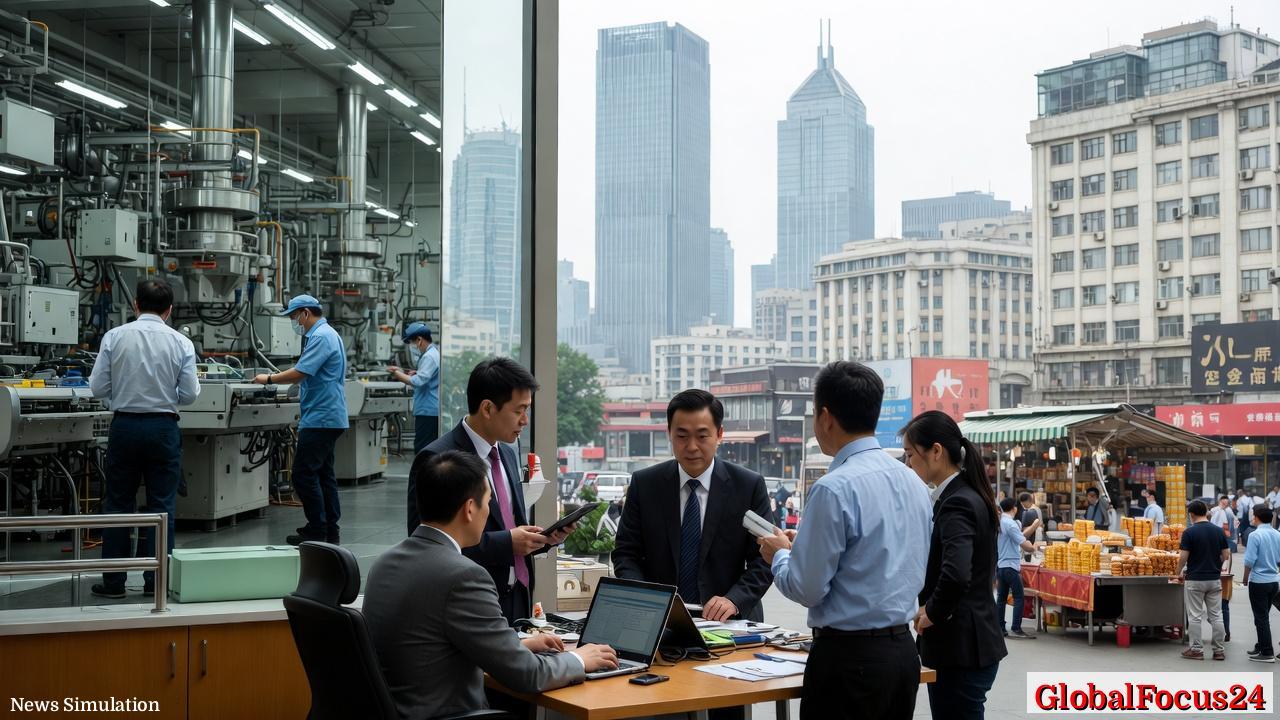
China Surges to 2025 Growth Target Amid Global Headwinds and Trade Dynamics
China weathered a year of global economic uncertainty to meet its official gross domestic product growth target for 2025, signaling resilience in the world’s second-largest economy. Official figures show a 5% expansion, a result that reinforces the long-term trajectory of China’s development strategy while underscoring the complexities of balancing rapid export-led momentum with domestic reforms and demographic challenges. The year’s performance blends historical context, regional comparisons, and a nuanced view of the economy’s drivers and pressures.
Historical Context: Decades of Growth and the Demographic Shift China’s growth story since the turn of the century has been characterized by a transition from an export-heavy industrial engine to a more diversified, consumer- and technology-oriented economy. In the early 2000s, growth stemmed largely from manufacturing scale, infrastructure investment, and an export surge that integrated China deeply into global supply chains. Over the past decade, policymakers have aimed to rebalance growth toward services, innovation, and domestic demand, while managing the aging population and shifting labor force dynamics.
The 2025 results continue that historical arc: a 5% expansion, while comparatively modest against the heady double-digit years of earlier decades, signals sustained momentum in a more complex environment. This outcome unfolds as the country confronts a population decline that, even by official counts, has accelerated beyond prior projections. Demographic headwinds complicate long-term growth potential and press policymakers to intensify productivity gains, foster high-tech sectors, and expand consumer-driven growth to offset shrinking labor supply.
Economic Drivers: Trade Surplus as a Key Pillar A defining feature of 2025 was a record-breaking trade surplus, approaching approximately $1.2 trillion. This extraordinary external surplus acted as a stabilizing macroeconomic force, providing supportive capital inflows, reinforcing the current account balance, and underpinning exchange-rate resilience. Exports benefited from competitive pricing, integrated global supply chains, and demand for manufactured goods, reflecting China’s ongoing role as a global supplier of electronics, machinery, and consumer products.
Domestically, investment growth cooled relative to earlier boom cycles, a development that aligns with a deliberate shift in policy emphasis. While private and state-led investment remained substantial, the government signaled a gradual transition toward quality-driven growth—prioritizing efficiency, environmental performance, and emerging industries over sheer scale. This shift helped moderate inflationary pressures and contributed to a more balanced growth profile, even as external demand carried a sizable portion of output.
Regional Comparisons: Benchmarking Against Peers Within Asia, several economies faced comparable issues—ranging from inflationary pressures to shifting export demand and supply chain realignments. Japan and South Korea confronted slower external demand and demographic challenges, while Southeast Asian economies benefited from regional supply chain diversification and rising domestic consumption. Against this backdrop, China’s 2025 performance stands out for its combination of a sizeable external surplus and continued growth, illustrating how a large, transition-oriented economy can maintain momentum amid turbulence.
China’s performance also invites a look at developed economies overseas. In the United States and parts of Europe, growth in 2025 reflected a mix of resilient consumer demand and manufacturing adjustments, as well as policy-influenced investment cycles. While the global economy demonstrated pockets of strength, it also faced volatility from geopolitical tensions, trade frictions, and energy price fluctuations. Against this mixed backdrop, China’s achievement highlights the persistence of its export sector and the ability to navigate external shocks with a steady growth cadence.
Policy Framework: Navigating Moderation and Reform The 2025 results reflect a policy framework that emphasizes stability, gradual reform, and strategic investment in capable, high-value sectors. The government has prioritized innovation-driven development, digital infrastructure, and green technology as pillars of sustainable growth. Measures that support small and medium-sized enterprises, alongside targeted incentives for high-tech manufacturing and services, have helped translate macroeconomic stability into concrete progress in productivity and innovation.
Monetary policy, closely coordinated with fiscal measures, has aimed to balance liquidity conditions with the goal of controlling inflation and supporting employment. The approach seeks to prevent excessive credit growth while ensuring financing for strategic sectors, such as semiconductors, electric vehicles, and renewable energy technologies. The combined effect is a growth environment that favors quality and resilience over rapid but uneven expansion.
Supply Chains and Global Trade: Resilience Under Pressure The 2025 trade performance underscores the enduring resilience of China’s global supply chains. Even as trade tensions persisted, the export sector demonstrated adaptability—diversifying markets, adjusting product mixes, and leveraging scale to maintain competitiveness. The record surplus also points to the importance of external demand as a stabilizing mechanism for the broader economy.
Global buyers continued to rely on China for a wide range of goods, from consumer electronics to industrial equipment. This reliance helped cushion the economy from domestic investment slowdowns and provided a platform for ongoing technological collaboration and manufacturing efficiency improvements. The trade dynamics of 2025 illustrate how a large, export-oriented economy can sustain growth by combining competitive manufacturing capabilities with strategic shift toward higher value-added production.
Public Reaction and Market Signals: Confidence in Continuity Public reaction to the year’s economic results reflected a cautious optimism. Businesses highlighted the stability of the external balance and the predictability of policy directions, while households weighed the implications of demographic trends for future consumption and savings. Financial markets responded to the positive growth figure with adjustments in expectations for investment, currency movements, and equity performance, reflecting a complex interplay between macro stability and sector-specific opportunities.
From a regional lens, investors looked at the long-run viability of growth drivers, balancing concerns about aging demographics with the potential for productivity gains and technological advancement. Policymakers emphasized clarity and continuity, signaling a continued preference for measured reforms and targeted investments that bolster domestic resilience without compromising international competitiveness.
Economic Impact: Jobs, Investment, and Innovation A 5% GDP growth rate, supported by a large current account surplus, has multiple implications for employment, investment, and innovation. Employment dynamics benefited from robust exports and manufacturing activity, while services sectors gradually absorbed more labor through higher-value offerings and digital economy expansion. The investment landscape showed a tilt toward capital-intensive industries, including advanced manufacturing, information technology infrastructure, and green energy projects, aligning with a broader strategy to raise productivity and environmental performance.
Investors weighed opportunities in high-tech sectors, where government incentives and private capital aimed to accelerate breakthroughs in areas such as artificial intelligence, semiconductor production, and renewable energy technologies. The overall economic impact included enhanced trade relationships, stronger foreign exchange resilience, and a framework that supports long-term growth through structural reforms and steady policy guidance.
Regional Outlook: United States, Europe, and Beyond In the broader regional context, Chinese growth interacts with the pace of recovery and investment in major economies. U.S.-China relations continue to influence trade patterns, technology policy, and supply chain considerations, while European demand for Chinese goods or technology remains a significant factor in regional trade balances. The Asia-Pacific region, in particular, is watching how China’s reform pathway affects neighboring economies through supply chain realignments, investment flows, and shared infrastructure initiatives.
Historically, regional peers have seen varied outcomes based on domestic policy choices, currency dynamics, and external demand. As China sustains a 5% growth trajectory, regional partners assess implications for commodity markets, transportation networks, and investment climates. The cross-border effects of a healthy Chinese economy can stimulate regional demand for raw materials, components, and advanced manufacturing services, while also encouraging diversification strategies to reduce exposure to any single market.
Future Prospects: Toward Sustainable, High-Quality Growth Looking ahead, observers expect China to maintain a path toward sustainable, high-quality growth. This includes continuing reforms that enhance productivity, expand consumer demand, and strengthen social safety nets in the face of demographic shifts. Investment in innovation, digital transformation, and green technologies is likely to remain at the forefront of policy planning, with an emphasis on integrating domestic and international markets through improved trade relations and investment rules.
Challenges persist, including the need to further rebalance growth away from dependence on external demand and to broaden private-sector confidence in investment opportunities. Policymakers will likely prioritize reducing financial risks tied to local government debt, managing real estate sector adjustments, and ensuring a stable monetary environment that supports enterprise investment without stoking inflationary pressures.
Conclusion: A Steady Cadence in a Dynamic Landscape China’s 2025 performance underscores a nuanced balance between resilience and reform. A 5% growth rate, underpinned by a record trade surplus and supported by a framework aimed at innovation and sustainable development, points to a growth path that prioritizes stability, productivity, and long-term capacity. While demographic shifts and global uncertainties present ongoing challenges, the year’s results demonstrate China’s ability to navigate a complex global economy with a steady, pragmatic approach.
As markets, policymakers, and businesses digest these figures, the broader lesson is clear: resilience in the face of external volatility requires adaptable strategies, diversified growth sources, and a commitment to structural reforms that unlock higher value across industries. In this context, China’s 2025 outcomes offer a lens into how a large, transition-focused economy can sustain progress by aligning policy, industry, and international engagement toward a common objective: durable, inclusive growth.