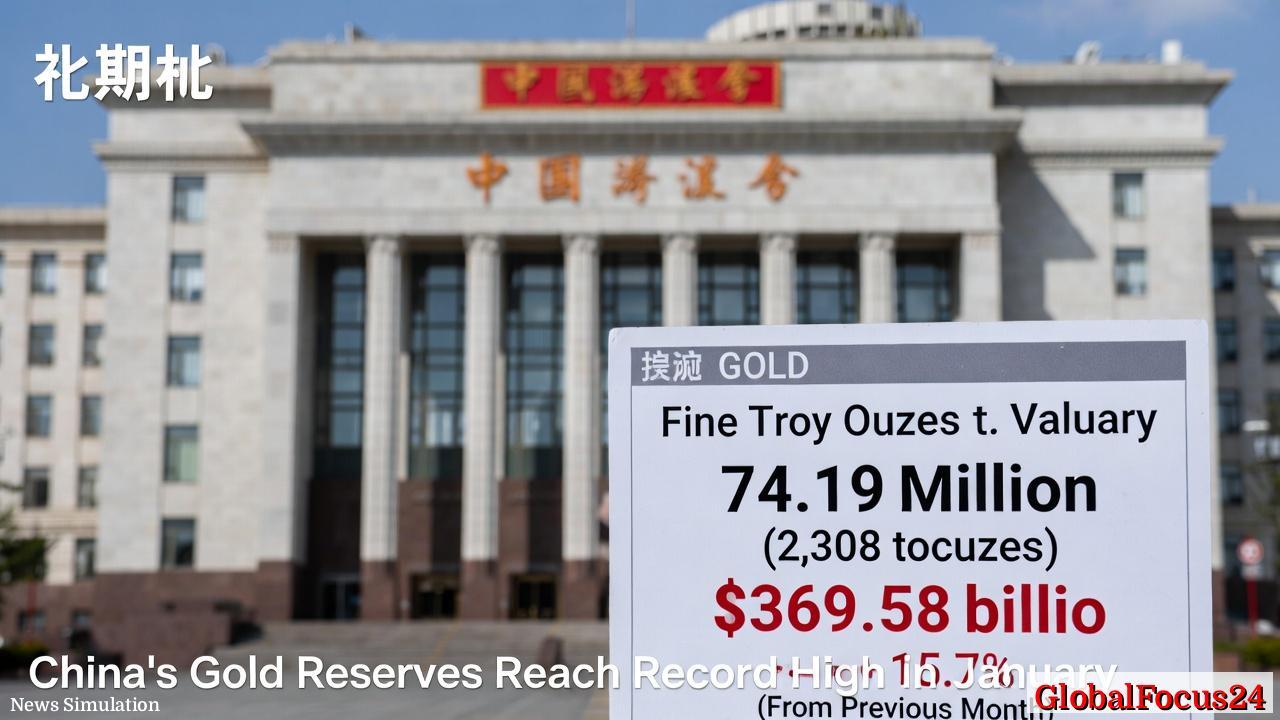
China’s Gold Reserves Reach Record High in January
Beijing — China’s central bank reported a continuation of its systematic accumulation of gold, with January's official data showing reserves rising to a record high of $369.58 billion. The update reflects a 15.7% month-on-month increase and marks the 15th consecutive month of gold purchases since the People’s Bank of China (PBOC) resumed steady accumulation in late 2024 after a brief earlier pause. The central bank added 40,000 ounces to its holdings in January, bringing total fine-troy ounces to 74.19 million, or about 2,308 metric tons.
Historical context: a strategic shift toward diversification and balance sheet resilience China’s ongoing gold purchases fit a broader historical arc in which the country has sought to diversify its foreign exchange reserves, supplementing a heavy reliance on official dollar assets with tangible reserves that can function as a hedge against currency volatility and geopolitical uncertainty. Since late 2022, policymakers have increasingly emphasized the role of gold as a store of value and a means of reducing exposure to single-asset risk. The January data underscores the persistence of that strategy, as the reserves’ value has swelled roughly 260% from levels seen in October 2022, driven in part by surging global gold prices that climbed above peaks not seen in years.
Economic impact: signaling confidence and stability in a shifting global landscape The continued growth in China’s gold holdings carries several implications for the economy and financial markets. First, it reflects a deliberate shift toward asset diversification within the country’s official sector, potentially influencing domestic demand for gold as an investment and as a symbol of economic steadiness. Second, the expansion of gold reserves provides a cushion against currency depreciation or external financing shocks, contributing to a more resilient external position as trade volumes evolve and monetary conditions tighten globally.
In relative terms, gold now represents approximately 9.6% of China’s total foreign exchange reserves, which stood near $3.4 trillion at the end of January. This share, while modest relative to the total, has grown meaningfully over the past few years as the PBOC has balanced its asset mix. The shift also aligns with the broader trend among several large reserve holders to diversify holdings away from a heavy concentration in dollar-denominated assets, alongside strategic considerations tied to global monetary dynamics and market sentiment.
Regional comparisons: how peers are positioning precious metals China’s gold accumulation mirrors, in part, a wider pattern seen among other major reserve holders, though with distinct timing and emphasis. For example, central banks in several economies have increased gold purchases during periods of heightened uncertainty or when diversification of reserve assets is a stated priority. The United States maintains a comparatively smaller role for gold in official reserves, while central banks in parts of Europe and Asia have resumed or intensified gold acquisitions as part of risk management and policy signaling. The scale and pace of China’s purchases, however, remain notable for their consistency and the sustained run of monthly acquisitions since late 2024.
Market dynamics: the price environment and the currency backdrop January’s record reserve level occurred in a context of elevated gold prices, which have continued to attract demand from central banks seeking a balance between liquidity, liquidity risk, and long-term value storage. While price volatility can influence the timing of acquisitions, the PBOC’s steady approach signals a commitment to a longer horizon strategy rather than opportunistic, short-term positioning. The evolving macro environment—encompassing currency movements, inflation expectations, and geopolitical risk—helps explain why gold remains a relevant instrument for official reserve management.
Public reaction and policy implications: signaling resilience without distortion Public response to central bank reserve dynamics often centers on questions about the implications for consumption, investment, and exchange rates. In China, official reserve management is primarily viewed through the lens of macroeconomic stability and national confidence in the monetary framework. While the central bank’s purchases are not designed to influence short-term markets in isolation, they contribute to an environment where the currency framework gains additional structural support in times of global uncertainty. For policymakers, maintaining a diversified reserve mix helps cushion the economy against shocks and supports credit conditions by underpinning the credibility of macroeconomic policy.
The path ahead: considerations for investors and stakeholders For investors and analysts, the ongoing expansion of gold reserves provides a signal about the official sector’s risk management posture. It may influence expectations around long-term inflation hedging, cross-border capital flows, and the relative attractiveness of gold-related assets within diversified portfolios. Observers will likely monitor subsequent monthly data for signs of persistent accumulation, recalibration in response to gold price movements, and any shifts in the balance between gold and other reserve assets.
Technical detail: current holdings and reserve composition
- January reserves: about $369.58 billion, up 15.7% sequentially.
- Gold volume: 74.19 million fine troy ounces, approximately 2,308 metric tons.
- Monthly addition: 40,000 ounces in January.
- FX reserves total: roughly $3.4 trillion at the end of January.
- Gold share of reserves: about 9.6%.
Implications for global gold markets and financial safety nets China’s ongoing accumulation adds to the global demand narrative for gold, reinforcing gold’s role as a cornerstone asset in official safety nets. The central bank’s approach contributes to a broader sense of monetary prudence and risk management that complements domestic economic reforms and strategic growth initiatives. In an interconnected global system, diversification of reserves can affect liquidity, currency stability, and the perceived reliability of monetary authorities, influencing both short-term market behavior and long-range planning by counterparties in trade and finance.
Regional economic context: China’s growth environment and export resilience China’s economy has faced a complex mix of domestic reform priorities, post-pandemic normalization, and shifting external demand. The gold reserve expansion occurs alongside ongoing efforts to maintain financial stability, sustain investment in infrastructure and technology, and manage exchange rate expectations. While the direct effects of reserve diversification on gross domestic product are limited, the credibility and resilience associated with a diversified reserve portfolio support confidence among investors and trading partners. As regional economies in Asia adapt to evolving supply chains, energy costs, and demand cycles, China’s reserve strategy remains a key data point in assessing the region’s financial architecture and risk posture.
Conclusion: a measured stance in a dynamic world China’s gold reserves reaching a record high in January underscore a deliberate, methodical approach to reserve management. By steadily increasing holdings for the 15th consecutive month, the PBOC signals a commitment to asset diversification and a robust financial buffer in an era of heightened global uncertainty. The evolution of reserve composition, coupled with the overall growth of foreign exchange assets, reflects a broader trend among large economies to balance traditional currency holdings with tangible reserve assets. As markets watch for the next updates, the trajectory suggests that gold reserve strategy will continue to be an influential factor in China’s macroeconomic stability and its role in global financial markets.