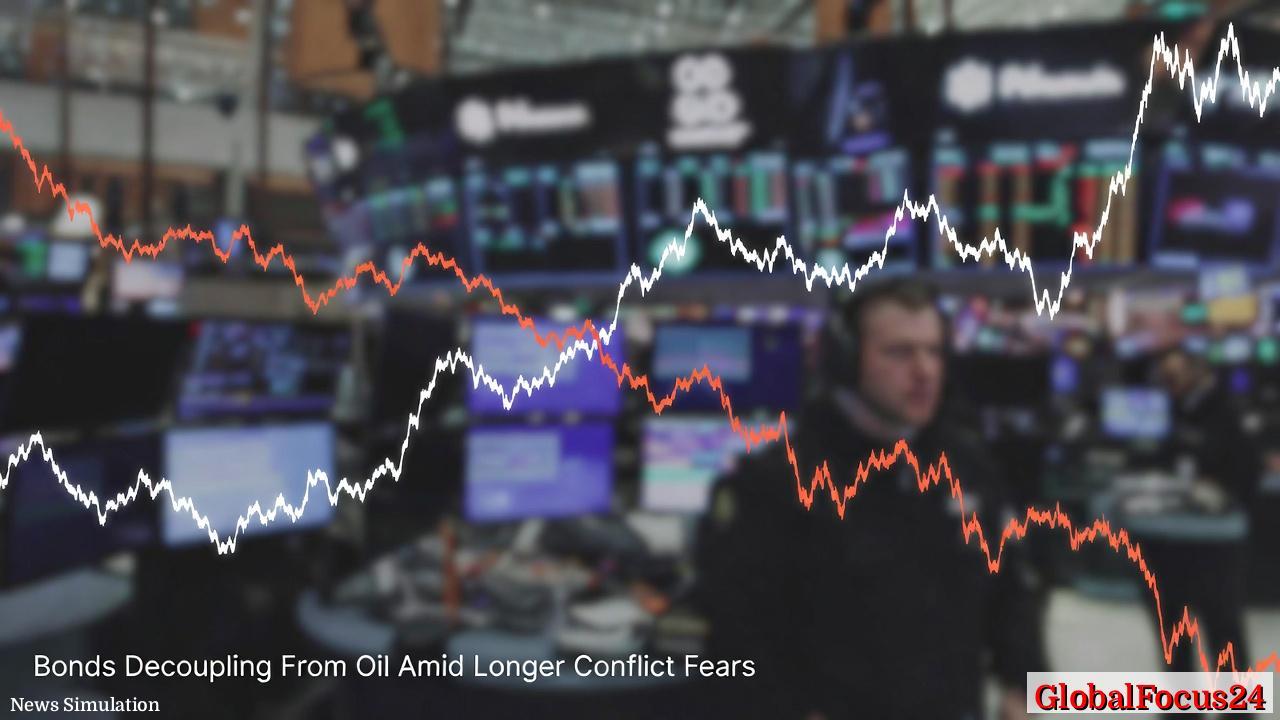
Bonds Decoupling From Oil Amid Longer Conflict Fears
Market Correlations Begin to Fray
For much of the past week, global financial markets have been moving in lockstep with energy prices. As geopolitical tensions deepened in the Middle East, oil and bond markets initially followed a familiar pattern: crude prices rose on fears of supply disruptions, while investors sought safety in government debt, pushing bond prices higher and yields lower. That pattern has broken sharply in recent days.
Government bonds are now selling off even as oil prices remain elevated, underscoring a shift in investor focus from immediate conflict risk to the longer-term specter of persistent inflation and tighter monetary policy. The decoupling signals growing concern that an extended geopolitical crisis could keep inflation pressures alive, forcing central banks to hold interest rates higher for longer than expected.
Oil Prices Hold Firm Despite Volatility
Benchmark crude oil prices have hovered near multi-month highs, with Brent crude trading above $90 a barrel and West Texas Intermediate (WTI) holding only a few dollars below that threshold. The resilience reflects both the durability of demand and the fragility of supply routes that pass through key chokepoints, especially the Strait of Hormuz, which handles roughly one-fifth of the world’s seaborne oil shipments.
Market participants remain alert to any sign of escalation that could disrupt flows through these routes. Tanker insurance premiums have risen through the week, and analysts report an uptick in charter rates as carriers price in the possibility of extended geopolitical unrest.
While there has been no direct interruption in output, the perceived risk is enough to sustain the oil market’s recent rally. This structural bid in energy prices contrasts with the behavior of bond markets, where optimism about stabilizing inflation has abruptly reversed.
Bond Markets Pivot to Inflation Risk
Government bonds, particularly U.S. Treasuries, have come under renewed pressure. The two-year Treasury yield surged past 4.8% after a steep selloff, reflecting investor sentiment that interest rates are unlikely to ease anytime soon. The ten-year yield followed, climbing toward 4.5% and breaking the pattern of inverse movement with oil prices seen earlier in the week.
In normal circumstances, elevated oil prices trigger safe-haven flows into bonds. However, when those higher energy costs risk feeding inflation, investors instead demand higher yields to compensate for expected price pressures. Traders increasingly expect the central bank to delay any consideration of rate cuts, and some now see the possibility of an additional rate hike as early as April.
Rate futures markets show probability increases for sustained policy tightening, while inflation-linked bonds are seeing rising demand—a clear signal that inflation expectations are reviving after months of improvement.
Historical Context: When Energy and Bonds Diverge
The bond–oil relationship has long been regarded as a barometer for economic sentiment. Historically, periods of geopolitical conflict have triggered a predictable pattern: crude spikes on supply fears, while bonds rally as investors seek safety. Yet, this correlation weakens when inflation becomes the dominant concern.
A similar divergence last emerged in the 1970s oil shocks, when surging energy costs coincided with rising inflation and central banks were forced into a tightening cycle. The result was a breakdown in traditional market relationships—safe-haven assets offered little protection as inflation eroded their real returns. The present environment evokes echoes of that history, though market structures and monetary tools are more sophisticated today.
During the Gulf War in 1991 and the 2003 Iraq invasion, bond yields initially fell in tandem with rising oil, reflecting risk aversion. However, they bounced back as the conflicts dragged on, mirroring renewed inflation anxiety. This pattern suggests investors interpret today’s volatility not merely as a geopolitical event but as a potential trigger for a broader inflationary regime.
Central Banks Face Renewed Dilemma
For policymakers, the decoupling of bonds and oil poses a complex challenge. The central bank must balance its mandate to contain inflation with the risk that tighter financial conditions could dampen growth just as global trade faces renewed uncertainty.
The longer oil prices remain elevated, the greater the likelihood ofinflation reaccelerating. Fuel costs feed into transportation, manufacturing, and wholesale prices, creating a chain reaction that affects consumer spending power. Recent data already show that energy-related price increases have begun to filter through to core inflation metrics.
Market expectations for policy rates reflect this tension. While some analysts had anticipated rate cuts by mid-2026, those projections are being postponed. Instead, investors are positioning for a sustained period of restrictive monetary policy, particularly in the United States and parts of Europe where inflation remains above target.
Economic Impact Across Regions
Regionally, the effects of this bond–oil decoupling are diverging. In the United States, the economy’s relative energy independence cushions the direct impact of higher crude prices, but inflation dynamics remain sensitive to global supply chain costs and wage growth. The dollar has strengthened as yields rise, putting additional strain on emerging markets that borrow in U.S. currency.
In Europe and Asia, higher energy costs have a more immediate impact. European bond yields have also climbed, though less dramatically than in the U.S., as investors anticipate slower growth but continued inflation pressures. In Japan, the yield curve remains under close control due to the central bank’s targeted purchasing operations, though market participants are increasingly testing the limits of that policy with short-term speculative positioning.
Emerging markets, especially those reliant on oil imports, face renewed current account pressures. Nations such as India, Thailand, and the Philippines are experiencing currency weakness and rising yield differentials, which could complicate fiscal management. Energy-exporting economies, conversely, are enjoying a temporary windfall, though many remain cautious about expanding production while geopolitical risks remain high.
Equities Show Resilience Amid Uncertainty
While bond and oil markets diverge, global equities have exhibited a surprising degree of stability. Major stock indices remain supported by expectations that corporate earnings will hold up despite higher input costs. Investors also see potential for policy intervention if financial conditions tighten too rapidly.
Energy producers and defense contractors have led recent equity gains, offsetting weakness in consumer and industrial sectors. The technology sector, though sensitive to bond yield movements, has remained resilient thanks to ongoing investment in artificial intelligence and automation—areas perceived as less cyclical and more structural in growth potential.
Market strategists note that equities’ relative calm may reflect positioning rather than confidence. Many institutional investors reduced exposure to rate-sensitive assets earlier in the year, leaving room for selective buying even under volatile macro conditions.
A Shift in Market Psychology
The decoupling between oil and bonds underscores a broader shift in market psychology—from fear of crisis to fear of duration. Investors are no longer reacting solely to immediate conflict risk but to the prospect that the conflict’s economic consequences could persist for years. Sustained inflation could reset yield curves, reprice credit spreads, and alter capital allocation decisions across sectors.
This recalibration has pushed volatility indices higher, though not to crisis levels. The message from the market is one of nervous adjustment rather than outright panic: traders are recalculating the equilibrium between growth, inflation, and risk, not fleeing from it.
Outlook: Prolonged Tensions and Long-Term Repricing
Looking forward, much will depend on the trajectory of the conflict and the speed at which energy markets stabilize. If crude prices remain elevated through the next quarter, bond yields could continue to climb as investors demand higher premiums for inflation risk. Conversely, a de-escalation in geopolitical tensions could restore some correlation as energy prices ease and safe-haven demand returns.
Either outcome highlights how the global economy remains tightly interwoven with energy dynamics. Even as national energy strategies evolve toward diversification and decarbonization, oil retains outsized influence on inflation expectations and market sentiment.
For now, the message from markets is clear: the traditional relationship between oil and bonds is undergoing a structural test. The longer the conflict endures, the more likely it is that bond markets will prioritize inflation over safety—marking a new phase in the complex dance between energy and finance.