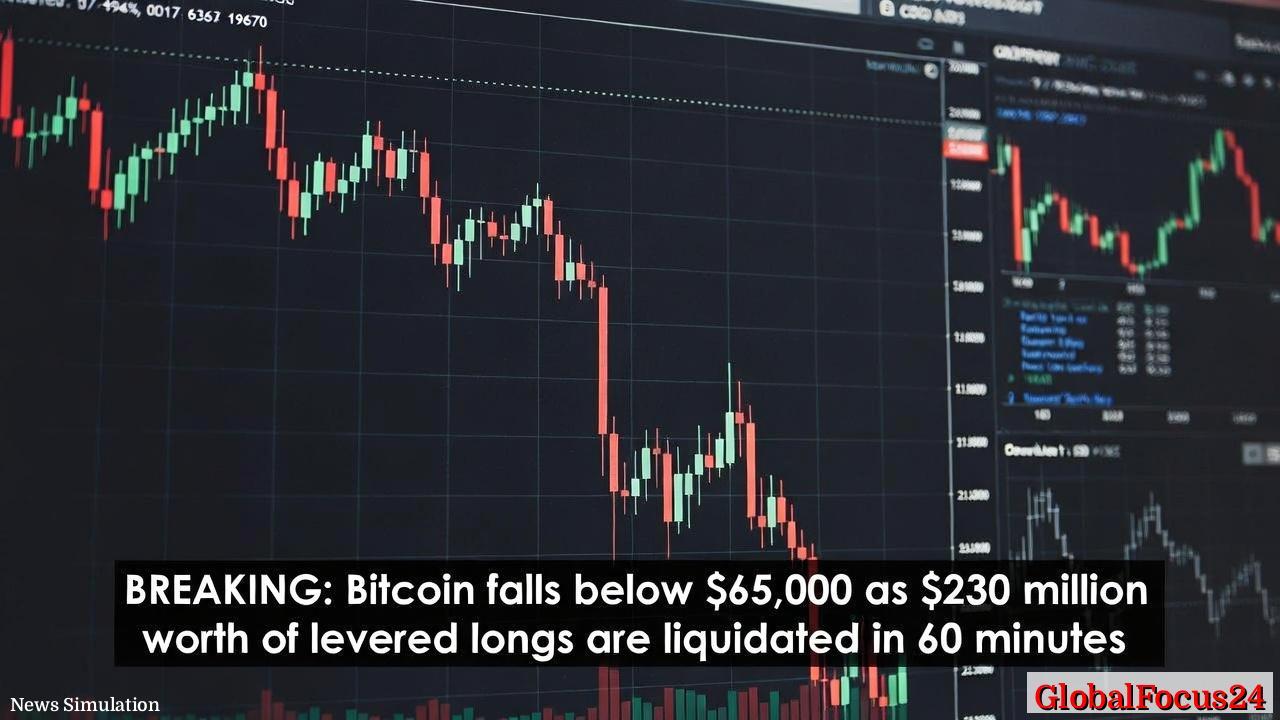
Bitcoin Plunge Triggers $230 Million Levered-Longs Liquidation Across Derivatives Markets
In a rapid move that caught traders off guard, Bitcoin slipped below $65,000, sparking a flurry of forced liquidations in the crypto derivatives space and highlighting the fragility of highly leveraged positions in a volatile market. Within an hour, roughly $230 million in long contracts were liquidated, underscoring the accelerated pace of price discovery and risk management in today’s digital-asset ecosystem.
Context and Background Bitcoin, the largest cryptocurrency by market capitalization, has navigated a years-long cycle of sharp swings driven by macroeconomic signals, institutional participation, and evolving regulatory discourse. The latest episode arrives after a period of relative resilience, with bitcoin hovering near key psychological and technical levels that traders watch as a gauge of market sentiment. Historically, price corrections in digital assets have unfolded in waves: a sudden move triggers liquidations, which can amplify near-term volatility before a renewed supply-demand balance re-emerges. This cycle has become familiar to market participants who monitor order-book depth, funding rates on perpetual swaps, and cross-asset correlations that influence risk-on versus risk-off dynamics.
Economic Implications The immediate economic impact of a swift liquidation event extends beyond the price tick in a single asset. Leveraged positions in crypto futures and options translate market moves into concentrated losses for that moment, potentially spilling into related sectors of the digital-asset economy. Exchange-margin requirements and automatic liquidations serve as blunt risk-control tools, but they can also exacerbate short-term price pressure if multiple lifters of long exposure are forced to exit simultaneously. For exchanges, the episode tests liquidity provision and the efficiency of settlement infrastructure during heightened volatility, with potential spillovers to spot markets, institutional desks, and retail portfolios that hold crypto exposure as part of diversified strategies.
Regional and Sectoral Comparisons From a regional perspective, the current episode mirrors patterns observed during prior sell-offs when price volatility intersects with derivatives-driven dynamics. In major markets with active futures trading, liquidity tends to tighten quickly during sharp moves, prompting a cascade of liquidations that temporarily widen bid-ask spreads and reduce order-book depth. Comparisons across regions show that more mature crypto ecosystems—where clearinghouses, risk controls, and funding-rate mechanisms are well established—tend to absorb surges in leverage with less systemic disruption than nascent markets that lack deep liquidity pools. The balance between centralized exchanges and decentralized venues also influences how traders respond to sudden price changes, with each venue presenting different risk-control architectures and margin-calling practices.
Market Structure and Risk Management The episode underscores the importance of robust risk management in crypto markets. Investors who use leverage should balance potential upside against the risk of rapid deleveraging, particularly in markets characterized by high weekend and overnight risk. Market participants increasingly rely on dynamic margin requirements, real-time monitoring of funding rates, and diversified hedging strategies to mitigate the likelihood of abrupt liquidations. On the institutional side, hedge funds and asset managers often implement multi-venue risk controls and scenario analysis to gauge how correlated positions might react to volatility spikes. Retail traders, meanwhile, are reminded of the importance of risk caps and clear exit strategies when engaging with high-leverage products that amplify small price movements into outsized gains or losses.
The Mechanics of the Move The quick deterioration below the $65,000 level likely triggered a sequence of margin calls across major exchanges. Perpetual futures contracts, which do not have an expiry date, require funding payments to keep the contract price aligned with the underlying asset. When funding rates swing negative, holders of long positions pay funding to those with short exposure, a dynamic that can attract or penalize positions based on market momentum. In a sharp downturn, liquidations can cascade as automated systems force the closing of positions to satisfy margin requirements, thereby injecting additional selling pressure into the market. Observers watch liquidity metrics—such as order-book depth and the pace of open interest adjustments—to gauge whether the market is experiencing a temporary dip or the onset of a broader trend change.
Historical Perspective Crises and corrections in the crypto space have followed notable inflection points since the market’s modern ascent. Past episodes often feature a combination of macro triggers, technical breaches of key levels, and shifts in investor sentiment that drive accelerated selling or buying pressure. While price recoveries have occurred, the duration and depth of each cycle vary, influenced by macroeconomic conditions, regulatory clarity, and the evolution of on-chain activity. Historians of crypto markets note that liquidity conditions and market depth have improved over time as more participants enter the space and as risk-management tools mature, even as volatility remains a defining characteristic of digital assets.
Technological and Regulatory Context Technology platforms that support trading and settlement have evolved to handle higher volumes and faster settlement cycles, but they remain sensitive to rapid price movements. Exchanges continuously upgrade matching engines, risk controls, and reliability measures to prevent outages during stress periods. Regulatory developments in major jurisdictions continue to shape market structure, with ongoing discussions around custody, investor protection, and the surveillance of market manipulation. In this environment, participants must stay informed about regulatory signals that can influence liquidity, margin requirements, and the availability of certain products or markets.
Investor Sentiment and Public Reaction Public reaction to sudden liquidations is often mixed, with some participants interpreting the move as a temporary pullback and others viewing it as a reminder of inherent risk in highly leveraged markets. Market commentary from professionals typically emphasizes disciplined risk management, the importance of diversification, and the value of hedging strategies that can dampen the impact of abrupt price swings. Retail communities frequently discuss price levels, funding rates, and potential catalysts that could spark a recovery, while institutional observers weigh the longer-term implications for market efficiency and price discovery.
Impact on Related Markets Beyond Bitcoin itself, the ripples of a leveraged-long liquidation can affect related digital assets, including altcoins and decentralized finance tokens. When major liquidations occur, correlations can tighten temporarily as traders adjust exposures across the broader crypto complex. This cross-asset influence is dampened or amplified by individual asset liquidity, market news cycles, and evolving derivative product offerings, which shape how quickly other assets respond to shifts in Bitcoin's price. Market participants monitor these relationships to assess risk exposure and to identify potential hedging opportunities in correlated instruments.
Outlook and Strategic Considerations Looking ahead, analysts expect volatility to remain a defining feature of crypto markets in the near term, with subsequent price stabilization depending on macroeconomic cues, regulatory clarity, and ongoing adoption of blockchain-based financial products. Traders may favor risk-managed strategies, including disciplined margin usage and diversified exposure across spot and derivatives markets. Institutions that provide liquidity and risk management services will play a key role in restoring confidence and ensuring orderly trading during periods of stress. For regional markets with robust digital-asset ecosystems, the experience could reinforce the importance of transparent pricing, reliable settlement infrastructure, and strong risk controls as foundations for sustainable growth.
Conclusion The swift price move below $65,000 and the ensuing $230 million in levered-long liquidations within a 60-minute window illustrate both the resilience and fragility of modern crypto markets. As participants absorb the lessons from this episode, the emphasis on prudent leverage, comprehensive risk management, and diversified market access remains central to navigating a landscape where volatility is an enduring companion. The episode also highlights the evolving maturity of crypto markets, where liquidity provisions, risk controls, and institutional participation continue to shape the trajectory of Bitcoin and its broader ecosystem.
Key Takeaways
- A rapid price breach can trigger widespread forced liquidations in derivative markets, underscoring the need for disciplined risk management.
- Leveraged positions amplify short-term moves, increasing the potential for both outsized gains and significant losses.
- Market structure improvements and regulatory clarity continue to influence liquidity and resilience in digital-asset trading environments.
- Regional differences in liquidity and risk-management practices shape how quickly markets absorb shocks and recover.
- Ongoing adoption of hedging strategies and diversified exposure remains a central theme for investors navigating volatility in Bitcoin and related assets.