Bitcoin Falls Below $64,000 as Geopolitical Tensions Spark Market Sell-Off
Cryptocurrency Market Reacts to Escalating Middle East Conflict
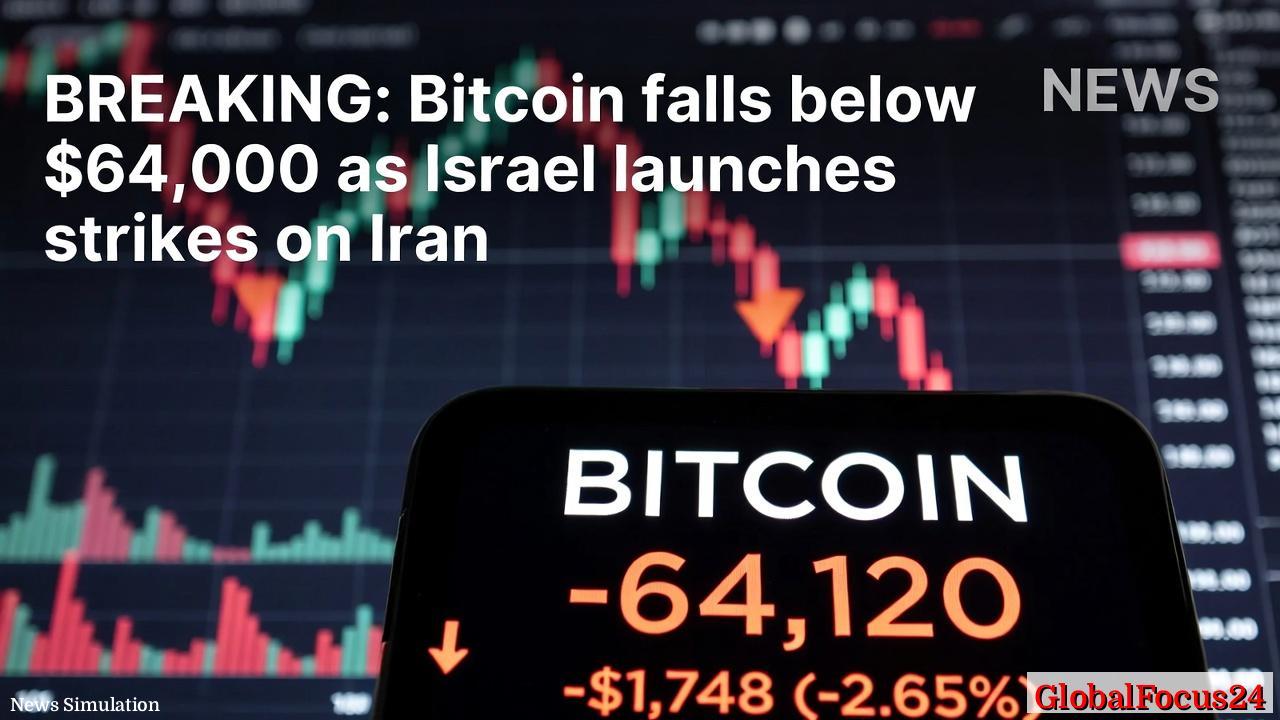
Bitcoin, the world’s largest cryptocurrency by market capitalization, fell below $64,000 late Friday, marking a sharp 2.65% drop in a matter of hours. The decline came as reports surfaced of Israeli strikes on Iranian targets, reigniting fears of a broader regional conflict in the Middle East. In just 15 minutes of volatile trading, more than $100 million worth of leveraged long positions were liquidated across major crypto exchanges, underscoring the fragility of sentiment in risk markets.
The sell-off came after weeks of relative calm in digital assets, with Bitcoin recently hovering above $66,000 and attempting to stabilize following a turbulent start to 2026. But renewed geopolitical uncertainty and rising global risk aversion appear to have rattled investors across asset classes, sending Bitcoin — often viewed as a barometer of speculative risk appetite — sharply lower.
The Ripple Effect of Geopolitical Risk
Markets across the world responded swiftly to the news from the Middle East. Oil prices briefly surged in after-hours trading, while global stock index futures dipped as traders assessed the potential fallout from another chapter of regional escalation. Cryptocurrencies, with their 24-hour global trading cycle and heightened sensitivity to shifts in sentiment, were among the first assets to react.
Although some investors traditionally view Bitcoin as a “digital gold” — a hedge against uncertainty — recent price action has revealed that the asset still tends to behave more like a high-risk investment during sudden market shocks. When investors flee riskier assets, Bitcoin often trades in tandem with equities rather than safe-haven assets like gold or U.S. Treasuries.
This pattern has been observed before. In early 2022, when geopolitical tensions flared before Russia’s invasion of Ukraine, Bitcoin also sold off alongside stock markets before gradually recovering. Analysts note that while the long-term narrative of Bitcoin as an inflation or currency hedge remains intact for some holders, short-term correlations with risk assets persist.
Liquidations Deepen Market Slide
The intensity of the latest drop was amplified by widespread liquidations in the derivatives market. More than $100 million in long positions were wiped out in the span of minutes, according to data aggregators tracking major exchanges such as Binance, OKX, and Bybit. High levels of leveraged trading — where speculators borrow funds to amplify potential returns — can accelerate both rallies and crashes.
Once prices began to slide below key technical levels, automated liquidations triggered a cascade effect, forcing exchanges to sell positions to meet margin requirements. This chain reaction deepened the decline, pushing Bitcoin briefly to an intraday low near $64,120 before stabilizing slightly.
Ethereum, the second-largest cryptocurrency by market capitalization, also fell by roughly 3%, dipping below $3,400. Other major altcoins followed suit, with Solana, Avalanche, and Cardano all posting losses between 3% and 5%. The total global crypto market capitalization dropped by about $70 billion during the downturn.
Historical Parallels and Market Psychology
The market’s reaction to geopolitical news has a familiar pattern. Historically, sudden escalations in global tensions tend to prompt a “flight to safety,” as investors move capital into traditionally secure assets. During similar crises — from the 2019 U.S.-Iran standoff to the 2020 oil market collapse and the 2022 Ukraine conflict — Bitcoin has typically experienced short-term drawdowns.
However, the asset often rebounds quickly once market participants reassess the risk outlook. Data from past episodes show that Bitcoin’s price tends to recover within weeks after initial sell-offs, as traders look for buying opportunities during periods of fear-driven volatility.
Analysts caution, though, that the current geopolitical environment could lead to prolonged uncertainty. A sustained conflict in the Middle East might disrupt oil flows, increase inflation pressures, and prompt major central banks to reconsider their monetary outlooks — all of which could shape crypto performance in the coming months.
Broader Market Context and Economic Implications
Friday’s drop in Bitcoin also coincided with a pullback in broader technology and equity markets. Futures for the Nasdaq Composite and S&P 500 fell modestly after the news broke, suggesting investors were trimming exposure to risk-sensitive sectors. Global energy prices edged higher, raising concerns about potential inflationary spillovers if oil exports are disrupted.
From a macroeconomic perspective, volatility in cryptocurrencies has increasingly mirrored movements in traditional financial markets. Over the past two years, as institutional participation in digital assets grew, Bitcoin’s correlation with equities tightened. This trend has made crypto markets more responsive to macroeconomic data releases, central bank policy decisions, and geopolitical developments alike.
Economists also note that the financialization of Bitcoin — through ETFs, derivatives, and custody services — has contributed to its integration into global capital markets. As a result, events that shake investor confidence or alter risk projections in traditional finance can have a direct and immediate impact on Bitcoin’s price movements.
Regional and Comparative Reactions
The latest decline has been particularly felt in Asia-Pacific markets, where retail trading activity remains high despite consolidated regulations. Exchanges in Singapore, Hong Kong, and South Korea reported surges in trading volume, as investors rushed to reposition amid the turbulence.
In contrast, trading activity in the U.S. remained relatively orderly, as institutional investors appeared to adopt a wait-and-see stance. European markets followed global trends, with minor outflows from crypto-focused investment funds as the euro weakened slightly against the dollar.
Compared with previous regional contagions, the reaction has so far remained contained. During the 2024 Middle East tensions, Bitcoin suffered a sharper intraday loss of nearly 5% before stabilizing. This time, analysts see signs of a more mature market, with liquidity providers and institutional market makers helping to prevent excessive dislocation.
Analysts Weigh Market Outlook
Market strategists remain divided about Bitcoin’s near-term trajectory. Some technical analysts see potential support around the $63,500 level — a price floor that coincides with the 50-day moving average — suggesting the asset could consolidate before regaining strength.
Others warn that if geopoliticals persist, Bitcoin could test lower levels, especially if leveraged liquidations continue. Traders are closely watching macro indicators, including U.S. inflation data and Federal Reserve commentary, for clues about whether global risk sentiment will stabilize.
Despite short-term headwinds, long-term proponents highlight that Bitcoin’s supply halving expected later in 2026 could provide a structural underpinning for prices. Historically, halving events have reduced new supply and contributed to long-term upward momentum once immediate market fears subside.
Investor Sentiment Turns Cautious
Across crypto social media platforms and trading forums, sentiment has shifted sharply from optimism to caution. Many retail traders who had expected Bitcoin to reclaim $70,000 in the near term now appear to be waiting for clearer signals of stabilization. At the same time, some institutional investors are reportedly looking for entry points to accumulate at lower prices, viewing the drop as a potential long-term buying opportunity.
The general mood across markets suggests heightened anxiety but not panic. Volatility indexes spiked briefly but remained below the extreme readings seen during past sell-offs, indicating that traders expect the downturn to be manageable barring further escalation in the Middle East.
The Road Ahead
Bitcoin’s decline underlines the digital asset’s continued susceptibility to global macro and geopolitical shocks despite its decentralization and independence from state control. As risk sentiment oscillates, Bitcoin is once again serving as a real-time indicator of global investor confidence.
Whether the cryptocurrency can quickly recover will depend largely on geopolitical developments, energy market stability, and the broader trajectory of economic growth in early 2026. For now, the world’s most-followed digital asset remains under pressure, a reminder that even in the decentralized era, global turbulence can ripple through every corner of the financial system.