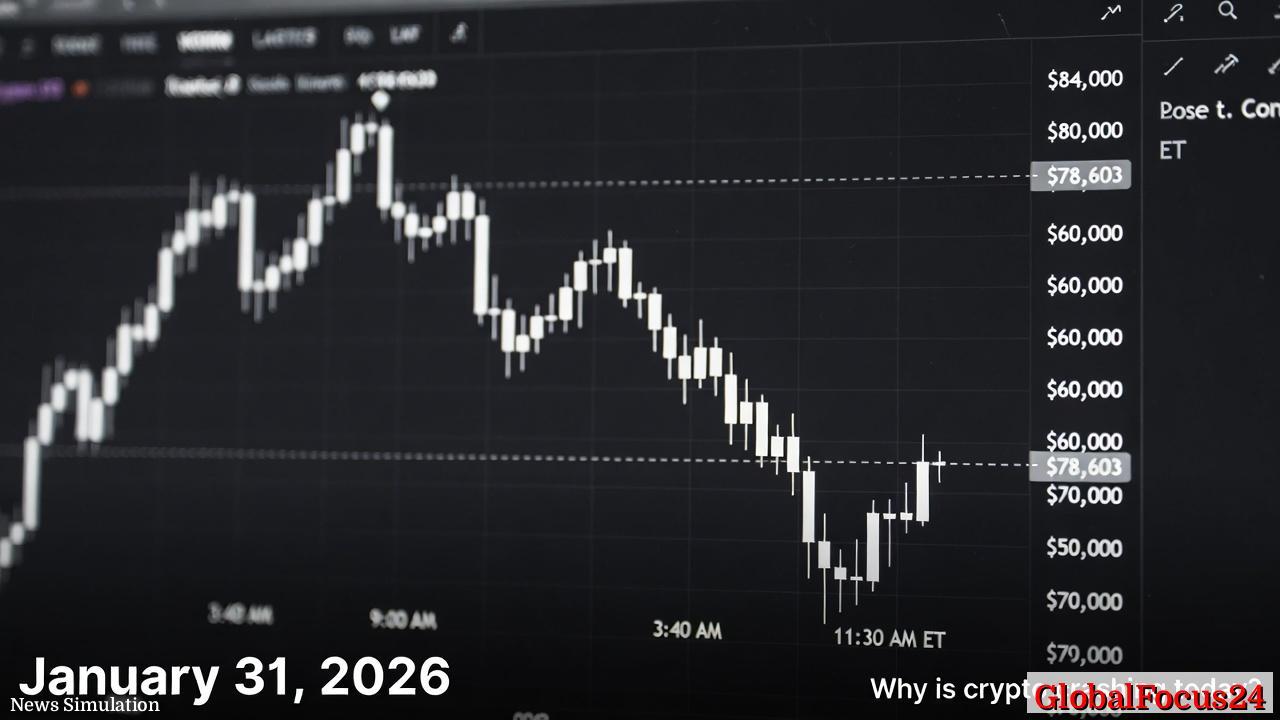
Bitcoin Slumps to $78,603 as Liquidation Pressure Reshapes Crypto Markets
Bitcoin’s sharp retreat on January 31, 2026, underscores the fragility of leveraged positions in a phase of thinner liquidity and heightened volatility. The digital-asset market faced a multi-wave sell-off that swept through the night and into the morning, culminating in a closing price of $78,603 on Bitstamp. The move marks a pronounced break from recent levels and illustrates how risk management, liquidity access, and macro-macroeconomic signals continue to drive price dynamics in the crypto space.
Historical Context: Crypto Markets in Transition
The January 31 decline sits within a broader arc of recent crypto-market cycles, where episodic liquidity squeezes and rapid liquidations have repeatedly punctuated longer-term uptrends. Since the market’s emergence, Bitcoin has shown a pattern of sharp, fast reversals when leverage is high and counterparties pull back liquidity during stressed periods. In the current cycle, traders and institutions alike have recalibrated their exposure to digital assets amid evolving regulatory rubrics, central-bank policy shifts, and a shifting risk appetite among global investors.
From a historical lens, 2020–2021 witnessed explosive growth in Bitcoin’s price, fueled by unprecedented retail participation and institutional interest. Those years were followed by episodes of volatility driven by macros and flow dynamics, including exchange-rate movements, risk-off episodes, and changing liquidity conditions on major trading venues. The latest movement on January 31, 2026, reflects a different, more mature market environment where liquidity depth can be tested quickly, and price discovery can occur in compressed timeframes.
Market Mechanics: How Liquidity and Leverage Shape Sell-Offs
- Rapid liquidation waves occurred in succession, beginning with the first wave at approximately 3:40 AM ET and continuing through 9:00 AM ET and 11:30 AM ET. Each wave exacerbated downward pressure as leveraged positions were forced to close, amplifying price declines.
- By midday, Bitcoin traded around $84,000 earlier in the session, before sliding to the intraday low of $78,603. The final hourly movements demonstrated how liquidity pockets can form when buy-side depth fails to absorb selling pressure, especially for assets with limited immediate settlement risk.
- Across the broader crypto market, roughly $1.3 billion in leveraged liquidations occurred over a 12-hour window. When large leveraged bets unwind, selling pressure can outpace the available bid support, producing air pockets in pricing and sudden, outsized moves.
- The closing price around $78,603 on Bitstamp signaled a material assessment of risk repricing across major exchanges, reflecting both technical indicators and a reevaluation of risk premium in the sector.
Regional and Economic Context: Global Implications
- The January 31 event is not just a Bitcoin story; it reverberates across regional markets where crypto-asset adoption intersects with fintech, payments infrastructure, and traditional finance. Regions with rising retail participation may experience sharper short-term price movements, while more institutionally oriented markets might emphasize risk controls and hedging strategies.
- Economically, the episode occurs amid ongoing conversations about macro policy environments, including inflation dynamics, interest-rate expectations, and cross-border liquidity conditions. Cryptocurrencies have increasingly been treated as a separate asset class within portfolios, but the mechanics of their markets still closely mirror traditional asset-class behavior during periods of stress: liquidity depth, margin requirements, and counterparty risk are all pivotal.
- Comparisons to other recent stress periods show a recurring pattern: rapid unwinds of high-leverage exposure lead to cascading liquidations, even when long-term fundamentals remain intact. This dynamic underscores the importance of robust risk management practices and the need for transparent liquidity metrics across platforms.
Regulatory and Market Structure Considerations
- The incident highlights ongoing conversations about the structure and resilience of crypto markets, including how exchanges manage margin, the speed of risk controls, and cross-exchange liquidity. Regulators are increasingly focused on ensuring that platforms maintain adequate capital and risk management practices to withstand sudden liquidity shocks.
- Market participants continue to seek clarity on custody solutions, settlement mechanisms, and the interoperability of different blockchain ecosystems. As institutional participation grows, the expectation is that more sophisticated risk controls and standardized reporting will emerge to support stability and confidence.
- The event also spotlights the role of stablecoins and collateral markets in providing a buffer during periods of volatility. The ability to quickly deploy or redirect collateral can influence how rapidly positions unwind and how price discovery unfolds in stressed sessions.
Investor and Public Reaction: Sentiment in the Wake of the Drop
- In moments following the sell-off, market sentiment often swings between concern over risk exposure and expectations for a potential rebound, depending on perceived liquidity depth and the resilience of price discovery mechanisms. Public reaction typically involves questions about whether the move constitutes a broader trend or a temporary liquidity squeeze.
- Analysts frequently point to liquidity metrics, order-book depth, and open interest across major futures and perpetual swap markets as indicators of whether buyers see value at the lower price levels or if capitulation is continuing. The balance between fear and opportunity tends to shape short-term trading decisions and longer-term investment strategies.
Technological and Operational Lessons
- The January 31 episode reinforces the importance of strong risk controls in high-leverage trading environments. For traders, it emphasizes the need to monitor margin use, leverage ceilings, and automatic liquidation triggers to mitigate cascading losses.
- For exchanges, the event underscores the value of resilient technology stacks, real-time risk monitoring, and robust connectivity to liquidity providers. The speed at which liquidations can propagate through a market is closely tied to the efficiency of price feeds, matching engines, and cross-venue settlement processes.
- From a product design perspective, the episode may influence future iterations of risk-management tools, including more granular margin metrics, improved liquidation sequencing, and enhanced protections for less liquid times or assets.
Implications for Investors and Portfolios
- Diversification remains a key principle as markets adapt to a more mature crypto ecosystem. Investors may consider balancing exposure across different digital assets, as well as integrating traditional hedges that can respond to macro shocks and liquidity stress.
- Risk budgeting and scenario analysis become even more essential in markets with significant leverage and potentially rapid price swings. Scenario planning can help investors prepare for sudden drawdowns without overreacting to short-term moves.
- The event serves as a reminder that, while the long-term potential of blockchain-based assets remains a topic of debate and research, the near term can be highly sensitive to liquidity cycles and leverage dynamics. prudent risk management, disciplined capital allocation, and clear investment objectives continue to be central to navigating these markets.
Regional Comparisons: The Global Perspective
- In North America, where institutional platforms have grown and liquidity networks are extensive, price movements can be rapid but often see deeper order-book support due to sophisticated market participants. Traders may benefit from more robust hedging capabilities and risk controls, though the presence of high leverage can still trigger sharp drawdowns during stressed periods.
- In Europe, regulatory developments and market structure differences can influence how liquidity dries up during volatility. Cross-border clearing arrangements and centralized platforms can affect the speed and depth of liquidations, shaping regional price behavior.
- In Asia-Pacific, rapid adoption and diverse liquidity ecosystems create a mosaic of responses to shocks. Some markets may experience pronounced volatility driven by local macro news, exchange-specific liquidity dynamics, or shifts in remittance flows and digital-payment adoption.
Conclusion: A Cautionary Moment for a Growing Asset Class
The Bitcoin price drop to $78,603 on January 31, 2026, exemplifies how interconnected factors—leverage risk, liquidity depth, regulatory developments, and macro dynamics—converge to drive abrupt market moves. While the long-term promise of decentralization and digital asset innovation remains a central narrative, the immediate takeaway from this episode is clear: in markets where leverage and liquidity are tightly intertwined, price discovery can flip from orderly to disorderly in a matter of hours.
Market participants will be watching liquidity metrics, exchange risk controls, and macro indicators to gauge whether the current cycle represents a temporary stress event or a signal of a broader re-pricing within the crypto ecosystem. As infrastructure continues to evolve and as investors adjust their strategies to manage liquidity risk more effectively, the near-term environment may feature heightened sensitivity to margin calls, order-book depth, and the availability of counterparties willing to absorb sell pressure.
Public and institutional stakeholders alike will likely seek clarity on how market structures can bolster resilience without stifling innovation. The January 31 episode serves as a concrete reminder that, even as technology advances, the financial dynamics that govern asset markets—risk, liquidity, and price discovery—remain deeply human in their origins and consequences. The road ahead will involve balancing the growth of decentralized finance with robust safeguards that protect investors and preserve the integrity of markets across regions.