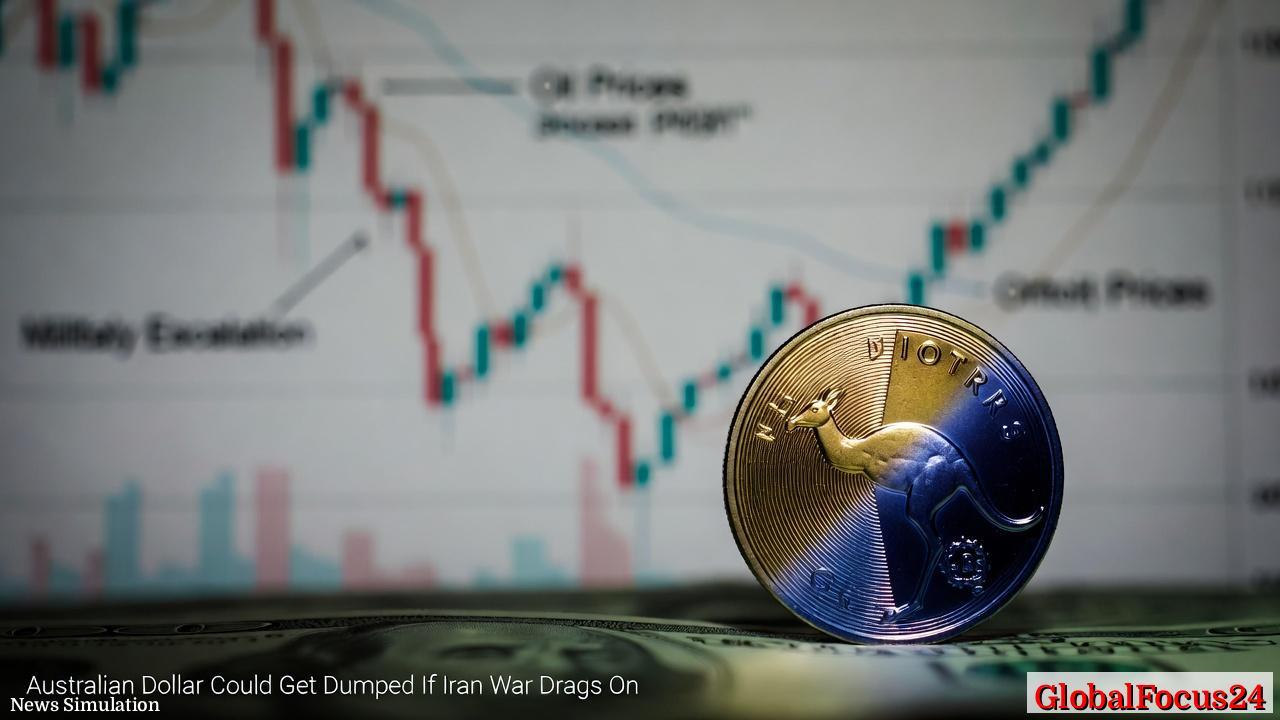
Australian Dollar Faces Renewed Pressure as Iran Conflict Escalation Sparks Global Risk Aversion
Mounting Geopolitical Tensions Threaten Market Stability
The Australian dollar is under increasing strain as investors brace for prolonged instability in the Middle East following intensified conflict involving Iran. Analysts warn that the currency could weaken further if military escalation continues, amplifying volatility across global markets and pushing traders toward safe-haven assets like the U.S. dollar.
In early Asian trading, the Australian dollar slipped to $0.7007 against the greenback, its lowest level in weeks. The move reflects broader jitters across commodity and equities markets, as investors react to reports of widening hostilities and concerns about global energy supplies. Regional currencies across Asia-Pacific, from the New Zealand dollar to the South Korean won, have also shown signs of vulnerability, retreating alongside risk-sensitive assets.
Investors Pivot Toward Safe-Haven Currencies
The renewed instability has sparked a classic “risk-off” shift in global markets. The U.S. dollar, long considered a haven during geopolitical crises, has strengthened as traders seek shelter from volatility. America’s relative energy independence and robust economic fundamentals further bolster its position, particularly as crude prices surge amid fears of supply disruptions.
“The Australian dollar is often an early barometer of global risk sentiment,” said one Sydney-based currency strategist. “When fears of conflict rise and commodity prices become volatile, risk appetite fades quickly—and the Aussie tends to fall.”
The Japanese yen and Swiss franc have also attracted renewed demand, highlighting the cross-market retreat from riskier assets. Traders note that while the scale of military action remains uncertain, even a limited conflict could prolong instability in energy markets and ripple through global growth forecasts.
Energy Market Shock Raises Stagflation Risks
The escalation in the Middle East is already causing significant tremors in the energy sector, with crude oil prices jumping sharply amid fears of supply threats. Iran remains a critical player in the global oil network, and any disruption to exports from the region could have cascading effects on the world economy.
For Australia, higher oil prices pose a complex challenge. Although classified as a commodity-linked economy, Australia is a net importer of refined fuels, leaving it exposed to higher energy costs. Rising fuel prices could exacerbate inflationary pressures, reducing household purchasing power and undermining business confidence.
This scenario raises the specter of stagflation—a situation where economic growth slows while inflation remains stubbornly high. Central banks across the Asia-Pacific, including the Reserve Bank of Australia (RBA), would face difficult policy decisions if stagflationary conditions take hold. Cutting rates to support growth could further weaken currencies, while maintaining higher rates risks squeezing domestic demand.
Historical Parallels and Lessons from Past Crises
Currency strategists often look to history for guidance when geopolitical tensions spike. Similar episodes, such as the Gulf War in 1991, the Iraq conflict of 2003, and more recently, the Russia-Ukraine war, show that commodity currencies tend to struggle during extended periods of conflict-driven uncertainty.
During the Gulf War, for instance, the Australian dollar weakened sharply following oil price spikes, even as Australia’s mineral exports remained strong. The same pattern repeated during the Iraq conflict, with elevated energy costs curbing foreign exchange inflows and amplifying global recession fears. In both cases, safe-haven currencies gained value, while risk-linked assets faltered.
Today’s market dynamics show similar features: commodity-linked currencies are sliding, while the U.S. dollar index remains buoyant. The implications for trade partners and energy-dependent economies are significant, particularly as investors weigh whether this conflict could stretch into months or even years.
Australia’s Trade Exposure and Regional Repercussions
Australia’s economic outlook remains intertwined with global trade and resource exports. The country’s key exports—iron ore, coal, and liquefied natural gas—are sensitive to commodity cycle disruptions. If energy prices remain elevated for an extended period, resource revenues could initially benefit. However, secondary effects such as inflation, weakened consumer demand, and disrupted supply chains could ultimately offset those gains.
Regional partners including China, Japan, and South Korea—major importers of Australian commodities—also face challenges from elevated oil prices. Higher input costs would dampen manufacturing and potentially slow demand for raw materials. As a result, the short-term benefit to Australia's terms of trade could be neutralized by reduced regional demand.
Currency analysts note that the Australian dollar’s performance often tracks global equities, given its strong correlation with investor sentiment. With Asian markets showing cautious tone and lower trading volumes amid geopolitical anxiety, further downside pressure appears likely unless diplomatic progress reduces tensions.
The Role of the Reserve Bank of Australia
The Reserve Bank of Australia finds itself navigating a delicate balance. Inflation, though moderating from 2024 highs, remains above target. At the same time, global risk aversion and tighter financial conditions complicate the outlook for growth.
Should the Iran conflict prolong and commodity prices stay elevated, the RBA may have limited room to ease policy. Yet a weakening currency could import inflation through higher import costs, particularly for energy and consumer goods. Policymakers are thus likely to maintain a data-dependent approach, monitoring currency movements closely while avoiding measures that might further destabilize financial markets.
Market watchers suggest that if the Australian dollar slides below technical support around $0.6950, further declines could accelerate, particularly if crude oil prices climb beyond $100 per barrel. Traders are already pricing in heightened volatility for the next quarter, reflecting uncertainty over both geopolitical and macroeconomic developments.
Comparisons with Regional Currencies
The New Zealand dollar, another commodity-sensitive currency, has mirrored the Australian dollar’s decline, slipping amid investor unease about global growth. Meanwhile, emerging Asian currencies such as the Indonesian rupiah and Malaysian ringgit have also come under pressure, reflecting concerns that higher energy costs will erode trade balances and increase inflation.
By contrast, the Singapore dollar has remained relatively resilient, supported by the city-state’s trade surplus and strong fiscal position. However, analysts caution that if oil prices continue to rise and global demand slows, even the region’s more stable currencies could experience volatility.
Regional central banks may intervene selectively to curb excessive currency swings, but their capacity to offset broader market trends remains limited when global risk sentiment deteriorates sharply.
Global Market Implications and Investor Outlook
The widening Iran conflict highlights the fragile intersection between geopolitics and financial stability. Investors fear that sustained warfare could destabilize major shipping routes in the Persian Gulf and the Strait of Hormuz, through which a significant portion of the world’s oil supply passes. Any interference with maritime trade could tighten energy markets further and disrupt supply chains that are still recovering from pandemic-era imbalances.
In this environment, investors are recalibrating portfolios toward defensive assets—U.S. Treasuries, gold, and the dollar—while trimming exposure to equities and commodity-linked currencies. Analysts emphasize that while the current market adjustments remain measured, an escalation could trigger broader capital flight from riskier assets, deepening currency depreciation across emerging markets.
Outlook: Growing Risks Amid Unresolved Tensions
For the Australian dollar, near-term prospects depend largely on whether diplomatic efforts can ease the conflict’s intensity. Without clear resolution, global risk aversion is likely to persist, keeping the currency on the defensive. Traders anticipate continued volatility as markets digest military updates, energy supply data, and policy signals from major central banks.
While Australia’s long-term fundamentals remain solid—anchored by resilience in resources, strong institutions, and diversified trade links—the immediate challenge centers on navigating a world where the balance between growth and inflation is increasingly precarious. The Iran conflict, by injecting fresh instability into already fragile energy markets, underscores how geopolitics can swiftly reshape financial landscapes.
Unless tensions de-escalate soon, analysts believe the Australian dollar could face a protracted period of weakness, mirroring patterns seen in past global crises. The broader message from traders remains consistent: in uncertain times, markets move not on optimism, but on the search for safety.