Asian Quantum Computing Stocks Surge After NVIDIA Unveils Open-Source AI Models
Strong Market Reaction Across Asia
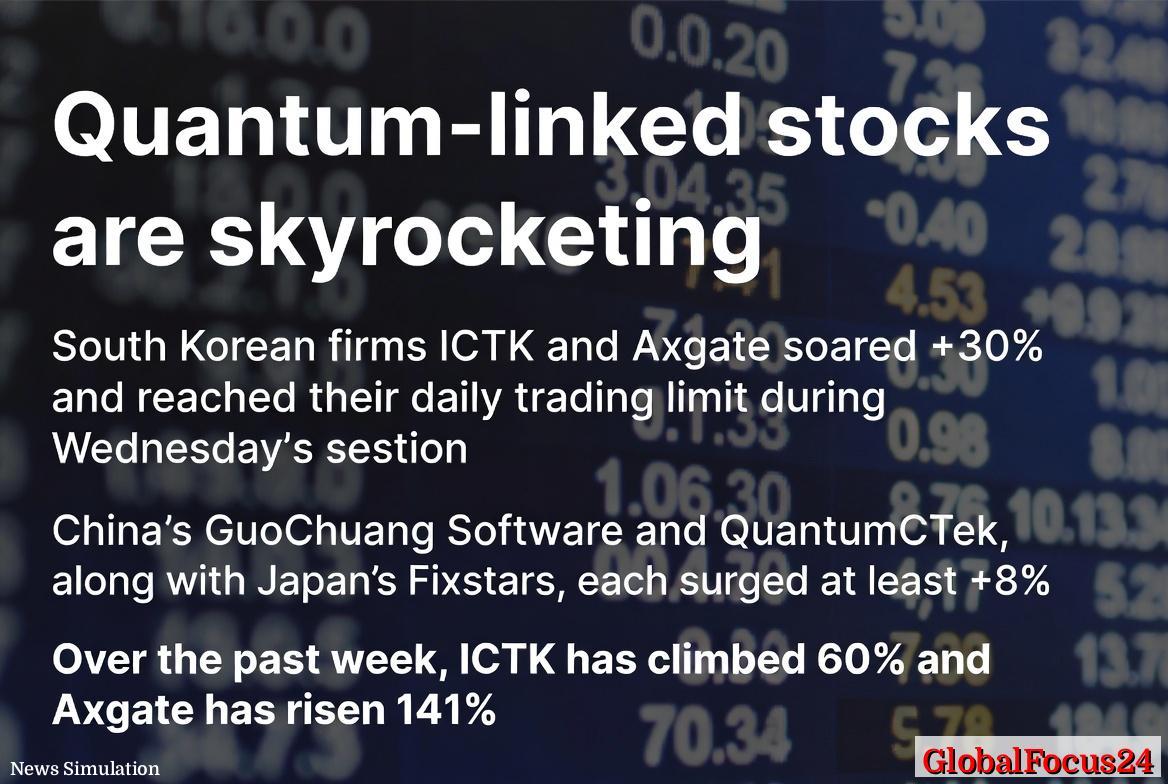
Asian technology stocks linked to quantum computing soared Wednesday after NVIDIA announced a suite of open-source artificial intelligence models designed to improve the scalability and performance of quantum systems. The rally was led by South Korean firms ICTK and Axgate, whose shares each rose 30% to hit their daily trading limits. Investors flooded into companies seen as potential beneficiaries of advances in practical quantum computing, driving strong gains across the region.
Over the past week, ICTK has surged 60%, while Axgate has skyrocketed 141%, highlighting a wave of enthusiasm not seen since the early days of the AI boom in 2023. The excitement quickly spread to other markets—China’s GuoChuang Software and QuantumCTek both gained more than 8%, and Japan’s Fixstars rose by a similar margin—on expectations that NVIDIA’s initiative could accelerate development across the global quantum computing ecosystem.
The Catalyst: NVIDIA’s Quantum-AI Integration Push
NVIDIA’s new initiative centers on a collection of open-source AI models engineered to enhance the interface between classical and quantum computing. The goal is to make quantum processing units (QPUs) more accessible and interoperable within existing data centers, creating a streamlined bridge between today’s machine learning infrastructure and the emerging world of quantum algorithms.
Analysts say the move positions NVIDIA at the core of a rapidly evolving hybrid computing environment that blends quantum and AI capabilities. The company’s goal of democratizing quantum computing with open-source tools marks a shift from proprietary experimentation to scalable, industry-wide collaboration.
In the short term, the announcement ignited speculative interest in firms that supply quantum communication systems, software security, and data encryption technologies—all areas expected to see increased demand as quantum computing enters commercial stages.
South Korea’s Tech Market Leads the Rally
In South Korea, ICTK and Axgate became focal points for investors seeking exposure to quantum technologies through cybersecurity and semiconductor-adjacent platforms. ICTK, known for its hardware-based security solutions for internet-of-things (IoT) devices and quantum key distribution (QKD) systems, saw record trading volume and closed at the upper limit of its daily range. Axgate, specializing in network security solutions, similarly benefited from optimism that quantum-safe networks will play a pivotal role in protecting future data infrastructure.
Local analysts noted that South Korea’s broader tech index received a modest lift as well, though gains were mostly contained to companies tied directly to quantum-related hardware and encryption software. Seoul-based brokerages cited increasing retail participation and algorithmic buying as secondary drivers of momentum.
China’s Quantum Pioneers See Renewed Interest
In China, GuoChuang Software and QuantumCTek both rallied strongly. These firms are pioneers in quantum encryption, communication equipment, and quantum key distribution. Their stock movements aligned with a rise in interest across China’s science and technology innovation board, known as STAR Market, which has a concentration of companies involved in advanced research fields.
Investors interpreted NVIDIA’s launch as a validation of China’s own long-term push toward quantum supremacy, a goal outlined in its 14th Five-Year Plan emphasizing indigenous innovation in key frontier technologies. Despite regulatory tightening and economic challenges in other sectors, China’s quantum industry has remained relatively insulated due to its strategic national importance.
Market commentators in Shanghai said foreign interest also played a part in Wednesday’s surge. Global funds tracking emerging technology indices reportedly increased exposure to Chinese quantum names, anticipating stronger cross-border collaborations prompted by open-source frameworks.
Japan’s Fixstars Benefits from Global Momentum
Japan’s Fixstars, a software developer focused on high-performance computing optimization, also gained more than 8%. The Tokyo-based firm has been quietly integrating quantum algorithm research with machine learning workflows, offering potential synergies with NVIDIA’s open-source models. Its rise underscored Japan’s growing presence in applied quantum computing, building on government-backed initiatives to foster academic–industrial cooperation.
Japanese analysts drew parallels between this week’s movement and the 2021 boom in battery technology shares, noting that while fundamental progress remains gradual, investor sentiment toward next-generation computing is shifting decisively upward.
Broader Market Context and Regional Comparisons
The surge in quantum computing-linked stocks resembles the pattern seen during previous hardware-driven innovation cycles in Asia. In 2016, the debut of next-generation semiconductor nodes triggered similar rallies in firms supplying the broader chip ecosystem. More recently, the 2023–2024 wave of enthusiasm surrounding generative AI mirrored this dynamic, with supplier and partner firms seeing exponential stock movements following major announcements by global tech leaders.
However, some analysts cautioned that Wednesday’s gains could reflect short-term speculation rather than a sustained revaluation. Quantum computing remains in its early commercial stage, with profitability timelines still uncertain. Most listed companies involved in related technologies generate revenue primarily from classical security, software development, or infrastructure deployment rather than quantum computation itself.
Nonetheless, market sentiment suggests growing belief that breakthroughs in hybrid quantum–AI development could accelerate commercialization earlier than expected. The introduction of open-source platforms could drive new competitive dynamics similar to how open-source machine learning libraries fueled the rapid scaling of deep learning in the late 2010s.
Economic Impact and Investment Outlook
Globally, the quantum computing market is projected to grow from around $1.7 billion in 2024 to more than $11 billion by 2030, according to multiple research firms. This growth is expected to come from a combination of government-funded research, private-sector partnerships, and increasing corporate adoption in fields such as pharmaceuticals, logistics, materials science, and financial modeling.
For Asian economies, particularly South Korea, China, and Japan, participation in the quantum computing race offers both technological prestige and economic opportunity. These nations already compete fiercely in semiconductors and high-performance computing, and each sees quantum research as a pathway to long-term industrial competitiveness.
South Korea’s Ministry of Science and ICT, for example, has been supporting domestic research in quantum communication and cryptography since 2019. China has built national laboratories dedicated to quantum networks and launched the world’s first quantum satellite in 2016. Japan, meanwhile, has linked its leading universities with private-sector firms through the Quantum Innovation Initiative Consortium, uniting academic research with corporate applications.
Historical Context: From Theory to Commercial Momentum
Quantum computing’s theoretical foundations stretch back nearly a century, but the technology only began attracting commercial investment in the past two decades. Milestones such as Google’s 2019 claim of “quantum supremacy” and IBM’s progress in developing larger, more stable quantum processors set the stage for the current wave of industrial interest. The focus has since shifted from experimental proof to practical applications—how to integrate quantum acceleration into ordinary computing workflows.
The transition gained speed as artificial intelligence became a dominant computing force. Modern AI models require immense processing power, pushing classical supercomputers close to physical and financial limits. Quantum systems, in theory, could offer exponential performance benefits for specific optimization and simulation tasks. NVIDIA’s latest move to combine AI optimization algorithms with quantum processing architecture aims to bridge that gap and prepare existing computing infrastructure for the quantum era.
Market Caution Amid Rapid Gains
While investors celebrated the latest rally, industry observers urged caution. Valuations for smaller quantum-linked stocks in Asia are now stretching beyond their fundamental earnings capabilities, raising the risk of short-term corrections. Past technology rallies, such as those surrounding blockchain or autonomous vehicles, have shown similar bursts of enthusiasm before retracing once expectations outpaced development.
Still, long-term indicators remain promising. Corporate investment in quantum research has increased substantially since 2022, with major technology companies establishing joint labs, venture funds, and educational partnerships. Governments are continuing to channel billions of dollars into national quantum programs, reinforcing the strategic importance of staying competitive in this emerging field.
The Road Ahead for Asian Quantum Leaders
As NVIDIA’s open-source initiative unfolds, Asia’s tech ecosystem is expected to play a crucial role in supplying both research expertise and hardware innovation. Companies like ICTK and QuantumCTek specialize in quantum encryption and secure communication, which could become foundational to global data networks built for quantum–AI integration. Meanwhile, Japan’s Fixstars and South Korea’s Axgate may see increasing demand for optimization software and cybersecurity platforms that can adapt to hybrid computing environments.
Analysts anticipate that partnerships between these regional leaders and global firms could accelerate technology transfer and contribute to establishing standards for quantum communication protocols, error correction, and hybrid processing frameworks.
Conclusion
Wednesday’s surge across Asian quantum computing stocks reflects more than a fleeting burst of market excitement—it signals a growing conviction that the next era of computation is approaching faster than anticipated. NVIDIA’s introduction of open-source AI models tailored for quantum development served as both a technical and psychological turning point, reminding investors that innovation often leaps forward when barriers to collaboration fall.
As quantum computing inches closer to commercial viability, Asia’s technology markets appear poised to be at the forefront of this transformation, balancing near-term volatility with the promise of profound long-term impact.