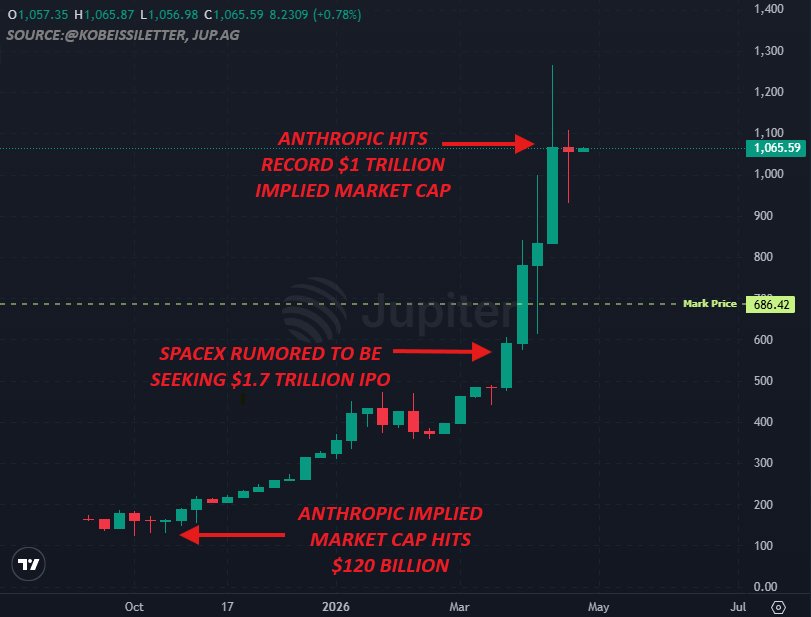
Anthropic Surpasses $1 Trillion Implied Valuation Ahead of IPO: A New Benchmark in AI Giants
Anthropic’s on-chain indicators point to a $1 trillion implied valuation ahead of its anticipated initial public offering, marking a historic milestone for AI-focused tech firms and signaling evolving investor sentiment toward high-growth, private-stage unicorns. According to recent on-chain trading data, pre-IPO instruments backed 1:1 by special purpose vehicle exposure have surged to a level that, if realized at the moment of an IPO, would place Anthropic among the most valuable technology companies in the world. The implied valuation represents a dramatic rise—approximately 733% since October 2025—reflecting both heightened demand for AI leadership and a broader appetite for risk in transformative technologies.
Historical context: a new era for AI company valuations
Anthropic’s ascent sits within a wave of unprecedented pre-IPO pricing activity among several AI and space-tech heavyweights. In the past decade, traditional valuation markers for private tech firms relied on preferred funding rounds, revenue multiples, and project-specific milestones. However, the emergence of transparent, on-chain instruments tied to SPV exposure as a real-time proxy for private company value marks a notable shift in how market participants gauge worth before a public listing. This mechanism, in which instruments are collateralized and traded with transparent, verifiable backing, has attracted a diverse cohort of investors seeking exposure to the AI economy without relying solely on private share allocations.
Anthropic’s current implied valuation places it alongside two other U.S.-based AI and space-leading firms that recently crossed the trillion-dollar threshold in implied terms: OpenAI and SpaceX. Together, these three entities contribute a combined implied market capitalization of about $3.7 trillion, underscoring a broader trend: investors are pricing in not just current performance but the potential long-term dominance of a handful of players shaping the next era of computing, automation, and machine intelligence. This concentration mirrors broader market patterns observed during periods of rapid innovation, when ownership and control over frontier technologies translate into outsized market perception—even if the firms are still private.
Economic impact: potential reverberations across the tech ecosystem
The prospect of a trillion-dollar implied valuation for Anthropic before a public offering carries multiple macroeconomic and sector-specific implications:
- Capital market signaling: A rising implied valuation signals strong investor belief in Anthropic’s competitive edge, pipeline of products, and strategic partnerships. Such signaling can attract additional private capital, influence talent markets, and entice strategic investors who seek early access to breakthrough AI capabilities.
- Funding dynamics for AI research: High pre-IPO valuations can broaden the capital base available to accelerate AI research, safety frameworks, and productization efforts. This can accelerate timelines for developing advanced models, deployment tools, and safety protocols that align with evolving regulatory and ethical norms.
- Talent absorption and wage dynamics: The AI arms race has heightened competition for top-tier engineering, research, and ethics talent. A sustained high valuation often translates into enhanced compensation packages, equity incentives, and the relocation of skilled workers to centers of innovation, thereby impacting regional labor markets and wage trends.
- Supply chain and ecosystem effects: Dominant AI players influence a wide array of suppliers, from cloud infrastructure to data providers and specialized hardware firms. A trillion-dollar implied valuation can ripple through supplier negotiations, pricing flexibility, and investment in next-generation compute infrastructure, including specialized accelerators and data center capacity.
- Regional economic momentum: The valuation snapshot underscores how AI leadership can shape regional economies. In tech hubs across the United States and globally, a surge of capital toward AI-focused enterprises can bolster local startups, university collaborations, research parks, and public-private research initiatives.
Regional comparisons: how Anthropic’s trajectory fits into global patterns
- United States: The U.S. continues to consolidate leadership in AI research, development, and deployment. Implied valuations at the trillion-dollar level for multiple AI-focused entities signal an ecosystem where venture capital, private equity, and corporate investment align to fuel scalable, safety-conscious AI solutions. Regions with dense tech ecosystems—from the Bay Area to Denver and Seattle—are likely to experience amplified crossover effects between academia, industry, and government research programs.
- Europe and the Asia-Pacific region: While the United States maintains a dominant position, AI investment narratives in Europe and Asia-Pacific emphasize regulatory clarity, data governance, and collaboration between public sectors and private firms. Elevated on-chain valuation signals can influence cross-border partnerships and talent mobility, potentially accelerating AI-driven productivity gains in these regions as firms look to diversify risk and access specialized capabilities.
- Global competition: The clustering of trillion-dollar implied valuations around a select group of AI leaders reflects a broader strategic competition shaping national policies, R&D incentives, and export controls. Policymakers in multiple jurisdictions are balancing the drive for innovation with concerns about ethics, safety, and strategic dependencies on key AI platforms.
Technological and market dynamics: what’s driving the surge in implied value
- Breakthroughs in foundation models and safety: The rapid development of large-scale language models, multimodal capabilities, and reinforcement learning from human feedback continues to expand the potential applications of AI across industries. Investors weigh not only the revenue potential but also the robustness of safety mechanisms and governance structures, which can reduce risk and unlock broader enterprise adoption.
- Commercialization pathways: AI-as-a-service, enterprise solutions, and vertical-specific applications enable firms to monetize AI capabilities across sectors such as healthcare, finance, manufacturing, and logistics. The ability to demonstrate tangible ROI through efficiency gains, cost reductions, and new revenue streams strengthens confidence in sustained growth trajectories.
- Infrastructure and compute scaling: Access to cost-effective, scalable compute resources remains a foundational driver of AI progress. Companies that secure strategic partnerships with cloud providers, data centers, and specialized hardware developers can accelerate product cycles and maintain a competitive edge, contributing to optimistic valuation assessments.
- Market sentiment and risk tolerance: A notable shift in risk appetite for disruptive tech has contributed to higher pre-IPO demand. Investors seeking exposure to transformative technologies often accept higher liquidity risk in exchange for potential outsized returns, a dynamic that can push implied valuations beyond traditional benchmarks.
What investors should watch ahead of the IPO
- Financial fundamentals versus implied value: While on-chain instruments provide a timely snapshot of market sentiment, they are not substitutes for audited financials, revenue visibility, and profitability metrics that will define the IPO prospectus. Prospective investors should evaluate product roadmap alignment, unit economics, customer adoption, and long-term margin profiles.
- Regulatory environment: AI governance, data privacy, and national security considerations will influence the IPO process and post-listing performance. Companies with strong governance frameworks and transparent compliance programs may attract a broader base of long-term investors.
- Competitive landscape: The AI domain features several global contenders pursuing similar capabilities. Investors will compare Anthropic’s strategic position, technological differentiators, and ecosystem partnerships with peers’ offerings, pricing strategies, and go-to-market approaches.
- Public-market media and sentiment: The transition from private market enthusiasm to public-market reception can hinge on narrative, execution, and perceived sustainability of growth. Companies that articulate a clear, responsible AI strategy with measurable milestones tend to generate steadier post-IPO performance.
Operational milestones to monitor
- Product pipeline milestones: Upcoming model updates, safety feature enhancements, and new enterprise integrations will be key indicators of momentum. Clarity on timelines and performance targets helps investors gauge execution risk.
- Enterprise adoption metrics: Customer logos, renewal rates, and expansion within existing accounts are critical to understanding real-world value creation. Demonstrable traction across industries supports confidence in durable revenue generation.
- Safety and governance initiatives: Public confidence in AI safety and ethical considerations remains a central concern for stakeholders. Evidence of rigorous safety testing, independent audits, and governance disclosures can differentiate a company in a crowded field.
- International collaboration and data strategy: Partnerships with academic institutions, research consortia, and multinational corporations can amplify scale and capabilities. Clear data governance policies and compliance with regional standards bolster investor confidence.
Public reaction and social implications
The heightened attention around Anthropic’s implied trillion-dollar valuation reflects a blend of awe, scrutiny, and pragmatic concern. On one hand, the milestone underscores the transformative potential of AI technologies to reshape industries, improve productivity, and create new economic opportunities. On the other hand, it reinforces debates about AI safety, labor displacement, and the concentration of market power within a handful of leading firms. Public reaction often centers on questions of transparency, accountability, and how rapidly evolving AI capabilities should be governed in a way that meaningfully protects workers and consumers without stifling innovation.
Conclusion: a watershed moment with implications beyond a single company
Anthropic’s on-chain, pre-IPO valuation milestone marks a watershed moment in the evolving landscape of technology finance. It highlights how innovative financial instruments can illuminate market expectations for private tech leaders ahead of an IPO, while also illustrating the accelerating pace of AI development and its broad economic ramifications. As Anthropic and its peers prepare for public-market scrutiny, stakeholders—from investors and policymakers to employees and customers—will closely monitor execution, governance, and the practical impacts of advanced AI across sectors and regions.
In the near term, the path ahead will revolve around delivering scalable, safe, and values-aligned AI solutions that can translate extraordinary valuations into real-world productivity gains. The market’s willingness to assign a trillion-dollar implicit value speaks to a belief in the potential for AI to redefine how businesses operate, how work is performed, and how societies navigate an era of rapid digital transformation.