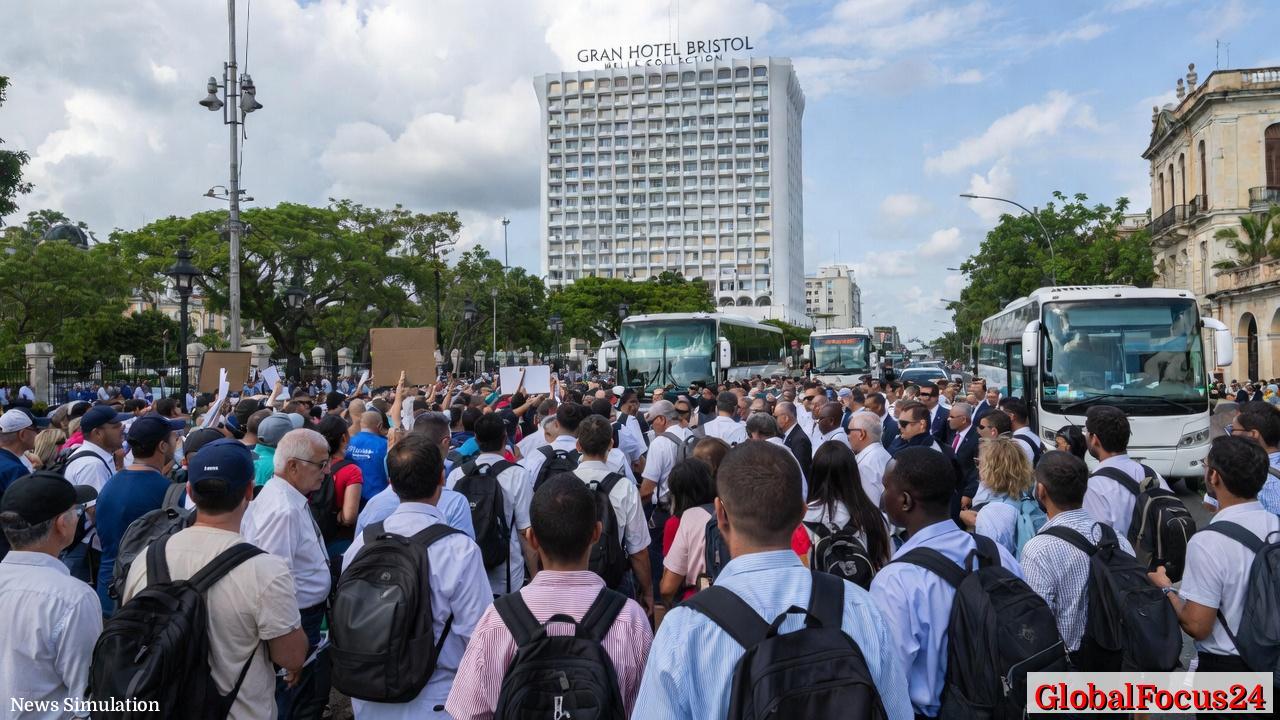
Hundreds Arrive in Havana with Humanitarian Convoy Amid Cuba’s Deepening Crisis
International Delegation Delivers Aid and Draws Fire Over Luxury Accommodations
HAVANA — Hundreds of activists from across North America and Europe descended on the Cuban capital this weekend as part of the Nuestra América Convoy, a highly publicized humanitarian mission that delivered what organizers say are 20 tons of supplies to alleviate worsening shortages on the island. The visit, however, has ignited a wave of criticism from Cuban exiles and human rights advocates who argue that the event served more as a political display than a relief effort.
The convoy, coordinated by the global nonprofit Progressive International in collaboration with Mariela Castro — daughter of former Cuban President Raúl Castro — included a mixed delegation of political figures, academics, and social media influencers. Among them were internet personality Hasan Piker and climate activist Isra Hirsi, daughter of U.S. Representative Ilhan Omar. Participants arrived via flights and vessels from multiple entry points and converged at Havana’s Palacio de Convenciones, where they met President Miguel Díaz-Canel and senior members of the Communist Party.
The trip took place against the backdrop of one of Cuba’s most severe economic crises since the early 1990s. Ongoing power outages, inflation, and shortages of food, medicine, and fuel have compounded the stress of everyday life for the nation’s 11 million residents.
A Country Struggling to Keep the Lights On
Cuba’s energy grid has collapsed under the weight of dwindling fuel supplies and aging infrastructure. The government acknowledges that most provinces are experiencing blackouts lasting from 12 to 22 hours a day. Reports from local residents detail refrigerators defrosting in sweltering heat and hospitals rationing electricity to keep essential equipment operating.
The island has not received a major oil shipment in more than three months, a disruption that authorities attribute to tighter enforcement of U.S. sanctions and the threat of secondary tariffs on countries that supply fuel to Cuba. In late 2023, Washington warned tankers operating from Mexico and Venezuela that they could face penalties for transfers suspected of violating trade restrictions. By early 2026, these measures had nearly paralyzed Cuba’s import capacity.
Economists say the shortfall has cut national power generation by as much as 60 percent, forcing factories to shut down and further reducing access to basic goods.
Convoy Organizers Describe an Effort to “Break the Blockade”
The Nuestra América Convoy’s public statement characterized its mission as part protest, part humanitarian operation. Organizers claimed they aimed to deliver medical supplies, food staples, and renewable energy equipment to help Cuban hospitals and communities weather the ongoing shortages.
At a press conference in Havana, spokespeople for the convoy accused the United States of imposing “economic suffocation” through decades-old trade restrictions. “Our presence here is a statement of solidarity,” said one representative. “We are showing that global civil society rejects collective punishment.”
The convoy delivered the aid through Cuban state distribution channels, but officials provided few details about how the materials would reach local populations. Past aid deliveries to Cuba have drawn scrutiny from international observers, who note that goods often pass through government-controlled networks that prioritize state institutions or loyalist communities.
Critics Question Motivation and Optics of the Visit
The arrival of foreign activists in luxury buses and high-end hotels reignited long-standing resentment among many Cubans abroad who fled the island’s authoritarian rule. Some described the convoy as a display of hypocrisy. One exile living in Florida said, “They come to a country with 20-hour blackouts, yet stay in hotels that burn through electricity for their comfort. It’s a mockery.”
Social media platforms lit up with posts from the Cuban diaspora. Miami-based artist Salomé García Bacallao accused the delegations of overlooking the regime’s repression and the mass exodus of Cubans seeking better lives. More than a million people have emigrated in the past five years, the largest wave since the 1960s.
Another critic noted that the resources used to accommodate the delegation could have powered more than 100 Havana homes for several days. Analysts say such optics may undercut the legitimacy of the movement’s humanitarian message, especially as the Cuban government leverages international visits to project an image of resilience and global support.
Historical Context of Cuban Aid and Sanctions
Humanitarian missions to Cuba have a complex history shaped by decades of geopolitical tension. Since the early years of the Cold War, foreign delegations from sympathetic nations and solidarity groups have sought to support Havana while opposing U.S. restrictions. During the 1990s “Special Period,” following the collapse of the Soviet Union, the island faced similar shortages of fuel and food. Thousands of volunteers from Europe and Latin America arrived to provide assistance — often working under strict supervision from state agencies.
The U.S. embargo, first enacted in 1960 and expanded over time, limits commerce and financial transactions between the two countries. Successive administrations have modified enforcement, with periods of easing followed by renewed restrictions. While critics argue the sanctions punish ordinary Cubans, supporters maintain that the measures target government control and human-rights abuses.
Over the past decade, Cuban-American relations have shifted dramatically. Diplomatic normalization efforts under the Obama administration opened travel and remittance channels, but many of these were reversed in subsequent years. As a result, international groups attempting to deliver aid now face heightened legal and logistical obstacles.
The Scale of Cuba’s Current Economic Strain
Cuba’s current situation has been described by economists as its deepest systemic crisis since 1959. Official data shows inflation running above 300 percent, a plummeting peso, and widespread closure of small private businesses. Agricultural production has declined sharply, forcing families to rely on ration books that often promise food unavailable in stores.
Fuel shortages have disrupted not only power generation but also transportation and agriculture. Rural residents report walking miles to reach work or school as bus routes disappear. Hospitals face intermittent water supply and delayed surgeries due to unreliable electricity.
Tourism — traditionally the island’s main source of foreign currency — has not recovered to pre-pandemic levels. International arrivals remain 40 percent lower than in 2018, in part because airlines have reduced flights amid rising costs.
Regional Comparisons Highlight Cuba’s Fragility
Compared with neighboring Caribbean nations, Cuba’s energy dependence and centralized economy have made it especially vulnerable to supply disruptions. The Dominican Republic, for instance, diversified its energy imports through private partnerships and renewable sources, reducing blackout frequency. Jamaica, which faces high fuel costs, established agreements with multiple international suppliers to stabilize electricity generation.
Cuba, constrained by politics and limited access to credit, has failed to modernize its grid or diversify imports. Most of its refineries date to the 1960s, operating below capacity. Even China, one of Havana’s key allies, has reduced investment in recent years, frustrated by unpaid loans and shipping obstacles.
Government Response and Public Frustration
President Miguel Díaz-Canel has framed the crisis as “economic warfare” and praised the convoy participants for what he called an “act of international conscience.” In his public remarks, he emphasized Cuba’s resilience and repeated that the government “will never surrender to external pressure.”
Yet on the streets of Havana and Santiago, frustration is evident. Residents queue for hours to refill cooking gas containers or charge phones at shared generators. Social media posts, though tightly monitored, show citizens calling for more transparency in aid distribution and questioning whether foreign visitors understand the reality of daily life on the island.
A Question of Impact
Whether the 20 tons of aid will meaningfully alleviate Cuba’s shortages remains uncertain. Economists point out that the island consumes that amount of food and fuel in less than a day. Nonetheless, the event has drawn international attention to the humanitarian dimension of Cuba’s economic collapse, renewing debate over the balance between sanctions pressure and civilian suffering.
In private conversations, some Cuban academics have called for pragmatic solutions — more regional cooperation, limited foreign investment, and renewed dialogue with Washington — as paths toward stability. Others warn that unless structural reforms accompany external aid, the crisis will persist regardless of short-term relief efforts.
For now, the Nuestra América Convoy stands as another chapter in the long story of foreign sympathy and domestic struggle. In Havana’s darkened streets, as generators hum and candles flicker in apartment windows, many Cubans express a weary gratitude tinged with skepticism. They have seen convoys come and go before, while the power — both electrical and political — remains concentrated in the same hands.