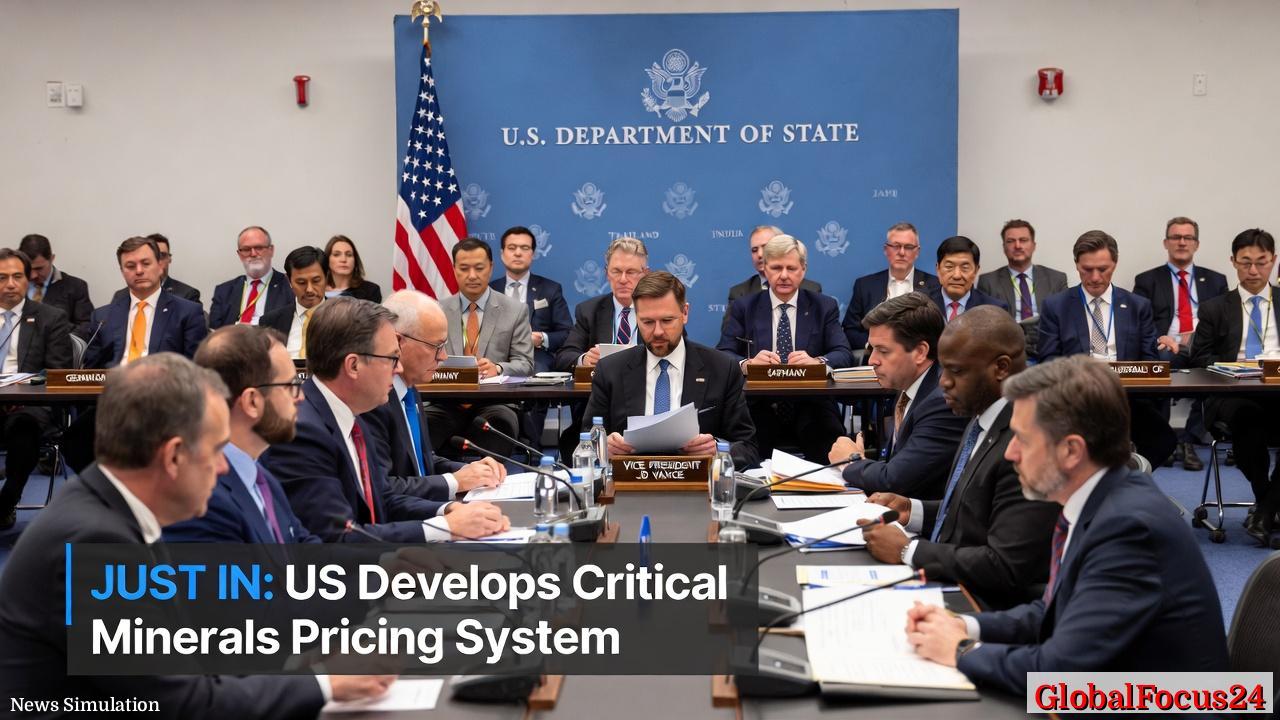
US Develops Critical Minerals Pricing System Amid Talks with Over 50 Countries
The United States has introduced a global price floor system for critical minerals, a major move aimed at reducing reliance on Chinese supply chains and securing stable access to materials vital for technology, clean energy, and defense industries. The plan, announced in Washington, D.C., during a high-level summit led by Vice President JD Vance, involves negotiations with more than 50 partner countries across Asia, Europe, Africa, and the Americas.
This emerging trade framework proposes setting reference prices at each stage of mineral production — from raw extraction to refined products — establishing a minimum benchmark maintained through adjustable tariffs. It marks one of the most ambitious attempts yet by the U.S. to create a predictable pricing environment for key materials such as lithium, cobalt, nickel, copper, and rare earth elements.
A Strategic Effort to Rebalance Global Mineral Trade
The initiative reflects growing concern in Washington and other capitals over the concentration of critical mineral supply chains in China. Currently, China processes roughly 60–70% of the world’s lithium, nickel, and cobalt, and controls over 85% of global rare earth refining capacity. This dominance has given Beijing substantial leverage in global trade, particularly as clean energy and defense supply chains expand.
The U.S. plan seeks to diversify sources of supply and investment. By creating a pricing system that ensures predictable returns, officials argue, the market can attract private capital to new mining and refining projects in allied nations. These could include resource-rich countries such as Australia and the Democratic Republic of Congo, as well as nations seeking to build up processing capacity like India, Indonesia, and Thailand.
According to U.S. trade officials, the pricing mechanism is designed to protect new producers from extreme price fluctuations—one of the most consistent obstacles to scaling mining and refining operations outside of China. “This is about creating stability, predictability, and fairness in a sector that underpins our modern economy,” said one senior official involved in the talks.
The Mechanics of the Pricing System
The proposed price floor system functions much like a stabilization mechanism. For participating countries within the prospective trade zone, critical minerals would have a base price tied to production costs, market demand, and environmental standards. If global prices fall below that floor due to market dumping or overproduction, adjustable tariffs or compensatory measures would balance the difference.
This system would not fix prices but instead establish a lower boundary ensuring that mining and processing industries remain economically viable despite market volatility. Analysts view the approach as an alternative to direct subsidies, emphasizing cooperative market management rather than heavy-handed intervention.
In practical terms, the framework would support long-term supply contracts between allied producers and manufacturers in fields such as electric vehicle batteries, semiconductors, renewable energy components, and defense technologies. For automakers and electronics producers in the U.S., Europe, and Asia, the goal is to secure material inputs that are both price-stable and responsibly sourced.
International Coordination and Trade Diplomacy
The U.S. has already formed policy partnerships with Mexico, Japan, and the European Union to coordinate mineral trade and identify priority resources eligible for participation in the system. Discussions are underway with major Asian economies — including South Korea, India, and Thailand — and with mineral-exporting nations in Africa and South America.
The newly launched Forum on Resource Geostrategic Engagement, announced alongside the pricing initiative, will serve as the institutional platform for these negotiations. Its agenda includes aligning investment policies, environmental regulations, labor standards, and infrastructure projects to create an integrated and sustainable global critical minerals network.
Countries such as Australia, Canada, and Germany have expressed preliminary support for deeper cooperation. According to trade officials familiar with the negotiations, the initiative builds on existing partnerships under frameworks like the Minerals Security Partnership (MSP) and the Indo-Pacific Economic Framework (IPEF). These collaborations aim to accelerate investment in new mines and processing facilities while enhancing transparency in global markets.
Economic and Industrial Impact
A stable pricing environment for critical minerals could have broad implications for global industries and inflation trends. Volatile costs for materials like lithium and nickel have previously disrupted battery production, contributing to fluctuations in electric vehicle prices and slowing renewable energy deployment. A predictable pricing floor could help manufacturers plan investments and reduce risk exposure.
For the U.S., which has limited domestic mining capacity, the new system may also encourage the reopening of dormant sites and the establishment of refining operations on American soil. The Inflation Reduction Act and Bipartisan Infrastructure Law had already allocated funding for battery materials and clean energy supply chains, but unpredictable commodity prices have complicated progress.
In Europe, where energy and industrial competitiveness remain sensitive issues, coordinated pricing could stabilize costs for green technologies. Meanwhile, developing economies with large mineral reserves, such as the Democratic Republic of Congo or Indonesia, could benefit from guaranteed market access and investment incentives tied to environmental and labor standards. Economists note that if managed carefully, the system could promote more equitable development by tying fair prices to responsible mining practices.
Lessons from Previous Efforts
This is not the first attempt to stabilize global commodity prices through coordination among producing nations. Historic precedents, such as the International Tin Agreement of the mid-20th century, sought to maintain predictable prices through stockpiling and buffer mechanisms. However, many of those institutions collapsed under shifting market forces and policy disagreements.
Modern proponents argue that today’s situation differs. The rapid expansion of clean energy and semiconductor sectors has created a sustained, structural demand for critical minerals. Unlike cyclical commodities such as oil or tin, these resources underpin multi-decade industrial transformations. With the energy transition accelerating worldwide, demand certainty may strengthen the viability of a price floor framework.
Still, experts caution that the system’s success will depend on broad participation and careful calibration. If too few countries adopt it, or if tariff adjustments prove complex to manage, the initiative could face enforcement challenges. Moreover, maintaining competitiveness against lower-cost suppliers in China will require efficient logistics, streamlined permitting, and consistent regulatory standards.
Regional Comparisons and Strategic Context
In the Asia-Pacific region, competition for critical minerals is intensifying. China has expanded its influence through investments in lithium mines in South America and cobalt projects in Africa. Meanwhile, Australia and Indonesia have emerged as key players, with ambitious efforts to climb the value chain from raw materials to processed components.
India has signaled growing interest in expanding domestic refining and entering global supply networks, aligning with the U.S.-led proposal as part of its “Make in India” industrial strategy. Japan and South Korea, both heavily reliant on imported minerals, are exploring long-term contracts and joint ventures with allied producers to hedge against potential disruptions.
In contrast, Europe’s efforts have centered on circular economy initiatives and recycling frameworks to reduce dependency on imported raw materials. The U.S. pricing plan could complement those policies by ensuring a more predictable supply base for companies investing in battery manufacturing and renewable energy storage.
Potential Challenges Ahead
Despite broad support, hurdles remain. Establishing a credible price floor requires accurate cost assessments across varied geological and economic conditions. Countries with lower production costs may resist higher baseline prices, while those seeking rapid industrialization could prioritize short-term gains over coordinated stability.
Another concern is enforcement: ensuring tariffs and price adjustments remain transparent and consistent without creating loopholes for arbitrage or market manipulation. Balancing national interests with multilateral goals will test diplomatic flexibility, especially as major producers compete for foreign investment.
Environmental and social standards also complicate the picture. Many of the world’s richest mineral deposits are located in regions with weak governance or limited infrastructure. Linking participation in the system to sustainability criteria could limit exploitation but may also slow investment in urgently needed resources.
Outlook for Global Supply Chain Resilience
The U.S. plan reflects a shifting philosophy in international trade — one that values stability and resilience over absolute market efficiency. As supply chains for electric vehicles, wind turbines, and semiconductors become increasingly geostrategic, securing access to essential minerals has become a matter of national security as much as economic policy.
If successful, the critical minerals pricing system could reshape how global markets function for years to come. It would mark a transition from the laissez-faire approach that dominated resource trade for decades toward a model of cooperative stabilization. For participating nations, the potential rewards include reduced exposure to geopolitical shocks, strengthened industrial capacity, and a more balanced global economic landscape.
Negotiations continue with partner governments, and pilot programs are expected to roll out later this year. The Forum on Resource Geostrategic Engagement will reconvene in the spring to formalize initial agreements and outline investment criteria. As the U.S. and its allies move forward, the world is watching closely — aware that the minerals powering the 21st-century economy are becoming as strategic as the oil and steel that defined the last one.