Turkey’s Central Bank Liquidates $8 Billion in Gold to Defend Lira Amid Mounting Economic Strain
A Record Gold Sell-Off to Support a Weakened Currency
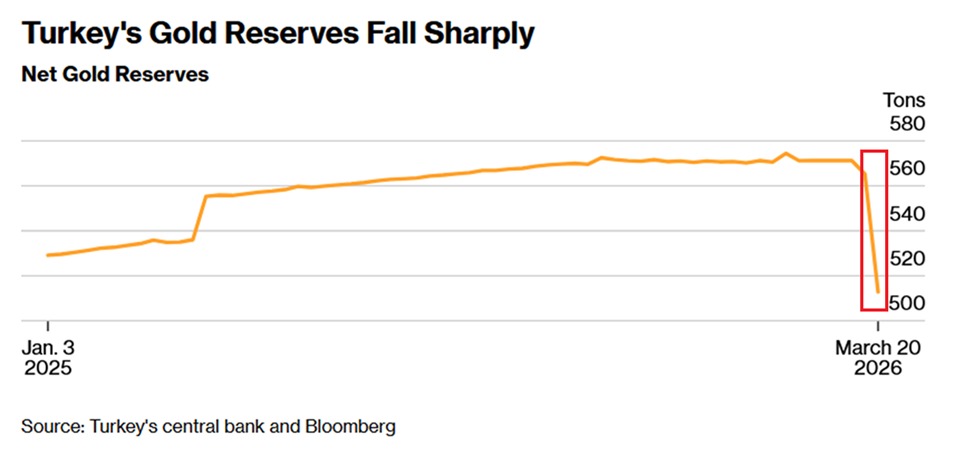
Turkey’s central bank has executed one of its largest gold liquidations in recent history, selling approximately 58 tons of gold valued at more than $8 billion over the past two weeks. The move comes as the country battles to defend the lira, which continues to face sharp depreciation pressures amid rising energy costs and dwindling foreign currency reserves.
According to central bank data, Turkey’s gold reserves fell by 6 tons in the week ending March 13 and then plunged by another 52 tons the following week, marking the steepest two-week decline in seven years. Following the sales, national holdings now stand at 513 tons—down from 571 tons in early March—underscoring the scale of monetary intervention underway to stabilize the domestic currency.
Liquidity Through Gold: The Mechanism Behind the Sales
Officials appear to have pursued a dual-track approach in the recent liquidation. More than half of the gold was reportedly used in swap arrangements—transactions in which the central bank borrows U.S. dollars against its gold assets. The remainder was sold outright on international markets in a bid to inject liquidity into foreign exchange reserves.
This massive outflow places Turkey as the largest source of gold liquidation globally in March 2026, surpassing even the roughly 43 tons withdrawn collectively from all global gold-backed exchange-traded funds during the same timeframe. The surge in gold sales reflects both the urgency of Turkey’s financial position and the limitations of its monetary toolbox in the face of external headwinds.
Foreign Reserves at Three-Year Lows
The country’s overall foreign-exchange reserves have fallen sharply, with official figures showing a drop of roughly $40 billion to reach $175 billion—the lowest level since the third quarter of 2025. These reserves are essential for supporting the lira, funding imports, and meeting international debt obligations.
Economists note that Turkey’s reserve buffer, once considered adequate relative to short-term liabilities, has become increasingly thin. The erosion stems from continuous market interventions to stem currency depreciation and from growing external financing needs tied to the import of energy and raw materials.
Growing Pressure from Energy Imports and the Iran War
The timing of these developments aligns closely with the surge in global energy prices following the outbreak of the Iran War earlier this year. The conflict has disrupted oil supply routes and driven up energy costs across the region. For Turkey—an economy heavily reliant on imported energy and closely tied to Middle Eastern crude supplies—the result has been severe strain on its trade balance and foreign exchange reserves.
Higher import bills have created a surge in dollar demand within the domestic economy. Businesses reliant on imported fuel, chemicals, and industrial commodities have scrambled to secure foreign currency, intensifying downward pressure on the lira. In this context, the central bank’s gold sales represent a defensive maneuver—a way to free up dollars to intervene in the market and supply liquidity to banks and import-dependent sectors.
The Lira’s Persistent Volatility
The Turkish lira has long been one of the most volatile emerging-market currencies, often reflecting a mix of structural vulnerabilities and policy uncertainty. Since early 2026, the currency has lost more than 12 percent of its value against the U.S. dollar, reversing modest gains from late 2025. Analysts attribute the weakness to a combination of factors: widening current-account deficits, persistent inflation, and a loss of investor confidence in the country’s policy framework.
The central bank’s decision to sacrifice part of its gold stockpile underscores growing concerns that conventional measures—such as interest rate adjustments—may no longer suffice to halt the lira’s slide. By selling gold, the central bank converts one of its most stable assets into dollars, effectively strengthening its capacity to intervene in currency markets, at least temporarily.
Historical Context: Gold as Turkey’s Financial Safety Net
For decades, gold has played an outsized role in Turkey’s monetary reserves strategy. During periods of political or economic instability, the central bank has often turned to gold both as a hedge against global market volatility and as an emergency buffer for foreign-exchange liquidity. The accumulation accelerated after the 2018 currency crisis, when the country sought to diversify away from dollar-denominated assets.
By 2020, Turkey was among the world’s top five official holders of gold, amassing more than 500 tons. These reserves became a symbol of financial sovereignty—a shield against international market shocks. The current liquidation, therefore, marks a reversal of policy and highlights the intensity of current economic pressures that have forced Ankara to draw upon what was once considered a last-resort asset.
Economic Implications of the Gold Drawdown
In the short term, converting gold to hard currency provides the immediate advantage of funding foreign-exchange interventions and paying for essential imports. However, the long-term implications are more complex. Analysts warn that selling gold reserves too aggressively may weaken market confidence in the central bank’s ability to manage future crises. Gold serves not only as a diversification tool but also as a signal of monetary stability; its depletion can rattle investor perceptions.
Moreover, with geopolitical risks still high and commodity prices unpredictable, the loss of physical gold holdings could leave Turkey more exposed to future shocks. If energy prices remain elevated or the war in Iran further disrupts supply chains, the need for foreign exchange could intensify before reserves can be replenished.
Comparisons Across the Region
Turkey’s situation mirrors broader challenges faced by energy-importing economies in the region. Countries such as Egypt and Jordan have also grappled with rising import bills and currency depreciation, though on a smaller scale. However, unlike Turkey, these nations have leaned more heavily on external financial assistance and IMF programs to stabilize their balance sheets.
In contrast, resource-rich Gulf states—particularly Saudi Arabia and the United Arab Emirates—have seen an uptick in their fiscal positions thanks to elevated oil prices. While they face different policy constraints, their ample reserves and trade surpluses have allowed them to act as stabilizers in the region, often providing bilateral support or credit lines to neighbors under strain.
This regional divergence has underscored Turkey’s unique predicament: a large, diversified economy but one highly dependent on imported energy and vulnerable to external price shocks. The gold sales, viewed through this lens, are both a symptom and a signal—an urgent attempt to buy time against deepening macroeconomic stress.
How Investors Are Responding
Initial market reaction has been mixed. The lira temporarily recovered around 2 percent following the first wave of gold sales but quickly retraced those gains after data confirmed the scale of the depletion. Bond yields have edged higher as investors weighed the potential for further declines in foreign reserves. Local business associations have voiced concern over tightening currency liquidity, warning that persistent pressure on the lira could lead to cost-push inflation and reduced access to imported machinery and technology.
Meanwhile, Turkey’s gold market—among the most vibrant in the global retail and jewelry sector—has reacted to the surge in supply. Domestic gold prices have softened slightly, though analysts note that long-term investor appetite for physical gold remains strong given inflation expectations above 40 percent on an annualized basis.
Outlook and Path Forward
Looking ahead, Turkey’s central bank faces a delicate balancing act. It must defend the lira without exhausting reserves, sustain essential imports amid surging costs, and restore investor confidence—all while navigating the global fallout of a regional conflict. Policymakers may need to pair gold and dollar interventions with tighter monetary conditions, fiscal restraint, and targeted measures to support energy security.
A potential factor working in Turkey’s favor is the gradual recovery in tourism revenues projected for the upcoming summer season. Foreign visitors could inject additional foreign currency inflows, providing marginal relief to reserves. Yet, economists caution that such inflows may not be enough to offset structural imbalances or the liquidity drain from sustained market intervention.
The broader picture suggests that Turkey’s strategy of gold liquidation—while effective in the short run—cannot substitute for deeper economic adjustment. The country’s reliance on imported energy and its exposure to geopolitical risk leave its currency highly sensitive to external shocks. Unless steps are taken to reduce these vulnerabilities, the lira’s volatility and reserve pressures are likely to persist.
A Moment of Reckoning for Turkey’s Monetary Strategy
The recent selloff marks a turning point in the evolution of Turkey’s monetary policy. For years, gold accumulation symbolized strength and self-reliance. Today, its liquidation signals the pressing constraints facing one of the world’s most dynamic emerging markets. Whether this intervention succeeds in buying the central bank enough time to stabilize the currency—or merely delays further turbulence—will depend on how effectively Turkey navigates the coming months of economic uncertainty and global volatility.