Historical Holiday Remarks and Market Reactions: Analyzing a High-Profile Christmas Day Broadcast
In a nationally observed holiday moment, a prominent political figure delivered a Christmas Day message that blended customary seasonal goodwill with a pointed political critique. The speech, characterized by its assertive tone and sweeping policy claims, has prompted widespread discussion about its messaging strategy, potential implications for markets and public sentiment, and the broader political and economic context in which it was delivered. As analysts sift through the statements, several themes emerge: a narrative of policy triumphs, a confident tone about border security and governance, and a call to rally support amid ongoing partisan division. This article examines the speech in detail, situating its assertions within historical patterns, current economic indicators, and regional comparisons across the United States.
Context and historical backdrop
Holiday addresses by political leaders have long served dual purposes: to offer reassurance during a time of year when public attention naturally shifts toward family and tradition, and to reinforce a political agenda ahead of upcoming electoral cycles or legislative battles. Historically, leaders have leveraged the platform to highlight domestic achievements, frame opponents in a distinct ideological light, and project a vision of national strength on the global stage. The Christmas Day broadcast in question follows that established playbook, but with a sharper emphasis on policy successes and a declarative stance toward political adversaries.
To understand the resonance and risk of such rhetoric, it helps to recall similar moments from past decades when leaders sought to unify a broad audience while advancing a political narrative. The tension between celebratory language and forceful policy claims is not new, yet the way a message frames economic performance, security credentials, and social policy—especially in areas like education, law enforcement, and sports—can shape public perception for months or years. In this instance, the speaker’s framing centers on a narrative of prosperity, safety, and national prestige, inviting listeners to view contemporary challenges through a lens of decisive leadership.
Economic context and implications
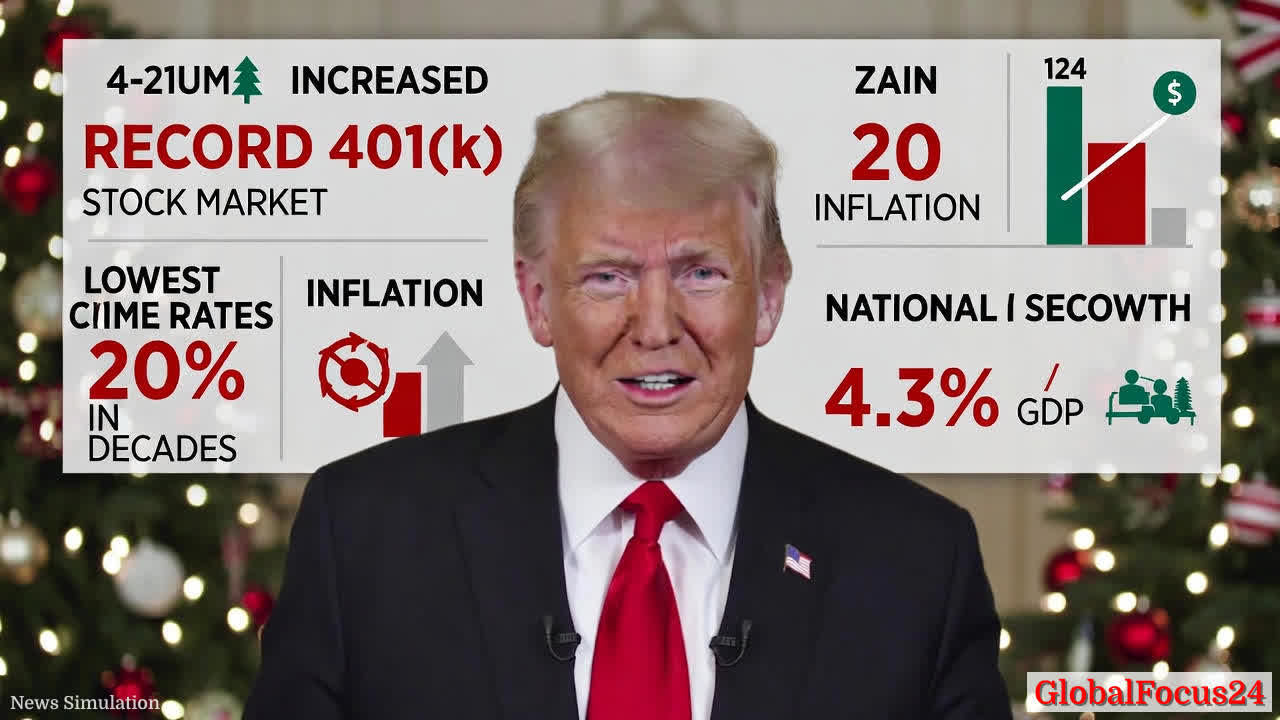
The speech touts a series of macroeconomic achievements, including stock market performance, 401(k) value growth, and overall GDP expansion. While such indicators are scrutinized by investors and policymakers alike, it is essential to place them within a broader economic framework. Market indices and retirement asset values are influenced by a complex mix of monetary policy, global trade conditions, consumer confidence, and corporate fundamentals. Isolated performance in a single period does not always capture longer-term trajectories, yet sustained gains in equity markets and retirement accounts often reflect favorable expectations about growth, taxation, and regulatory environments.
The claim of “zero inflation” and strong GDP growth surpassing expectations by a substantial margin is a bold assertion that warrants careful examination against official statistics. Inflation, as measured by widely used price indices, can fluctuate due to supply chain dynamics, energy costs, and wage trends. GDP growth, meanwhile, depends on consumer spending, business investment, and government policy, including fiscal stimulus and trade measures. Analysts typically compare such numbers to prior quarters, inflation-adjusted growth rates, and sector-specific performance to determine whether the figures reflect undergirding strength or short-term cyclical momentum.
One of the most consequential elements in the broadcast is the assertion that tariffs have generated significant economic growth and prosperity. Tariffs, as a policy tool, have a storied history of mixed outcomes. They can protect certain domestic industries in the short term but may also raise costs for consumers and businesses that rely on imports or export goods. The net effect of tariffs depends on their structure, the industries targeted, and the ability of the economy to adapt. In regional terms, some sectors may experience gains in domestic manufacturing and employment, while others may face higher inputs and reduced competitiveness abroad. A nuanced analysis must consider distributional effects across regions, workers, and supply chains.
Regional comparisons offer a useful lens for interpreting these claims. States with robust manufacturing bases and export-oriented industries could experience positive sentiment and investment if tariff policies are perceived to shield essential jobs. Conversely, regions heavily dependent on global supply chains or import-intensive sectors might face higher costs and demand adjustments. Historically, economies with diverse, flexible labor markets and strong innovation ecosystems tend to weather tariff fluctuations more resiliently, whereas regions with narrower industrial bases can experience amplified volatility. The Christmas message’s framing of tariffs as a universal boon stands in contrast to a more sector-specific analysis that highlights gains and trade-offs across different parts of the country.
Public reaction and social impact
Messages from national leaders often elicit a spectrum of responses, from applause and unity to skepticism and critical rebuttal. The broadcast’s blend of festive language with a combative posture toward political opponents is likely to energize supporters who favor a strong, decisive leadership style. At the same time, critics may argue that such rhetoric risks deepening polarization and obscuring a nuanced assessment of policy outcomes. Public reaction will unfold across traditional media coverage, social networks, and local discourse, with communities weighing the claimed achievements against concerns about the measures used to reach them, the durability of those gains, and the potential long-term consequences for civil discourse and governance.
From a regional standpoint, audiences in urban centers and diverse demographics may respond differently than populations in rural or industrial areas. Urban observers might scrutinize social policies, law enforcement claims, and the balance between security and civil liberties, while rural communities and manufacturing hubs could prioritize economic indicators, tariff impacts, and job security. The interplay between national messaging and regional realities often shapes up as a key dynamic in the public conversation after such broadcasts.
Policy areas highlighted and their broader significance
- Border policy and governance: The speech’s reference to “elimination of open borders” signals a stringent stance on immigration and border security. Policymakers and analysts typically assess border-related measures through the lenses of security, labor market impacts, humanitarian considerations, and international relations. The practical implementation of border restrictions involves coordination across federal agencies, legal frameworks, and diplomatic channels with neighboring countries.
- Social policy in sports: The claim to have repealed or restructured gender-related policies in sports touches on ongoing debates about fairness, inclusion, and athletic competition. Regional and national sports bodies weigh gender classifications, eligibility rules, and the implications for athletes, schools, and leagues. Policy shifts in this area can influence participation, media rights, and youth development pipelines, with ripple effects across communities.
- Law enforcement and crime rates: Asserting the lowest crime rates in decades connects to criminological data that track incidents, clearance rates, and public safety perceptions. Evaluating such a claim requires examining crime statistics across jurisdictions, the periods covered, and whether improvements reflect actual declines or changes in reporting practices, policing strategies, or population dynamics.
- Monetary policy and inflation: The combination of claimed zero inflation and stock market strength intersects with macroeconomic policy, including monetary policy decisions, supply chain resilience, and consumer demand. Analysts examine inflation trajectories, wage growth, and price stability to determine whether a zero-inflation claim is sustainable or merely reflective of short-term anomalies.
- National security and international reputation: The message’s emphasis on “strongest national security ever” and renewed global respect aligns with aspirational foreign policy rhetoric. Real-world evaluation involves looking at defense readiness, international alliances, cyber and traditional security capabilities, and the country’s standing in global institutions and diplomacy.
Journalistic approach to essential metrics
To provide readers with a clear, evidence-based understanding, it is important to compare the speech’s claims against independent data sources and historical benchmarks. This includes:
- Inflation rates and consumer price indices across time and regions.
- GDP growth trends, by quarter and year, adjusted for inflation.
- Employment statistics, wage growth, and labor force participation.
- Sectoral performance, particularly manufacturing, technology, and energy.
- Trade balances, tariff impact analyses, and supply chain resilience.
- Crime statistics by category, jurisdiction, and time period.
- Public opinion surveys documenting trust in government, perceived security, and policy priorities.
Such comparisons enable readers to gauge the degree to which the Christmas Day message aligns with measurable realities or represents a selective framing of outcomes. They also help illuminate how public sentiment might respond as new data emerges in the weeks and months ahead.
Contextualizing regional differences
Regional dynamics often shape how national policy announcements are received and implemented. The Northeast, with its dense urban centers and diversified economies, may respond differently than the South with its manufacturing and energy sectors, or the Midwest with its industrial base and agricultural ties. Western states, which blend technology, natural resources, and service industries, may exhibit varying sensitivities to tariff policy and immigration debates. Understanding these regional nuances helps explain pockets of support or skepticism and can inform policymakers as they tailor programs to local needs.
Public communication as a strategic tool
Beyond the substantive policy content, the Christmas Day broadcast demonstrates how political leaders leverage media moments to shape narratives. The use of a unifying holiday frame paired with a firm, adversarial tone toward opponents is a recognizable strategy designed to mobilize supporters, deter opposition, and project momentum. Newsrooms, analysts, and fact-checkers will likely scrutinize the factual accuracy and context of the claims, while educators, business leaders, and civic groups assess what these statements mean for governance and everyday life.
Looking ahead: what to monitor next
- Official economic data releases: monitor quarterly GDP growth, inflation, and unemployment to see how subsequent reports align with the speech’s claims.
- Legislative and executive actions: observe any policy shifts related to immigration, border enforcement, or social policy, and evaluate their implementation timelines and regional impacts.
- Market reactions: track stock market volatility, sector performance, and retirement account trends in response to policy cues and subsequent commentary from officials.
- Public opinion dynamics: follow polling and qualitative surveys to understand how the message influences perceptions of leadership, policy legitimacy, and national confidence.
Conclusion
The Christmas Day address offers a snapshot of how a political figure communicates about achievement, security, and national standing during a season traditionally associated with reflection and hope. While the message foregrounds a narrative of strong governance and economic vitality, readers should approach the claims with a critical eye, aligning them with independent data and regional realities. The real test will be how policies are implemented, how data evolves in the coming months, and how communities across the country experience the tangible effects of these policy choices. In a landscape where economic signals, security concerns, and social debates intersect, informed, constructive analysis remains essential for a well-functioning democracy and an informed public.