Why It Pays to Recheck Your Tax Withholding This Year
As tax season approaches, millions of workers face a straightforward, high-stakes decision: review and adjust federal tax withholding to align with new rules and personal circumstances. Recent inflation adjustments to tax brackets, higher standard deductions, and a slate of updated provisions from new legislation mean that a careful check can translate into more take-home pay, greater refund predictability, or a smoother tax filing experience. This article explains how these changes interact, why a proactive review matters, and how to approach the process in practical terms.
Historical context: how withholding evolved with inflation and policy Over the past decade, the federal tax code has repeatedly responded to shifting prices and demographic changes. Inflation adjustments automatically recalibrate the income thresholds that determine tax rates, aiming to preserve the purchasing power of working Americans. These adjustments usually broaden the brackets slightly, allowing more wages to be taxed at lower rates before moving into higher ones. Parallel to bracket changes, standard deductions have risen, reducing the amount of income subject to tax for many filers who do not itemize.
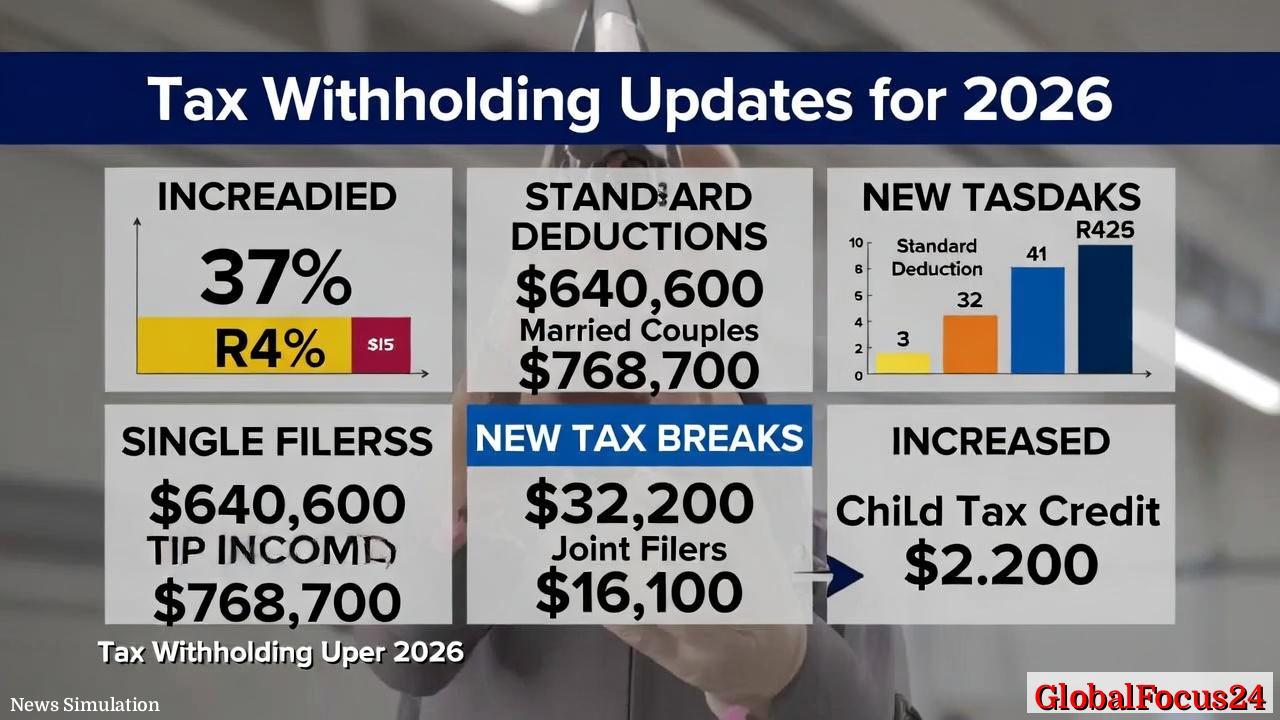
The 2026 tax landscape reflects both these inflation-driven recalibrations and policy decisions designed to expand relief for families and workers. For example, the top marginal rate threshold for single filers is now higher than in the prior year, while the corresponding limit for married couples filing jointly has also moved upward. Standard deduction amounts have grown as well, varying by filing status, which directly affects how much income is shielded from taxation before any credits or deductions are applied. These shifts do not occur in isolation; they interact with new or expanded tax breaks that influence withholding calculations and net take-home pay.
Economic impact: why small withholding changes matter Even modest changes in withholding can materially affect a household’s financial flow. When withholding is set too high, employees receive smaller paychecks month to month, effectively giving the government an interest-free loan throughout the year and delaying access to cash that could be used for savings or expenses. When withholding is set too low, workers may owe a larger-than-expected sum when filing, potentially triggering penalties and interest. The balance is delicate: tax liabilities are settled annually, but paychecks are ongoing.
With the 2026 changes, several dynamics emerge:
- Bracket creep is less of a concern for many, as higher thresholds mean more income can be earned at lower marginal rates. This can reduce the likelihood of being pushed into a higher bracket mid-year if earnings rise modestly.
- Higher standard deductions reduce taxable income for a broad swath of taxpayers, especially those who do not itemize. This shifts the optimal withholding portrait for many households.
- Expanded credits and deductions, such as increases in the child tax credit and allowances for tips and overtime, can meaningfully reduce tax liability when properly reflected in withholding.
Regional comparisons: how different economies feel the effects Tax policy shifts reverberate differently across regions. In areas with higher living costs or wage levels, the practical effect of withholding adjustments can be more pronounced because even small changes in take-home pay influence budgeting for housing, transportation, and essential goods. In high-cost regions like parts of the West and Northeast, residents may benefit disproportionately from increased standard deductions and expanded credits, given their typically higher baseline expenditures. Conversely, regions with broader gig economy participation may see greater gains from withholding tools that accommodate nontraditional income streams, such as 1099 earnings or other supplementary income.
The regional employment mosaic also matters. States with robust job markets and rising wages may experience more frequent pay-period recalibrations as workers receive bonuses, overtime, or shift differentials. This makes timely withholding reviews even more important to ensure that year-end tax outcomes align with expectations.
Practical guidance: how to review and adjust withholding
- Gather your current financial snapshot
- Collect recent pay stubs, your most recent tax return, and records of other income such as side gigs or investments.
- Note any changes in family circumstances (marriage, divorce, dependents), job changes, or large one-off earnings that could affect your tax liability.
- Use the official withholding estimator
- The federal withholding estimator is a free online tool designed to help you calculate the right Form W-4 adjustments based on your income, deductions, and credits. Input data from your pay stubs and tax returns, including all income sources, to generate personalized recommendations.
- If you receive income from multiple jobs, note each employer’s withholding situation, as the estimator can account for how combined earnings shift overall liability.
- Understand how new provisions affect your situation
- Review how the higher standard deduction interacts with your itemization decisions. If your situation suggests you’ll benefit more from the standard deduction, withholding adjustments can reflect that reality.
- Consider credits that impact your overall tax liability, such as child-related credits or education-related credits, and how claiming those credits through withholding can smooth refunds or reduce liabilities.
- Decide on a strategy: more take-home vs. larger refund
- If you prefer steady cash flow throughout the year, increase withholding slightly to minimize year-end balance due.
- If you anticipate a larger refund and want to maximize monthly take-home pay, reduce withholding and let the refund flow at tax time.
- For many households, a balanced approach—modest adjustments to accommodate new credits and deductions—works best to avert surprises while preserving some monthly cash flow.
- Implement changes through Form W-4
- Most employees do not need to file a new W-4 unless there is a change in employment status or you want to adjust withholdings proactively. However, submitting an updated W-4 can align with the latest year’s policy shifts and your current financial picture.
- The updated form includes additional fields for tips and overtime and reshaped sections for dependents credits, enabling more precise withholding calculations.
- Monitor and revisit as needed
- Life events such as marriage, childbirth, home purchase, or significant changes in income warrant a fresh review. Early-year adjustments generally maximize benefit, ensuring more consistent take-home pay through the remaining pay periods.
Real-world scenarios: what workers are likely to notice
- A single filer with a moderate salary who qualifies for a higher standard deduction and the child tax credit might see a noticeable difference in take-home pay after adjustments, particularly if they have reported tips or overtime in their income.
- A two-earner household with three children could experience meaningful changes in their monthly cash flow when withholding is aligned to the expanded credits, reducing the risk of under-withholding or over-withholding across pay cycles.
- A gig economy worker with irregular earnings benefits from a withholding strategy that accounts for nontraditional income sources, ensuring that tax obligations are managed without large end-of-year surprises.
Public reaction and expectations For many workers, the prospect of keeping more money in each paycheck while avoiding a surprise tax bill at filing time has generated a constructive buzz. Financial advisors emphasize the importance of proactive planning, especially in the wake of inflation and rising living costs. Employers generally support employee efforts to optimize withholdings, as it can lead to smoother payroll administration and reduced administrative corrections later in the tax season.
Conclusion: act early to optimize your financial picture Inflation adjustments and new tax provisions create a favorable environment for many taxpayers, but the benefits hinge on timely action. A careful review of withholding, informed by the latest guidelines and personal circumstances, can translate into steadier monthly income, improved budgeting, and a smoother tax-filing experience. By leveraging tools designed to reflect current law and personal income, workers can align their withholdings with their real tax liability, avoiding last-minute surprises and making the most of this year’s tax changes. As the calendar moves from winter to spring, the window to optimize withholding remains open—and with it, an opportunity to stabilize household finances in a year defined by cost pressures and evolving policy.