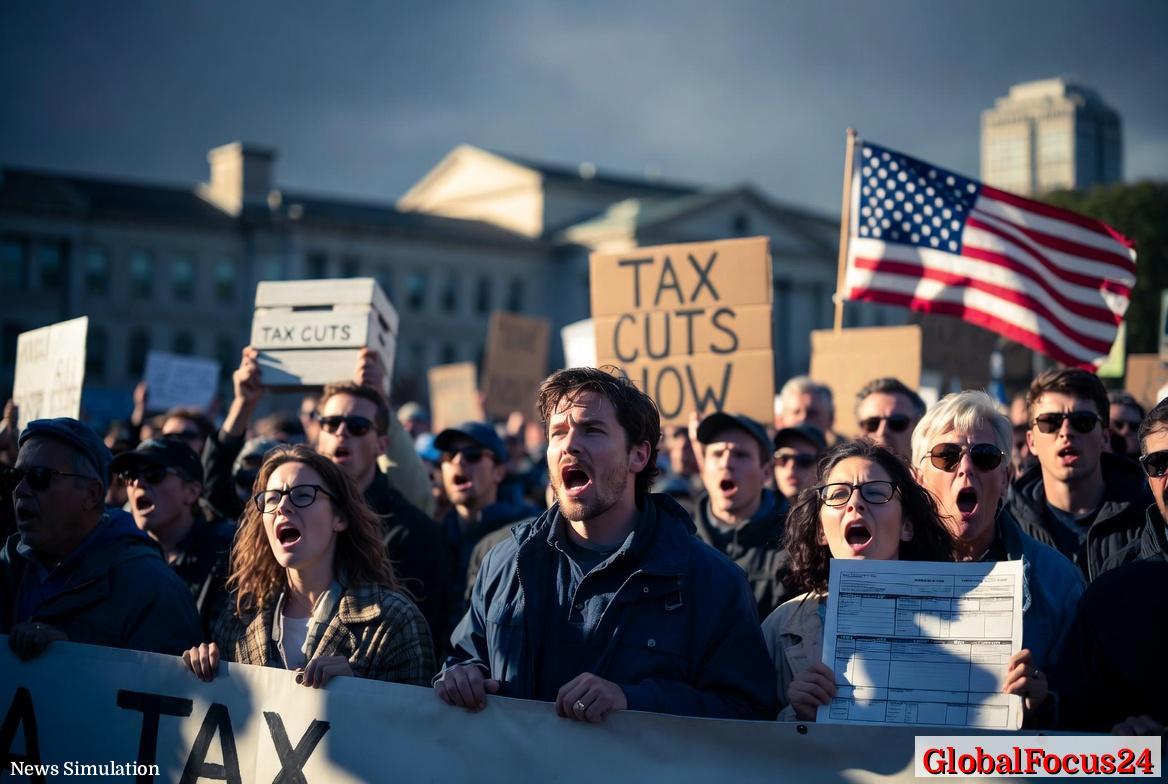
A New American Tax Revolt: Bipartisan Calls to Shrink the Burden
Rising Discontent as Tax Filing Season Ends
Across the United States, a renewed wave of tax discontent is coursing through voters from both major parties. This year’s filing deadline, April 15, landed squarely amid growing frustration over the expanding cost of living, widening budget deficits, and the sense that government spending has raced far ahead of ordinary citizens’ wallets.
From small business owners in Texas to middle-income families in California, the national conversation about taxes has shifted from reform to revolt. Instead of focusing solely on tax fairness or redistribution, the new coalition—spanning traditional conservatives, disillusioned moderates, and an increasing number of progressive voters—is united by one demand: smaller, simpler, and less intrusive taxation.
The mood, in the words of one historian, feels “post-representational.” Americans are no longer arguing only about how taxes should be structured; they are questioning the size and scope of government itself.
Historical Echoes of Rebellion
The American Revolution was famously ignited in part by anger over taxes, though in truth the issue was entangled with broader questions of representation, imperial oversight, and trade. But the slogan of that era—“no taxation without representation”—remains emotionally potent. In 2026, as the nation grapples with record federal spending and an expanding deficit exceeding $35 trillion, many citizens feel the burden has once again become intolerable.
Periods of tax rebellion are not new in U.S. history. In the late 1970s, California’s Proposition 13 slashed property taxes and inspired a national wave of tax-cutting measures. In the 1980s, the Reagan administration ushered in a monumental reduction in top marginal rates, reshaping economic policy for a generation. The 1990s and early 2000s alternated between cautious hikes and targeted cuts, typically justified by deficit control or economic stimulus.
Yet the current uprising differs in one crucial respect: it is being driven less by ideology and more by bipartisan fatigue. Both Republicans and Democrats are voicing unprecedented dissatisfaction with the total size of the tax bill. The belief that taxes have become unmoored from tangible public benefit now links rural and urban voters, a rare bridge in an age of political polarization.
The Pressures Behind the Revolt
Several forces have converged to create this volatile moment. Inflation, wage stagnation, and housing costs have eroded the real income of many working Americans. At the same time, state and federal governments have expanded spending on infrastructure, social programs, and technology incentives that, while broadly supported, have yet to yield visible benefits for everyone.
High interest rates have also worsened fiscal anxiety. The federal government now spends more each year servicing its debt than funding many major departments combined. Economists warn that this trajectory may soon crowd out public investment, putting pressure on politicians to either raise taxes further or cut spending deeply.
For citizens navigating expensive housing markets, escalating healthcare premiums, and shrinking disposable income, tax bills have become symbolic of a deeper economic malaise. For some, especially younger professionals and retirees, each April serves as a reminder that their personal budgets remain under siege.
Economic Ripple Effects
The tax revolt movement—loosely organized but growing louder—already has tangible economic implications. Analysts note that personal savings rates, depressed in recent years, have ticked up slightly as taxpayers withhold spending in anticipation of possible reform. Consumer sentiment surveys indicate that trust in government fiscal management has weakened, prompting shifts in investment behavior.
Businesses, meanwhile, are bracing for uncertainty. A swing toward large-scale tax reduction, if realized, could bring short-term liquidity for households and corporations but deeper long-term consequences for public revenue. Economists caution that while tax relief often stimulates consumption and growth, it can also heighten deficits if not matched by spending reductions.
One likely flashpoint lies in state budgets. States like California, New York, and Illinois—home to the highest combined state and local tax burdens—face intensified criticism from residents relocating to lower-tax jurisdictions in Texas, Florida, and Tennessee. The pattern is accelerating a regional realignment of labor and capital, reshaping housing markets and state fiscal strategies across the country.
Regional Comparisons: A Nation Divided by Tax Philosophies
America’s tax geography in 2026 reflects distinct regional philosophies. In the South and Mountain West, policymakers largely emphasize low taxes and lean public spending. Texas, Florida, and Nevada continue to attract businesses seeking to escape high income taxes and regulatory complexity. The resulting migration has spurred population growth but also strained infrastructure and housing availability.
The Northeast and Pacific coasts, by contrast, maintain more expansive tax systems to fund transportation, education, and social safety nets. Supporters argue these investments yield higher long-term productivity, pointing to relatively strong public services and robust innovation ecosystems. Yet even in these traditionally progressive regions, discontent is rising. Calls for property tax caps and simplified filing processes are growing louder, even among voters historically supportive of larger government programs.
In the Midwest, where manufacturing remains central, the focus has shifted toward competitiveness. Emerging debates in Michigan, Ohio, and Wisconsin revolve around balancing corporate tax relief with incentives for job creation and clean energy industries. The tension between fiscal discipline and economic modernization remains unresolved.
Shifting Political Alliances
At the national level, bipartisan rhetoric around tax reduction has created unexpected alliances. Republican policymakers advocate broad rate cuts and structural simplification, echoing long-standing supply-side arguments that lower taxes fuel economic growth. Democrats, responding to voter pressure, increasingly frame targeted reductions—as in payroll or middle-income taxes—as a means of restoring purchasing power and fairness.
This convergence differs from previous tax battles that split neatly along party lines. While disagreements remain over which groups should benefit most, both sides now recognize the political urgency of addressing fiscal fatigue. Congressional hearings this spring have revealed uncharacteristic cooperation between lawmakers exploring new caps on social security taxes, higher deductions for families, and mechanisms to simplify small business compliance.
Still, major legislative action faces obstacles. Any significant tax reform would collide with the reality of ballooning national debt and mandatory spending obligations. Analysts note that without commensurate budget cuts or revenue offsets, large-scale tax reductions could trigger market concerns or renewed inflationary pressure.
Public Sentiment and Street-Level Frustration
Public expression of frustration has gone beyond social media. Protests have sprung up in several state capitals and metropolitan centers, particularly after reports of IRS backlogs and delayed refunds. While these demonstrations remain peaceful, they illustrate a deeper impatience with bureaucratic inefficiencies and perceived government overreach.
Polls suggest that trust in the federal tax system has fallen to its lowest level in nearly two decades. Only about one in three Americans now believes their tax dollars are well spent. The sentiment crosses demographic and partisan boundaries, making the emerging tax revolt less a movement of ideology and more a cultural reckoning over value and accountability.
The symbolic power of “tax rebellion” resonates particularly during spring—a season that has always represented both financial reckoning and renewal for millions of households. Social networks brim with frustration but also creativity, as new citizen-led organizations crowdsource policy proposals and pressure local officials to demand fiscal transparency.
Lessons from Past Tax Revolts
History suggests that tax revolts can reshape political orders. California’s Proposition 13, passed in 1978, permanently altered state revenue structures and inspired national movements for property tax caps. The Tea Party wave of the late 2000s redefined conservative activism and influenced a decade of federal budget debates.
However, historians caution that backlash movements can yield unintended outcomes. Sudden declines in public revenue can erode services, shift costs to local governments, or deepen inequality if cuts disproportionately affect essential programs. The challenge for today’s reformers lies in balancing fiscal relief with sustainable governance—a tension that has defined American politics since its founding.
The Road Ahead
As the 2026 election cycle approaches, candidates across the political spectrum are recalibrating their platforms. Early campaign slogans emphasize not only tax cuts but also fairness, simplicity, and efficiency. A consensus may be emerging that the U.S. tax code—sprawling across 70,000 pages of statutes and guidance—is outdated for the digital economy it now governs.
Analysts foresee an opportunity for structural modernization: streamlining deductions, integrating digital payment platforms for small businesses, and adopting consumption-based models to replace certain income-based levies. Others warn that without careful planning, populist pressure for immediate cuts could outpace the government’s ability to absorb lost revenue.
Still, one message rings clear. The American taxpayer, from factory floor to high-rise office, is no longer content to accept taxation as a fixed feature of modern life. The sentiment recalls an older, founding impulse—restless, skeptical, and demanding renewal.
A Revolt Rooted in Identity
What began two and a half centuries ago as a protest against imperial fiscal policy has evolved into a recurring national ritual: the questioning of who pays, how much, and for what. Every generation rediscovers the line between contribution and coercion. In 2026, that line feels newly blurred.
As April’s tax season gives way to a summer of spirited debate, the words that echo from history seem pared down to a starker creed. The new American rallying cry may be this: not “no taxation without representation,” but simply “less taxation, period.”