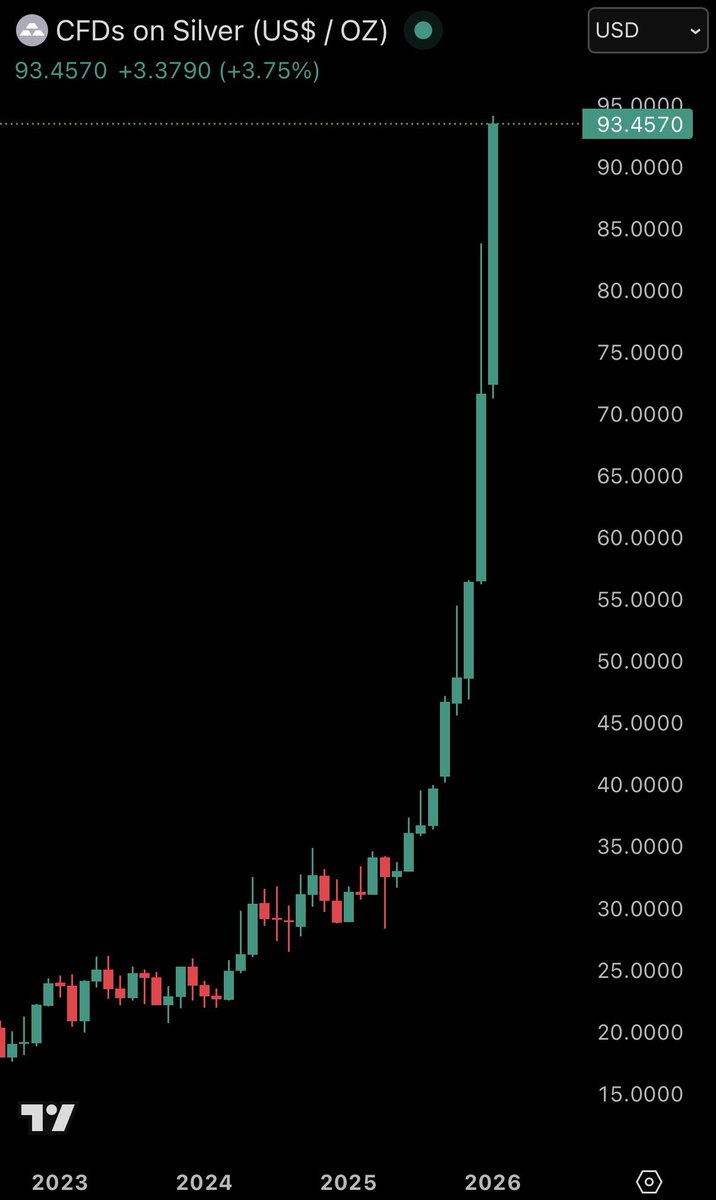
Silver Prices Soar to Record $93.46 per Ounce Amid Global Economic Shifts
A Stunning Rally in Precious Metals
Silver prices surged to $93.46 per ounce on January 19, 2026, climbing 3.75% during the session, marking one of the most dramatic rallies in the metal’s modern history. The ascent represents a near-tripling of value from levels around $30 per ounce in 2023, propelling silver into unprecedented territory.
Analysts across the commodities market describe the move as a "parabolic phase" of a multi-year uptrend that accelerated sharply in late 2025. The steep vertical rise on recent charts underscores a combination of market speculation, industrial demand, and renewed investor appetite for tangible assets during uncertain global economic conditions.
Historical Context: From Modest Gains to Meteoric Rise
For much of the past decade, silver traded in a relatively confined range between $20 and $30 per ounce. After peaking above $49 in 2011 amid post-financial-crisis stimulus and inflation fears, prices languished through much of the 2010s, often overshadowed by gold.
However, the past three years marked a wholesale reversal of fortune. Beginning in early 2023, silver gained momentum as inflation persisted and central banks began reconsidering their rate policies. By mid-2025, when global manufacturing began rebounding from supply chain disruptions, silver’s dual role as both a precious and industrial metal came into renewed focus.
Historically, such surges have been rare. Comparable gains occurred in 1979–1980, when silver briefly spiked to around $50 during the Hunt brothers’ buying spree, and again in 2010–2011 when investors turned to hard assets after the Great Recession. The current rally dwarfs both in intensity and scale, surpassing even the inflation-adjusted record highs from those prior periods.
Drivers Behind the Surge
Industrial Demand Expands Rapidly
Silver’s price strength is deeply tied to industrial usage. Unlike gold, which derives most demand from monetary and jewelry markets, silver plays a vital role in electronics, solar panels, and electric vehicles.
Over the last two years, global photovoltaic (solar) installations have grown at record rates, with many nations accelerating renewable energy projects. Silver, essential in photovoltaic cells due to its superior conductivity, became increasingly scarce as demand outpaced mining supply.
Likewise, growth in electric vehicle manufacturing and expansion of digital technologies—ranging from 5G telecommunications to AI-powered data centers—have further intensified consumption. Refined silver inventories held by major exchanges fell sharply during 2025, setting the stage for today’s tight supply and high prices.
Monetary Hedge and Safe Haven Appeal
Beyond industrial use, silver’s resurgence reflects a traditional safe-haven dynamic. With global inflation rates still unsteady and several major economies facing fiscal challenges, investors turned to precious metals as protection against currency depreciation and financial market instability.
Central banks’ diverging monetary strategies in late 2025—some easing to stimulate slowing growth, others maintaining higher rates—added to volatility in global bond markets. In that climate, silver offered both liquidity and perceived stability, especially for investors seeking an alternative to gold, which has also undergone substantial gains but now carries higher per-ounce costs.
Supply Constraints and Production Challenges
Mining output has struggled to keep up. While major producers in Mexico, Peru, and China continue to dominate global supply, recent labor disputes, energy shortages, and environmental restrictions have slowed production.
Exploration efforts have increased, but the pipeline of new projects remains limited. Many silver mines are by-products of lead, zinc, or copper extraction, meaning output depends on broader industrial mining conditions rather than dedicated silver production. This structural constraint leaves the market highly sensitive to demand shocks.
Economic Impact and Market Reactions
The surge in silver prices has generated ripple effects across multiple sectors. For manufacturers, especially in the solar and electronics industries, the rapid price escalation poses cost challenges. Analysts estimate that silver makes up between 6% and 10% of photovoltaic cell manufacturing costs, and substitution efforts with lower-cost materials are underway—though at the expense of some efficiency.
For investors and commodity traders, the rally has provided exceptional returns. Exchange-traded funds (ETFs) backed by physical silver have seen record inflows since the beginning of the year, while futures volume on major exchanges has surged. Volatility, however, remains high, with intraday price swings exceeding 5% in several sessions.
From a macroeconomic standpoint, the sustained rise in silver reflects both optimism and anxiety. Rising industrial demand signals continuing recovery in green technologies and infrastructure, whereas the hedging behaviors reveal lingering concern over inflation and monetary instability.
Regional Comparisons: Global Ripples of the Silver Boom
North America
In the United States, silver’s rally has invigorated the mining sector, particularly in Nevada and Alaska. Mid-tier producers have reported surging profitability, and several exploration companies are restarting projects previously deemed uneconomical. However, rising costs for energy and equipment may limit near-term expansion.
Canada’s mining industry is also benefiting, with operations in Ontario and British Columbia reporting improved margins. The Canadian dollar’s moderate strength has partially offset export advantages, but demand from the U.S. market remains robust.
Latin America
Mexico and Peru, the top global producers, face complex dynamics. While national export revenues are climbing, miners are contending with environmental regulations and local disputes over royalties and land rights. Governments have signaled intentions to renegotiate mining contracts amid record profits, highlighting potential risks to future supply stability.
Europe and Asia
In Europe, higher silver prices are prompting renewed debate over material sourcing for the green energy transition. The European Union’s ambitious solar expansion targets could face additional cost pressures if prices remain elevated. Some European manufacturers have already accelerated recycling initiatives to recover silver from expired electronic components.
Meanwhile, industrial demand in Asia, especially from China, India, and South Korea, continues to drive the market’s momentum. China’s dominance in solar cell manufacturing positions it as both a major consumer and a strategic player. Reports indicate that several Chinese firms have secured long-term supply contracts to mitigate price volatility.
Comparing Silver to Other Precious Metals
Silver’s dramatic rise stands out even amid strong performances by other precious metals. Gold, historically the benchmark safe-haven asset, reached above $2,700 per ounce earlier this month, marking its own all-time high. Platinum and palladium have seen modest rebounds but lack the explosive momentum driving silver.
The silver-to-gold price ratio—a key metric for traders and analysts—has narrowed sharply to around 35:1, compared to more than 80:1 just three years ago. This shift signals a revaluation of silver’s intrinsic and industrial worth relative to gold’s purely monetary character.
Historical Lessons and Future Outlook
Analysts caution that while the fundamentals remain supportive, such steep price movement often invites speculative excess. History provides reminders of abrupt reversals following parabolic climbs, as seen in 1980 and 2011. Profit-taking, policy shifts, or stabilization in industrial growth could all trigger corrections.
That said, long-term perspectives remain bullish. Structural demand from renewable energy and technological manufacturing continues to expand, underpinned by global decarbonization goals. Meanwhile, persistent production challenges limit the likelihood of a quick supply response.
Economists note that even if silver retraces from current peaks, it may have entered a new pricing era—one defined by scarcity, electrification, and shifting store-of-value priorities among investors and industries alike.
The Road Ahead for Silver
As silver trades near $95 per ounce, the question confronting the market is whether this represents the beginning of a sustained revaluation or the top of a speculative surge. For now, the balance of evidence suggests strong underlying demand across sectors and continued supply strain.
With renewable infrastructure booming, technology advancing, and global monetary uncertainty persisting, silver’s role in the 21st-century economy appears more dynamic than ever. Its performance over the coming months will serve as a barometer for both industrial confidence and investor sentiment in a rapidly changing world economy.