Saudi Arabia Ramps Up Red Sea Oil Exports as Strait of Hormuz Remains Closed
Surge in Shipments Through Yanbu
Saudi Arabia has sharply increased crude oil exports through its Red Sea port of Yanbu, restoring more than half of its pre-war output in a bid to stabilize global supplies after the closure of the Strait of Hormuz. According to port and industry data, shipments from Yanbu have surged to approximately 4.19 million barrels per day (bpd), a dramatic 185% increase from February’s 1.47 million bpd. The acceleration highlights Riyadh’s efforts to maintain energy flows to international markets despite the regional disruptions that have paralyzed its primary export routes through the Persian Gulf.
The steep rise in output from the Red Sea coast underscores Saudi Arabia's logistical agility and strategic investment in westward export capacity. A 746-mile pipeline connecting the kingdom’s major oil fields in the Eastern Province to Yanbu has become a critical artery, enabling the country to bypass the Strait of Hormuz entirely—a chokepoint that once handled roughly one-fifth of global oil shipments.
The Pipeline Lifeline: Bypassing a Blocked Strait
The East–West crude pipeline, often referred to as the Petroline, is playing a decisive role in securing Saudi Arabia’s resilience amid the regional crisis. Completed decades ago to reduce dependency on Gulf access, the pipeline can transport up to 5 million bpd when fully operational. With Hormuz closed following the escalation of the Iran War, Saudi Aramco has boosted flows through this route to near capacity, making Yanbu the centerpiece of its emergency export network.
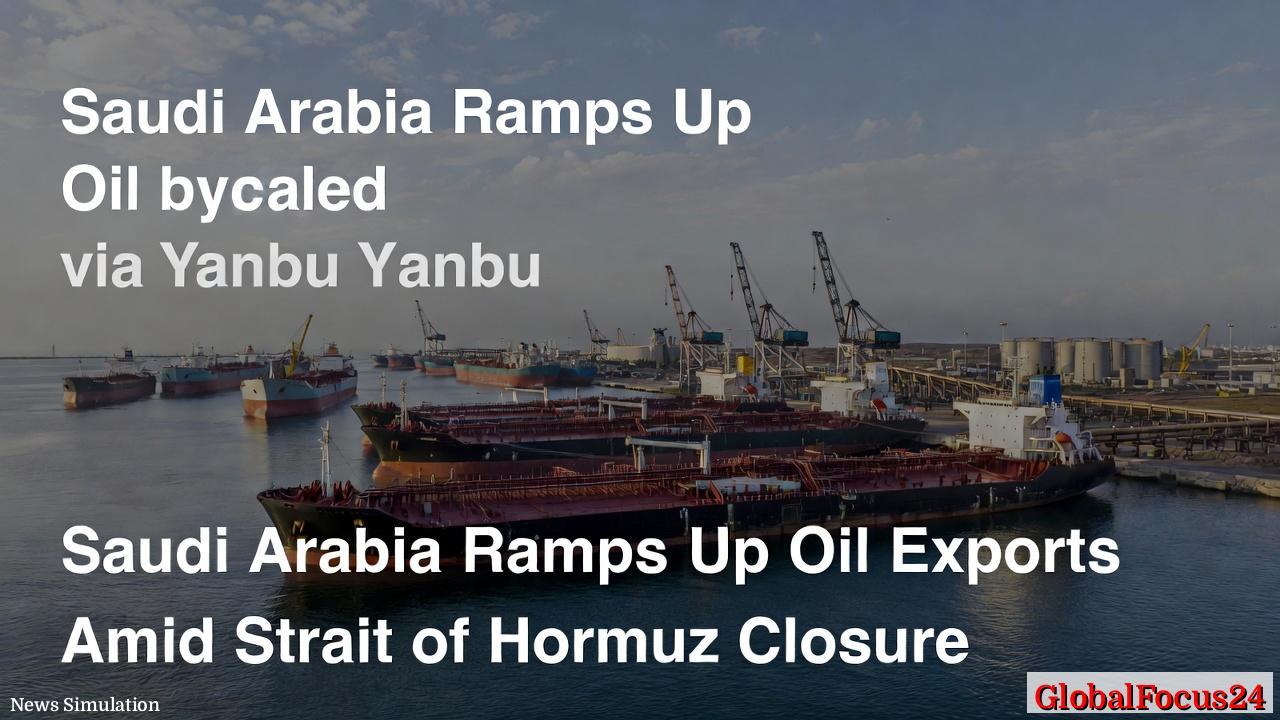
Satellite tracking data shows more than 32 large oil tankers currently waiting in or near Yanbu’s anchorage zones for loading, with additional vessels reportedly inbound. Industry analysts note that this bottleneck reflects both the surge in available supply and the logistical strain of rerouting exports westward. Despite the congestion, vessels are reportedly being processed at an accelerated pace as Saudi port operations run around the clock.
Recovering Capacity After Wartime Disruptions
Before the conflict, Saudi Arabia’s total export capacity stood at about 7 million bpd, much of it routed through the eastern Persian Gulf terminals such as Ras Tanura. In the immediate aftermath of the Strait of Hormuz closure, exports plunged dramatically as tankers were forced to remain anchored or diverted. The Red Sea pivot has now enabled the kingdom to recover roughly 60% of that total.
“Saudi Arabia’s ability to reroute significant volumes through Yanbu demonstrates foresight in infrastructure planning,” said one senior energy consultant based in London. “Few producers in the region have the flexibility to withstand the closure of such a vital maritime corridor.”
The adjustment has allowed Saudi Arabia to partly offset the global shortfall triggered by the conflict. Neighboring Gulf exporters, including Kuwait and the United Arab Emirates, remain heavily reliant on the Strait of Hormuz and have faced significant slowdowns, causing broader supply concerns that continue to reverberate through energy markets.
Global Energy Market Adjusts to New Routes
Global oil prices initially spiked sharply following the disruption but have since stabilized as Saudi Arabia increased Red Sea exports. Brent crude, which had surged beyond $120 per barrel during the early days of the crisis, has moderated slightly in recent sessions, trading near $110. Analysts attribute this partial stabilization to Saudi Arabia’s rapid logistical adaptation and the assurance of continued deliveries to major consumers, particularly in Europe and Asia.
Still, volatility persists. Insurance premiums for tankers operating anywhere near the Red Sea have more than doubled, reflecting ongoing security risks and logistical challenges. Shipping experts say rerouting tankers around Africa’s Cape of Good Hope to reach Asian buyers could further strain supply chains if the situation continues, prolonging elevated freight rates.
Meanwhile, refiners in Europe and South Asia are adjusting procurement strategies. India, one of the largest importers of Saudi crude, has begun receiving redirected shipments through the Red Sea and Suez Canal route, increasing voyage times but ensuring steady supply. European refiners, too, are seeing an uptick in shipments arriving via the Mediterranean, helped by Yanbu’s proximity to the Suez Canal corridor.
Historical Context: The Strategic Role of Yanbu
Yanbu’s strategic importance is deeply rooted in Saudi Arabia’s energy history. Developed originally in the 1970s as part of a government plan to diversify export routes, the port has long served as a secondary gateway for crude and refined products. It houses multiple export terminals and refineries, including major facilities owned by Saudi Aramco that process crude for both domestic consumption and international export.
The East–West pipeline—running from Abqaiq in the eastern province to Yanbu on the Red Sea—was built precisely to mitigate risks associated with regional instability in the Gulf. During the Iran–Iraq War in the 1980s, the pipeline ensured uninterrupted Saudi exports even as hostilities threatened tanker routes through Hormuz. Its resurgence in 2026 marks yet another reminder of its strategic relevance in maintaining global energy balance.
Economic and Strategic Impact
Economists estimate that the reactivation of full-scale Yanbu operations is injecting billions of dollars in daily export revenue back into Saudi Arabia’s economy, which had faced short-term strain from lost output following the war’s onset. For the global economy, the uptick in shipments has helped prevent a more severe oil shock that could have fueled inflation across major import-dependent economies.
Saudi Arabia’s success in mitigating export disruptions also amplifies its geopolitical leverage. As other regional producers struggle to compensate for lost capacity, Riyadh’s continued ability to deliver oil gives it renewed weight in global markets. This, in turn, could influence upcoming OPEC coordination talks, where production levels and price stability will take center stage.
On the domestic front, local industries in Yanbu have seen heightened activity. Port officials report record levels of ship traffic and expanded employment for technical and logistics roles. Temporary housing and supply facilities have been set up to accommodate the influx of workers needed to sustain high export volumes. The city’s infrastructure—once accustomed to steady but moderate throughput—now finds itself under intense national focus.
Regional Comparisons and Global Response
In contrast to Saudi Arabia’s swift adaptation, other Gulf states have found fewer alternatives. Kuwait and Qatar possess limited westward export capability, and although the UAE has its own Fujairah pipeline that bypasses Hormuz, its capacity remains constrained compared to Saudi Arabia’s system. As a result, global buyers have pivoted toward Saudi supplies, reinforcing the kingdom’s central role in stabilizing markets amid crisis.
Beyond the Gulf, Egypt and Sudan stand to benefit economically from increased maritime activity through the Red Sea, as transit fees and shipping services expand. The Suez Canal Authority has also reported a modest uptick in traffic as tankers rerouted via Yanbu make their way toward European and Mediterranean ports.
China, Japan, South Korea, and India—key customers of Saudi crude—have all voiced cautious optimism over the continued flow of shipments, citing the resilience of the Saudi export system. Still, analysts caution that a prolonged closure of Hormuz could continue to distort trade balances, raise shipping costs, and hinder global energy logistics.
Infrastructure Challenges and Long-Term Outlook
While Yanbu’s surge in operations has been lauded as a logistical triumph, challenges remain. The port infrastructure, built to handle diverse energy exports, now faces continuous high-volume turnover that tests capacity limits. Maintenance teams are reportedly working on rotation to keep processing equipment in service, while expanded storage capacity is under urgent development to accommodate upcoming arrivals.
Saudi authorities have hinted at possible pipeline throughput expansions and targeted port upgrades, including additional berths, enhanced dredging, and digital traffic management. Energy analysts expect these measures will not only sustain current output but also strengthen the kingdom’s long-term energy security posture.
The broader outlook for global oil supply hinges on two key variables: the duration of the Strait of Hormuz closure and the pace of expansion in alternate export routes. If the Red Sea corridor continues to operate without major incident, Saudi Arabia’s partial recovery could serve as a stabilizing anchor for world energy markets—though pressures on refining, shipping costs, and security spending are likely to persist.
A Nation in Motion
The sight of giant supertankers queuing outside Yanbu captures the tension and urgency of the moment: a global energy network rerouted, reengineered, and rebalanced in real time. For Saudi Arabia, the swift scaling-up of exports through the Red Sea not only restores critical revenue but also reaffirms its position as the linchpin of global oil stability.
As operations at Yanbu continue to expand, the port has once again become a symbol of Saudi adaptability—connecting the heart of its eastern oil fields to the western seas and, by extension, to a world that remains deeply dependent on its flow of energy.