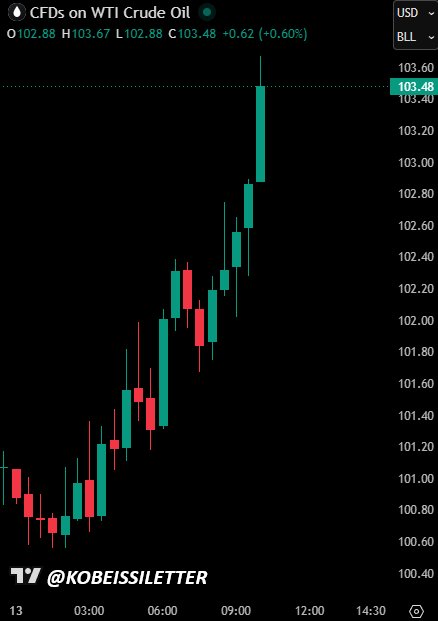
)
Oil Prices Rally as Iranian Peace Talks Stall, Shaping Global Energy Markets
In a developing moment for global energy markets, U.S. crude prices surged toward $104 per barrel after signals that discussions between the United States and Iran have stalled. The spike, which marks a notable rebound from multi-month lows, underscores the delicate balance between geopolitical risk, supply assurance, and economic resilience as energy buyers and policymakers navigate an uncertain horizon.
Historical Context: From Volatility to the New Normal Oil markets have long reacted to geopolitical shocks, with the price path often reflecting an implicit calculus about supply disruption, demand resilience, and strategic reserves. The current price movement sits within a broader historical arc that includes episodes such as the 1970s oil shocks, the early-2010s supply constraints, and more recently, the fluctuations tied to geopolitical flashpoints in the Middle East and the broader implications of energy transition dynamics. Each episode tends to leave a resonance: the reminder that energy markets are not merely about extraction and transport, but about global economic sentiment, industrial activity, and the political choices of major energy players.
The stalled peace talks between the United States and Iran introduce a classic risk premium into prices. When diplomatic progress appears uncertain, traders recalibrate their expectations for supply security, particularly for crude flows that have historically traveled through strategic corridors. While the immediate reaction centers on near-term price levels, the longer-run implications touch on investment plans, refinery runs, and the pace of energy diversification across regions that rely on imports for a portion of their energy mix.
Economic Impact: Price Movements and the Real Economy Oil price changes carry a direct and indirect influence on a wide range of economic sectors. The move toward the mid-$100s per barrel range can affect consumer energy costs, transportation expenses, and the price signals that influence business investment decisions. Higher crude prices tend to creep into gasoline and diesel pricing, which in turn can affect household budgets, logistics costs for manufacturers, and the operating costs of fleets and distribution networks. The magnitude of the impact depends on a country’s exposure to imported energy, refining capacity, and the flexibility of its energy portfolio.
- Energy-intensive industries and transportation-heavy sectors are most sensitive to crude price swings. In economies with limited domestic production, a sustained price level near $100 per barrel can elevate input costs and, in some cases, influence inflation trajectories.
- For importing nations, volatility can prompt strategic stockpiling or hedging strategies. National reserves and market interventions may be mobilized to dampen abrupt price fluctuations, reflecting a longstanding toolkit in energy security planning.
- Conversely, energy-exporting regions may experience a fiscal and trade balance effect as revenue streams respond to price movements. Fluctuations in oil prices can alter government spending, public investment, and regional development plans, particularly in nations whose budgets are heavily linked to energy earnings.
Regional Comparisons: Diverse Impacts Across Markets The global oil market does not respond uniformly to geopolitical signals. Different regions experience nuanced effects based on exposure to imports, refining capacity, and economic structure.
- North America: The United States and Canada maintain complex energy ecosystems that blend domestic production with imports. A surge toward $104 per barrel has mixed implications: it can support upstream investment in certain basins while applying pressure on downstream industries and consumers. Transportation costs, from trucking to air travel, feel the ripple effects, though wholesale price dynamics often diverge from retail price trajectories due to competition and policy measures.
- Europe: European economies, with growing energy diversification but still substantial reliance on imported crude and refined products, monitor price shifts with keen attention. The energy transition and decarbonization policies interact with fossil fuel markets, creating a dynamic where policymakers balance price stability, energy security, and climate commitments.
- Asia-Pacific: In Asia, energy demand growth and refining capacity play pivotal roles in how price signals transmit. Import-reliant economies may experience consumer price pressures, while energy-intensive manufacturing hubs watch carefully for cost pass-through to export-oriented sectors.
- Middle East and North Africa: Regional producers in this zone have a distinct set of considerations. Geopolitical dynamics and production capacity management intersect with global demand patterns, creating a framework in which price movement can influence regional policy choices and investment in downstream infrastructure.
Supply and Demand Dynamics: The Market's Underlying Forces Beyonds, several structural forces shape the oil market today:
- Supply uncertainties: Political tensions and diplomacy in key producing regions can constrain supply expectations. Sourcing reliability and transportation security become central to risk assessments for buyers and traders.
- Demand resilience: Global economic activity, particularly in large consumer economies, supports a baseline level of demand. Any shifts in growth projections or energy-intensive activity can either amplify or dampen price reactions.
- Energy mix and substitution: The pace of energy transition, including growing use of natural gas, renewables, and emerging technologies, interacts with crude demand. Substitution effects may modulate the sensitivity of oil consumption to price changes over time.
- Inventory and spare capacity: The presence or absence of strategic reserves and spare production capacity can provide buffers during shocks. Market participants watch inventories closely as an indicator of price stability or volatility.
Public Reaction and Market Psychology Events on the diplomatic front often trigger a mix of reaction from investors, businesses, and households. Traders may respond tos with rapid hedging, while refiners examine potential shifts in margins under changing input costs. Consumers may feel the indirect effects through gasoline prices and transportation costs, particularly if price momentum persists over weeks. While the trajectory of oil prices is influenced by a wide array of factors, the sentiment surrounding supply security frequently drives short-term moves as market participants reassess risk.
Geopolitical Risk and Global Energy Security The energy landscape remains inherently linked to geopolitics. Diplomatic friction between major powers can reverberate through crude markets, affecting not only price but also strategic planning for energy security. Countries are increasingly diversifying supply chains, investing in domestic refining capacity, and expanding strategic reserves to mitigate sudden shocks. This ongoing diversification trend aims to reduce exposure to single-point failures and to enhance resilience in the face of geopolitical volatility.
Environmental and Policy Context: Transition in Parallel While price spikes capture attention, the broader energy policy environment continues to evolve. Policymakers pursue a balancing act that supports economic growth, energy access, and environmental goals. Investments in cleaner energy sources and emissions reductions persist, with market signals often reflecting long-term expectations rather than short-term price movements. The interaction between fossil fuel markets and climate policies remains a critical dimension of energy strategy for governments, industries, and consumers alike.
Historical Comparisons: Lessons from Past Cycles History offers a lens to interpret today’s developments. Earlier episodes of price spikes prompted far-reaching policy responses, from strategic stock releases to revised energy efficiency measures. While each cycle has unique elements, the underlying theme remains: energy markets are sensitive to geopolitical risk and economic cycles, and effective management requires a blend of prudence, diversification, and informed policymaking. Observers often compare current movements to past episodes of volatility to parse temporary shocks from more persistent shifts in supply-demand balance.
Market Outlook: What Comes Next Analysts project a range of potential scenarios, underscoring how quickly sentiment can shift in response to diplomatic developments and macroeconomic indicators. Several factors could influence the near-term path:
- Diplomatic progress or breakdown: Any new development in talks could re-anchor price expectations, potentially stabilizing prices if risk premia recede.
- Inventory dynamics: Weekly petroleum status reports and refinery utilization rates can provide clues about the market’s supply discipline and potential price pressure.
- Global growth signals: Strength or weakness in major economies will affect demand projections, shaping longer-term price trajectories.
- Currency and financial conditions: The dollar’s strength or weakness and broader financial market dynamics can influence commodity pricing, given the global nature of oil trade.
Industry Responses: Operational Adjustments and Investment Signals Energy companies and downstream players respond to price movements and the evolving risk landscape with strategic adjustments. Upstream producers might review capex plans, production targets, and exploration timelines in light of price expectations. Downstream refiners assess refining margins, blending strategies, and capacity optimization to optimize throughput. Financial market participants adjust hedging positions and evaluate the risk-reward profile of energy equities and debt instruments tied to energy projects.
Regional Energy Security Initiatives Governments and industry coalitions are increasingly prioritizing energy security through a mix of diversification, strategic reserves, and investments in cross-border infrastructure. Interconnected grids, cross-regional pipelines, and refined product corridors are part of a broader strategy to reduce exposure to single-source shocks. These initiatives aim to maintain price stability while supporting ongoing economic activity and development goals.
Public Commentary and Consumer Implications Public sentiment often reflects a blend of concern over household budgets and recognition of the broader stakes in energy security. Policymakers emphasize maintaining affordable energy access while pursuing long-term goals around emissions reductions and energy resilience. Consumers may adopt more energy-efficient habits or adjust travel plans in response to price signals, particularly if volatility continues.
Conclusion: Navigating Uncertainty with Informed Strategy The surge toward $104 per barrel signals a moment of heightened attention to geopolitical risk, supply reliability, and the ongoing balance between energy affordability and security. As talks progress or stall, market participants will continue to monitors, supply indicators, and macroeconomic signals to gauge the trajectory of energy prices and their broader impact on economies worldwide. The situation reinforces the enduring reality that energy markets remain intertwined with diplomacy, economics, and the daily lives of people who rely on reliable and affordable energy to power homes, businesses, and mobility.